
Schema markup for AEO is helping resolution engines perceive a web page. Schema is readable by way of AI crawlers as it’s added to a website’s HTML. It lets in search engine marketing pros so as to add further context and map entities with out overwhelming the web page’s entrance finish or customers. This extra context equipped by way of schema reduces ambiguity and will increase the chance that the internet content material can also be appropriately cited in AI-generated solutions.

For SEOs and technical entrepreneurs new to schema markup, it could really feel overwhelming, yet schema is a non-negotiable for many who wish to apply AEO very best practices. Including schema is a low-risk, high-reward tactic as it undeniably strengthens search engine marketing and, theoretically, immediately helps how an Resolution Engine Optimization (AEO) crawler understands websites.
This complete information covers what schema markup is, the way it helps AEO, which schema varieties subject maximum for AI visibility, and easy methods to put in force structured information appropriately. Groups will even discover ways to steer clear of commonplace schema pitfalls so they are able to get it proper the primary time.
Desk of Contents
- What’s schema markup for AEO?
- Why Schema Markup Issues for AI Visibility
- Which schema varieties are maximum essential for AEO?
- The right way to Construction Your Entity Graph for AEO
- AEO Schema Easiest Practices
- The right way to Construction a Web page for AEO
- The right way to Enforce Schema for AEO in Content material Hub
- Not unusual Schema Pitfalls That Block AEO
- Continuously Requested Questions About Schema Markup AEO
- Imposing Schema Markup for AEO
Contents
- 1 What’s schema markup for AEO?
- 2 Why Schema Markup Issues for AI Visibility
- 3 Which schema varieties are maximum essential for AEO?
- 4 The right way to Construction Your Entity Graph for AEO
- 5 AEO Schema Easiest Practices
- 6 The right way to Construction a Web page for AEO
- 6.1 1. Outline a unmarried number one intent for the web page.
- 6.2 2. Anchor the web page to a number one entity.
- 6.3 3. Use transparent, descriptive headings that mirror person questions.
- 6.4 4. Position concise, factual solutions close to the highest of sections.
- 6.5 5. Enhance possession and authorship indicators.
- 6.6 6. Care for blank inner linking and hierarchy.
- 7 The right way to Enforce Schema for AEO in Content material Hub
- 8 Not unusual Schema Pitfalls That Block AEO
- 9 Continuously Requested Questions About Schema Markup AEO
- 9.1 Do I would like distinctive @identity values for each entity on a web page?
- 9.2 Can I come with each FAQPage and HowTo at the similar web page?
- 9.3 How frequently will have to I audit my schema around the website?
- 9.4 Can I put in force schema with out a developer?
- 9.5 What breaks AEO despite the fact that my JSON-LD validates?
- 10 Imposing Schema Markup for AEO
What’s schema markup for AEO?
Resolution engine optimization schema markup is an AEO technique wherein AEO experts upload more information to content material to lend a hand search engines like google and yahoo higher perceive, extract, and hopefully reuse knowledge from a web page when producing solutions. This extra knowledge is displayed the usage of structured information and schema. Schema markup and structured information are phrases which might be frequently used interchangeably, yet they’re now not the similar factor.
Structured information is information that’s been structured for a objective. Search engines like google and internet sites use schema in JSON or microdata, yet many applied sciences use structured information. Formatting information in databases or spreadsheets depends on structuring information.
Schema markup is used on the internet. There are explained varieties and houses that search engines like google and yahoo perceive (coated under).
Schema Markup: AEO vs. Conventional search engine marketing Schema
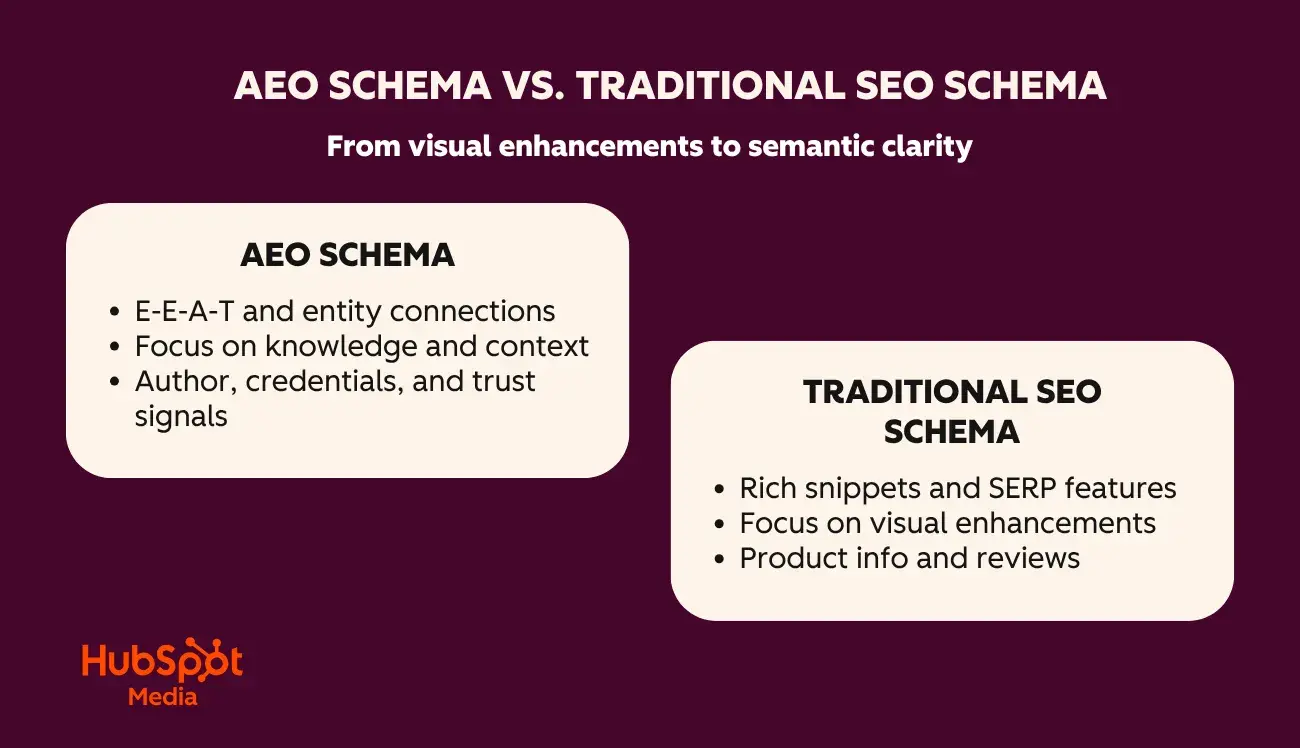
Conventional search engine marketing schema is basically used to lend a hand search engines like google and yahoo generate wealthy effects and enhanced SERP options, similar to product snippets, rankings, and assessment snippets.
The function of schema broadened as the worth of revel in, experience, authority, and agree with (E-E-A-T) larger. E-E-A-T is an idea utilized by Google’s human Seek High quality Raters. Subsequently, E-E-A-T elements could also be utilized by algorithms to evaluate content material’s credibility and reliability. Consequently, publishers started the usage of schema to explain authors, together with credentials that indicated experience. Authors had been additionally attached to verifiable entities that indicated revel in, similar to social media profiles or certifications. Agree with indicators turned into clearer and extra machine-readable.
As search engine marketing experts take at the AEO function, schema markup turns into much more outstanding. Entities, attributes, and relationships are actually essential as a result of they lend a hand internet sites serve as as structured wisdom bases moderately than remoted pages. This improves how obviously AI methods can perceive and contextualize content material. The function of schema has shifted from visible SERP improvements to semantic readability and extra context.
Why Schema Markup Issues for AI Visibility
Fresh checking out has proven that pages with well-implemented schema seemed within the AI Assessment and ranked very best in conventional search engine marketing. Pages with poorly applied schema or no schema didn’t seem in AI Overviews. This tells us that it isn’t simply the presence of schema that issues, however the implementation.
In some circumstances, the worth of schema markup for AI visibility is plain. Wealthy snippets or wisdom panels can seem inside hours of implementation. Alternatively, when schema is used for entity mapping or to strengthen E-E-A-T, the advantages are extra refined and long-term, with out the moment comments that wealthy effects supply. search engine marketing platforms like HubSpot’s search engine marketing advertising gear can lend a hand bridge that hole by way of surfacing technical suggestions, monitoring efficiency traits, and figuring out alternatives to make stronger content material for each search engines like google and yahoo and resolution engines.
As AI-driven discovery evolves, platforms like XFunnel (not too long ago bought by way of HubSpot) are rising to lend a hand groups know how content material plays throughout all the AI seek adventure from ratings to visibility inside resolution engines, copilots, and generative interfaces.
Featured Useful resource: The right way to Breathe New Existence Into Your Google Seek Effects With Wealthy Snippets.
Which schema varieties are maximum essential for AEO?
Group
Group schema is structured information used to explain a trade or logo as a first class entity. For many websites, it acts because the anchor entity that different schema varieties (Article, Particular person, Product, Carrier) attach again to. A company schema performs a foundational function in E-E-A-T by way of serving to crawlers obviously establish the content material’s supply. It strengthens authority, possession, and attribution indicators, which might give a boost to resolution engines when “deciding” which logo to agree with and cite. It defines such things as:
- Who the logo is
- What it does
- The place it operates
- How it may be verified around the internet (throughout social media, for instance)
- Different trade main points, similar to founder names, founding dates, and so a lot more
For AEO, the group schema is helping make certain the content material is continually related to the similar entity throughout pages, datasets, and AI interpretations. Right here’s an instance of a easy group schema AEO:
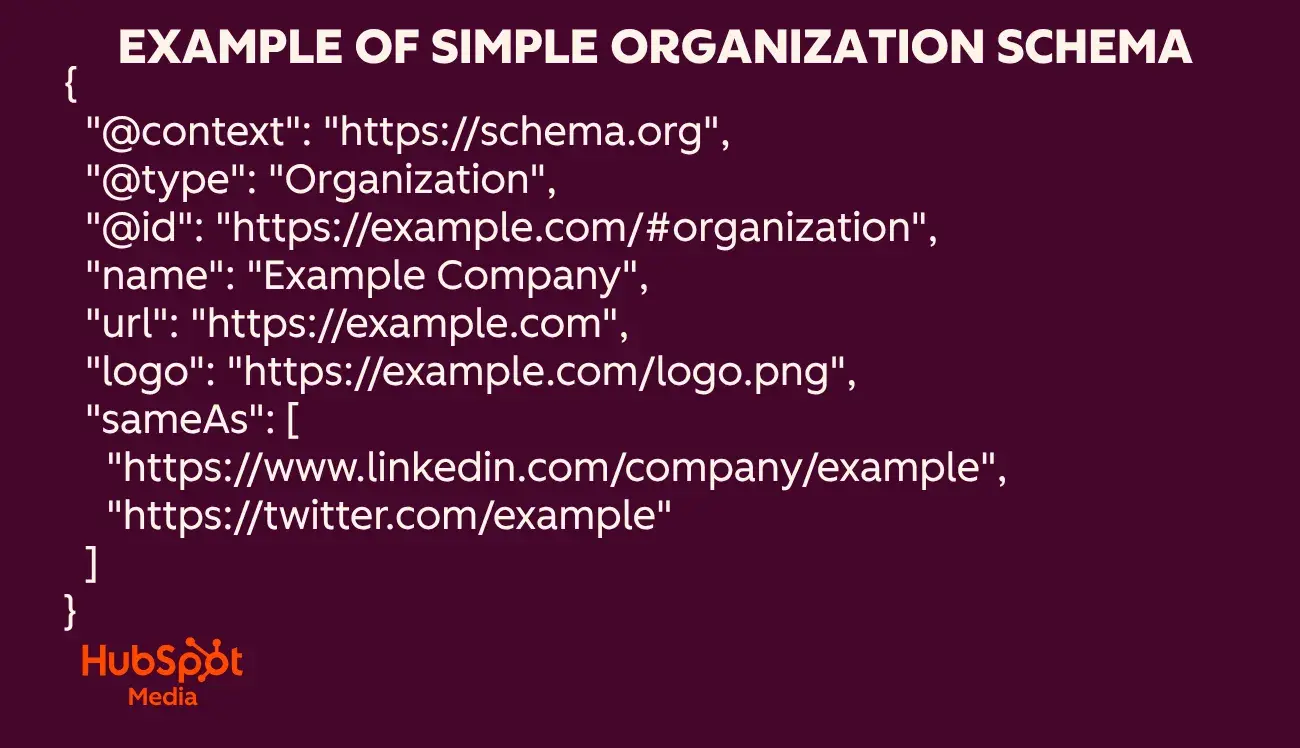
At a minimal, for a corporation schema to be legitimate, it wishes:
- @context
- @sort
- @identity
- title
- url
It’s additionally excellent to incorporate such things as:
- brand
- sameAs
- Description
- foundingDate
- founders
- contactPoint
- deal with
- key phrases
- knowsAbout
- workers
Why I love Group schema: I deal with group schema as a non-negotiable. It is smart for websites to offer context to crawlers about who they’re, what they do, and the way their web page works.
Professional tip: It may be difficult to spot some great benefits of group schema, yet it’s going to lend a hand companies protected a data panel. Manufacturers too can benchmark logo belief in AI gear prior to and after including it and spot the way it adjustments. For this, use HubSpot’s AEO Grader, a device that permits AEO experts to check their website’s AEO.
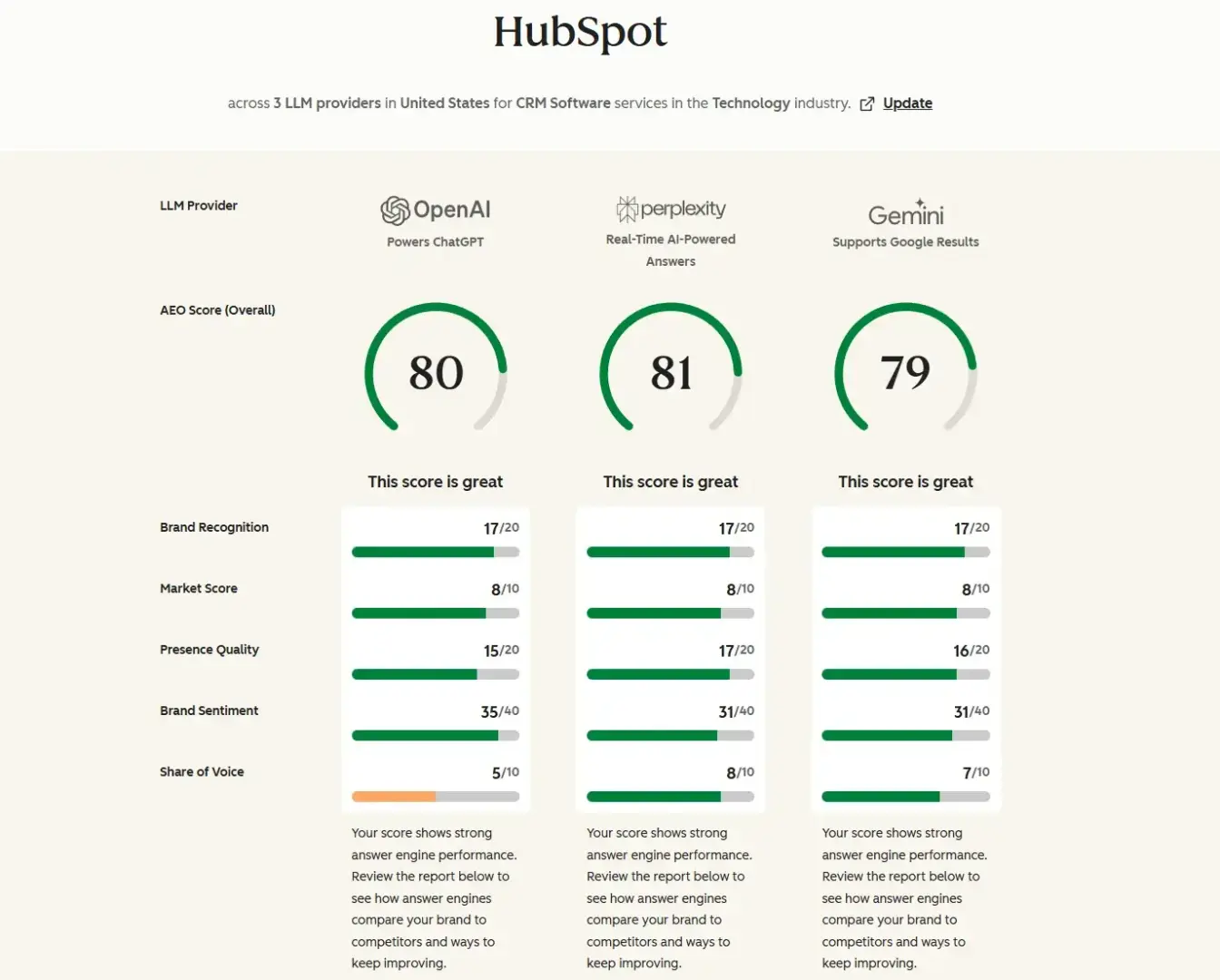
HubSpot’s AEO Grader evaluates entity readability, content material construction, and the chance {that a} web page shall be reused in AI-generated solutions. It’s a sensible solution to benchmark the actual have an effect on of including Group schema.
Particular person
Particular person schema is used to explain a person as an entity. It’s maximum recurrently used to constitute authors, founders, subject-matter professionals, and spokespeople, and is frequently related immediately to Group and Article schema to explain authorship and experience. For resolution engines, Particular person schema is helping unravel who’s answerable for the ideas on a web page and whether or not that consumer can also be relied on to talk at the matter. It might come with knowledge like their:
- Identify
- Function
- Enjoy
- Credentials
- Presence around the internet
Right here’s an instance of a easy Particular person schema:
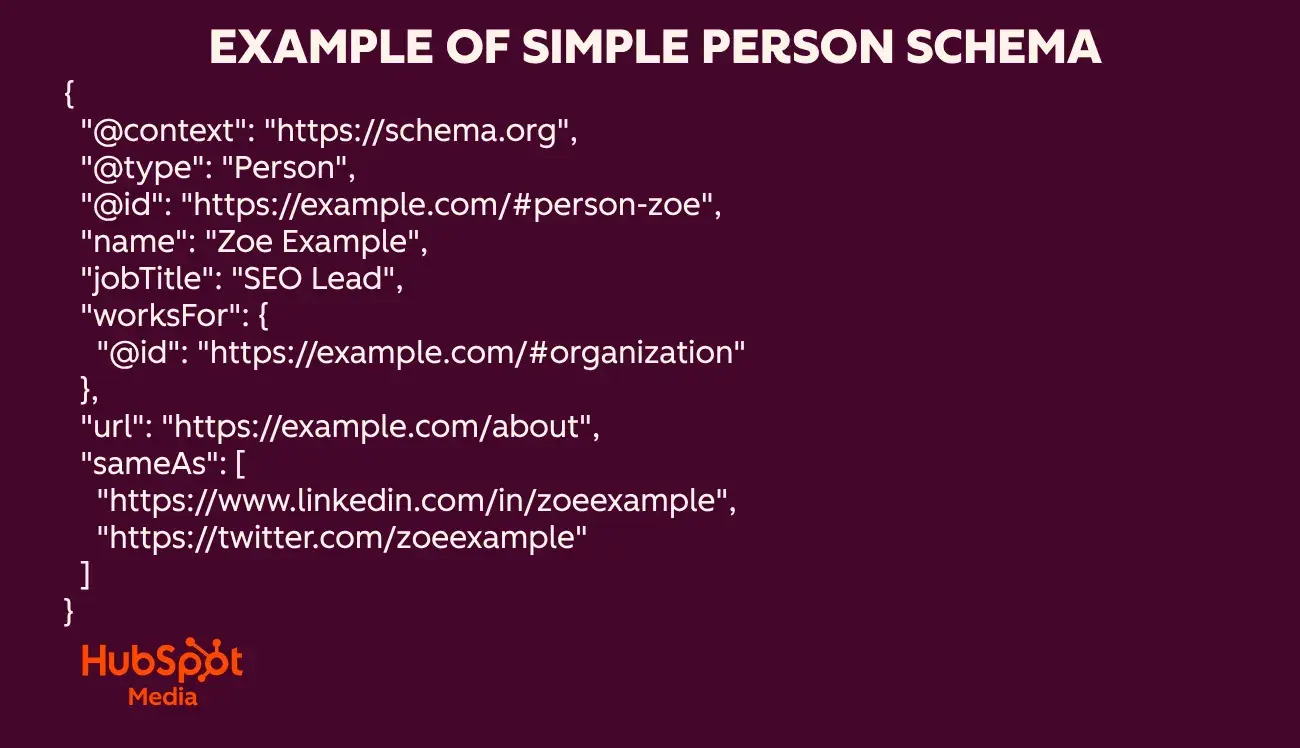
At a minimal, for an individual schema to be legitimate, it wishes:
- @context
- @sort
- @identity
- title
Different issues to incorporate:
- jobTitle
- worksFor
- url
- sameAs
- knowsAbout
- alumniOf
Why I love Particular person schema: I’ve discovered consumer schema to be truly impactful. I added it to my group schema on my About web page, related my social profiles the usage of the sameAs belongings, and highlighted my revel in within the knowsAbout belongings. Days later, I gained a data panel for my title. There’s indubitably that Particular person schema helped my wisdom panel seem. I’ve been ready to recreate this good fortune on a couple of shopper tasks, too, so it wasn’t a one-off.
Article
Article schema describes a work of written content material as a standalone entity. It’s maximum recurrently used for weblog posts, guides, information articles, and editorial content material, and is most often related to each the Particular person and Group schema to outline authorship and possession obviously.
Article schema is helping identify what the item is set. It marks up portions of the item, and stocks who wrote the content material, who revealed it, and when it used to be produced or up to date. An editorial schema additionally is helping AI methods perceive a web page’s scope and intent, lowering the chance of content material being misattributed or left out because of unclear possession. It contains knowledge like:
- Headline
- Creator
- Newsletter date
- Writer
- Primary matter or entity focal point
Right here’s an instance of a easy Article schema:
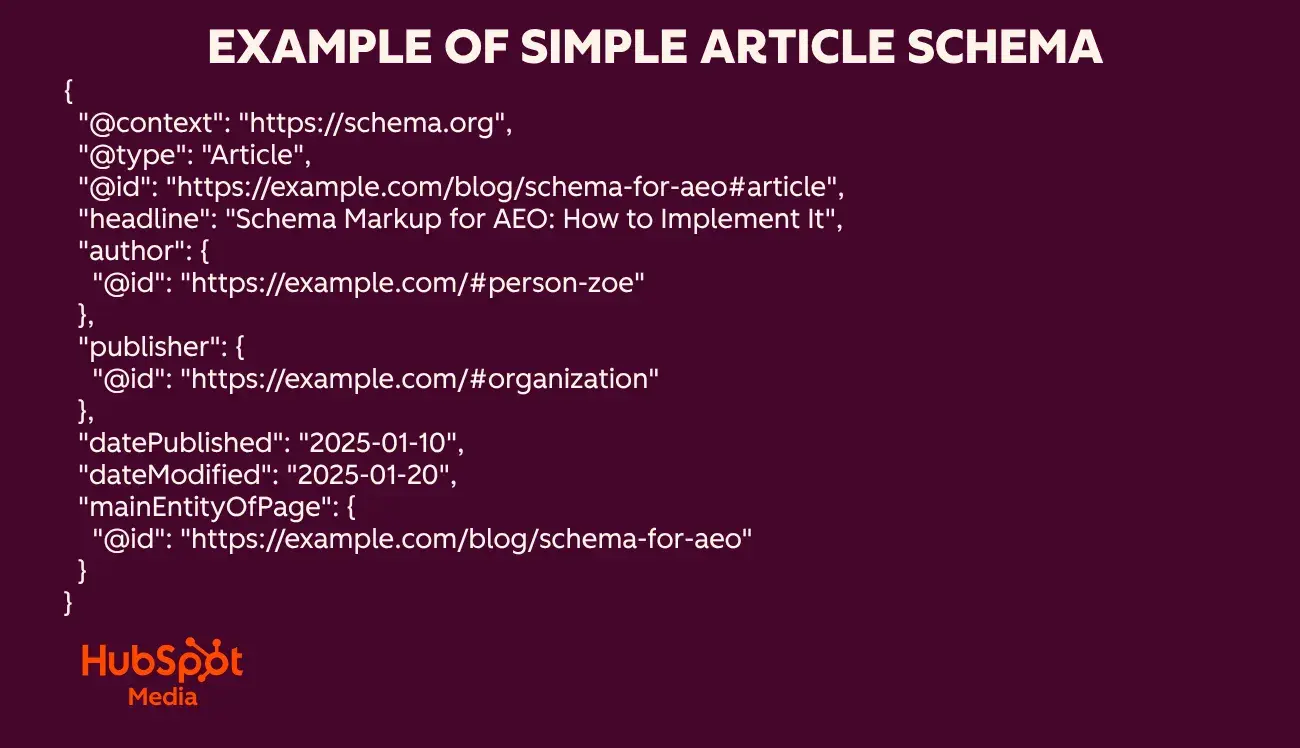
At a minimal, for an Article schema to be legitimate, it wishes:
- @context
- @sort
- @identity
- headline
- writer
It might additionally come with such things as:
- writer
- datePublished
- dateModified
- mainEntityOfPage
- about or mentions
Why I love Article schema: When Article schema is related to Particular person and Group entities, it gets rid of ambiguity round authorship and possession. Because the find out about discussed above finds, well-implemented schema aids ratings and visibility in AEO.
FAQPage
FAQPage schema is used to mark up an inventory of questions and solutions which might be absolutely visual on a web page. It might come with knowledge like:
- Questions customers recurrently ask
- Transparent, concise solutions
Right here’s an instance of a easy FAQPage schema:
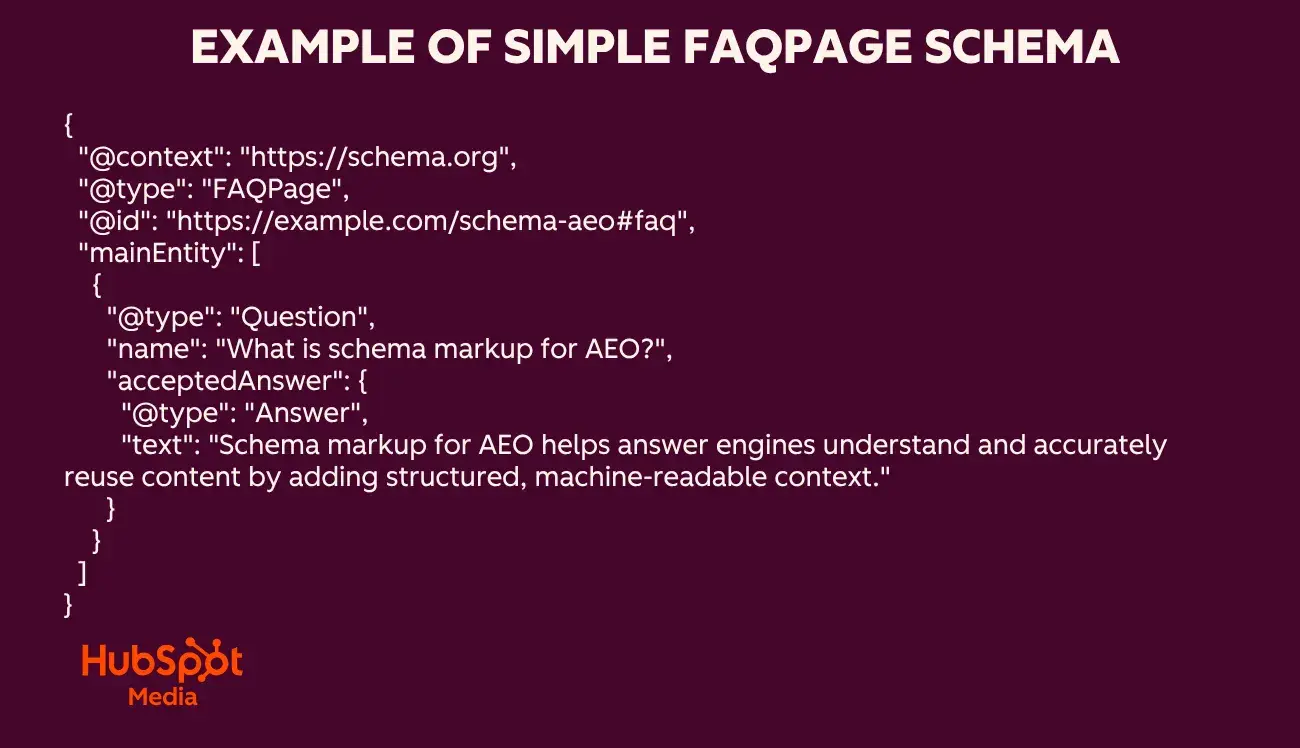
At a minimal, for an FAQPage schema to be legitimate, it wishes:
- @context
- @sort
- mainEntity
- Query with title
- acceptedAnswer with textual content
Operating with FAQ schema is lovely easy. There’s now not a lot so as to add, yet it could come with:
- Tightly scoped, intent-driven questions
- Concise solutions that reflect how customers ask questions
- Alignment between on-page reproduction and structured information
Why I love FAQPage schema: Many search engine marketing experts gave up on FAQPage schema when Google showed that FAQ wealthy effects are actually in large part reserved for authoritative executive and well being internet sites and don’t seem to be influenced by way of FAQ schema. FAQPage schema might nonetheless play a task in serving to crawlers perceive the content material. It’s relatively simple to automate if search engine marketing experts paintings with excellent builders who can follow the schema mechanically. We all know AEO crawlers can learn HTML, and there’s each likelihood that defining questions and solutions might lend a hand the solution engines.
Product
Product schema is used to explain a product as an entity, together with what it’s, who it’s for, and the way it may be bought. It might come with knowledge like:
- Product title and outline
- Logo or producer
- Pricing and availability
- Critiques and rankings
- Key attributes and identifiers
Right here’s an instance of a easy Product schema:
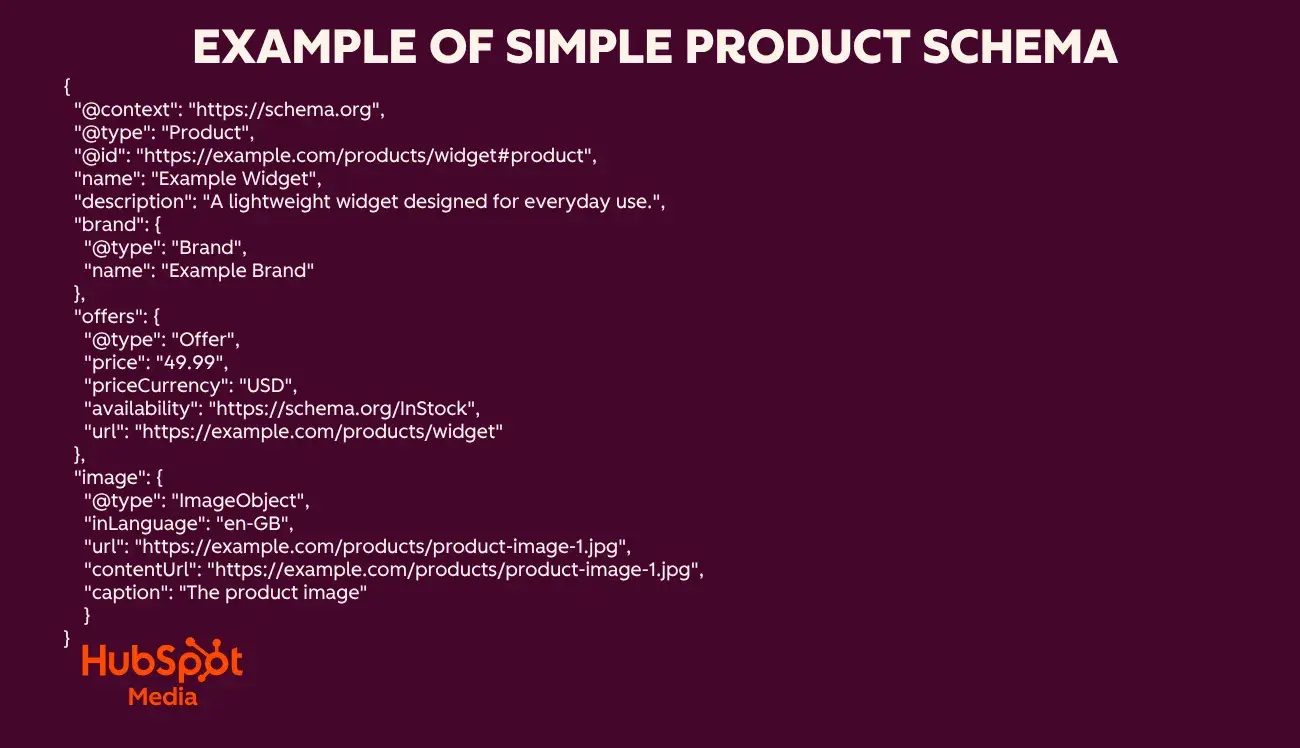
At a minimal, for a Product schema to be legitimate, it wishes:
- @context
- @sort
- @identity
- title
- provides
- symbol
It might additionally come with such things as:
- description
- logo
- aggregateRating
- assessment
Why I love Product schema: Product schema is a type of implementations that most often proves its worth inside a few days. After including product schema, together with product attributes similar to critiques, 5 stars have seemed within the natural record. From an AEO viewpoint, it supplies AI methods with structured, factual information to paintings with. The tips is straightforward to parse, and summarizing and controlling the details a few product offers companies the most efficient likelihood of showing appropriately in AI seek.
Carrier
Carrier schema describes a provider providing as an entity, together with what is equipped, who supplies it, and who it’s supposed for. It might come with knowledge like:
- Carrier title and outline
- The supplier (Group or Particular person)
- Carrier space
- Target audience or trade focal point
- Similar provides or pricing
Right here’s an instance of a easy Carrier schema:
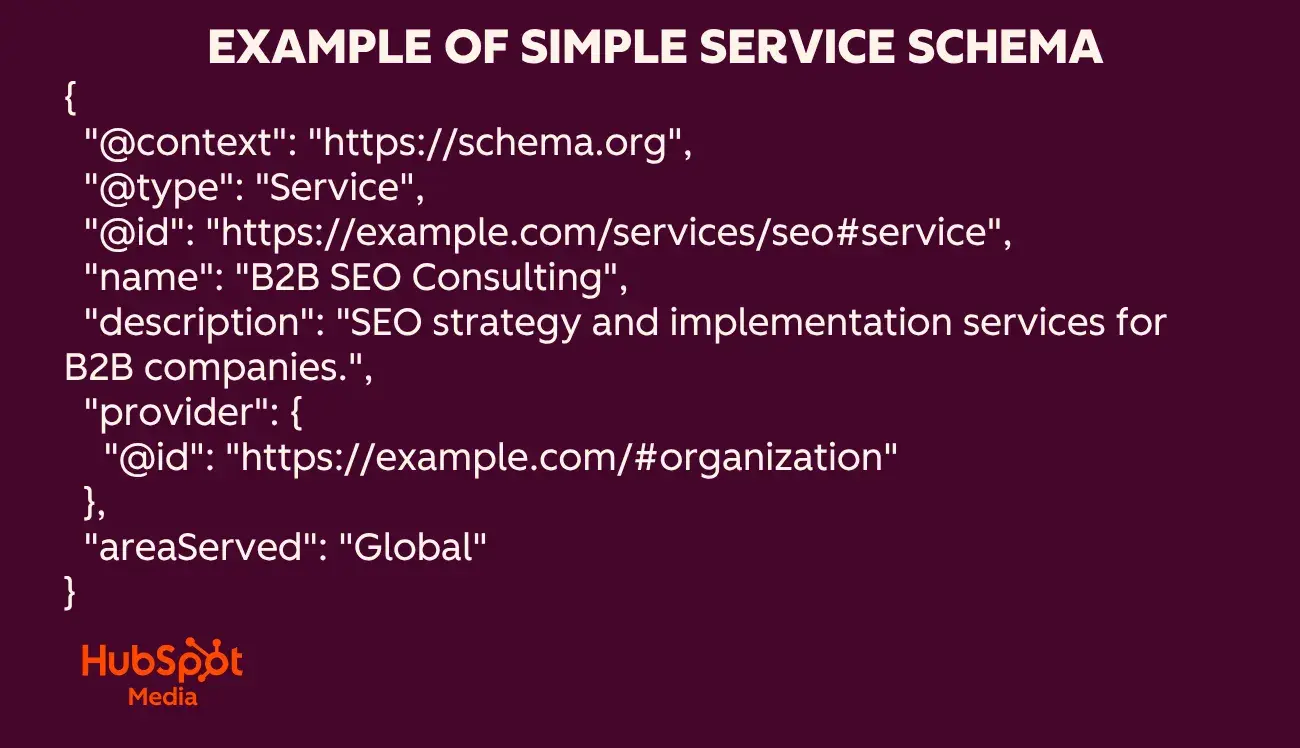
At a minimal, for a Carrier schema to be legitimate, it wishes:
- @context
- @sort
- @identity
- title
It might additionally come with such things as:
- description
- supplier
- areaServed
- target market
- serviceType
Why I love Carrier schema: As with Product schema, it could’t lend a hand to percentage extra a few provider with AEO crawlers. Including structured provider knowledge by the use of schema simplest improves readability. Carrier schema is definitely understood in conventional search engine marketing and will give a boost to enhanced seek effects and clearer provider classification.
BreadcrumbList
BreadcrumbList schema is used to explain a web page’s place inside a website’s hierarchy. It might come with knowledge like:
- The web page’s father or mother classes
- The order of pages within the website construction
- Canonical URLs for each and every degree
Right here’s an instance of a easy breadcrumb schema:

At a minimal, for a BreadcrumbList schema to be legitimate, it wishes:
- @context
- @sort
- itemListElement
- place
- title
- Merchandise
Why I love Breadcrumb checklist schema: Breadcrumbs are a quiet contributor to search engine marketing. It hardly will get credit score, but it surely constantly reinforces website construction for each search engines like google and yahoo and AEO. I’ve discovered it particularly helpful on huge or advanced websites.
Professional tip: HubSpot’s Content material Hub offers customers schema-ready content material out of the field. It applies structured information mechanically the place suitable and surfaces search engine marketing ideas immediately inside the editor, serving to groups align content material construction, metadata, and markup as they write. When paired with its AI content material generator, groups too can create well-structured, entity-rich drafts that already apply AEO very best practices, lowering the will for heavy handbook optimization later. Content material Hub is a sensible choice for groups that wish to put in force schema constantly with out depending on handbook JSON-LD injections on each web page.
The right way to Construction Your Entity Graph for AEO
A schema graph is sort of a attached map of a web page’s knowledge. It hyperlinks similar issues in combination, just like the trade, products and services, articles, folks, and places, so search engines like google and yahoo and AI search engines like google and yahoo can obviously see how the whole thing is expounded.
If a web page doesn’t use an entity graph, then what stays are separate schema blocks which might be extra like person sticky notes. Each and every one describes one thing (an editorial, a product, a company), yet search engines like google and yahoo need to do extra paintings to piece the whole thing in combination.
Each strategies can reference and hyperlink pieces the usage of the “@identity” belongings, however the schema graphs stay the whole thing in combination, making the ones references a lot more straightforward to procedure. It’s essential to notice that having an entity graph isn’t very important. Separate schema blocks will nonetheless be efficient, yet the usage of entity graphs is a very best follow.
What does a schema entity graph seem like?
The desk under displays two schema code examples:
- Separate schema block: Each and every schema (breadcrumb, article, consumer, and group) is enclosed inside a
Schema Graph

