
Entity-based search engine optimization is a content material optimization technique constructed round ideas, relationships, and context slightly than remoted key phrase words. Engines like google determine entities — distinct ideas, folks, puts, or issues — and fasten them throughout the Wisdom Graph to interpret which means and resolve topical authority.

This means mirrors a basic shift in how seek techniques paintings. Google not merely suits textual content; it maps how ideas relate to each other and evaluates whether or not content material meaningfully contributes to an issue’s broader ecosystem. As massive language fashions like ChatGPT and Gemini increasingly more form how data surfaces, the power of entity indicators determines which resources get cited, referenced, and ranked.
This information covers what entities are in search engine optimization, how they vary from key phrases, the place to search out those that subject, how you can construction content material round entity relationships, and how you can measure whether or not the method works.
Desk of Contents
- What are entities in search engine optimization?
- Why Entity-Based totally search engine optimization Issues for Content material and search engine optimization Entrepreneurs
- Tips on how to In finding Entities for search engine optimization
- Tips on how to Plan Subject Clusters With search engine optimization Entities
- Tips on how to Measure and File on Entity-Based totally search engine optimization Technique
- Steadily Requested Questions About Entity-Based totally search engine optimization
Contents
- 1 What are entities in search engine optimization?
- 2 Why Entity-Based totally search engine optimization Issues for Content material and search engine optimization Entrepreneurs
- 3 Tips on how to In finding Entities for search engine optimization
- 3.1 Step 1: Get started with transparent targets and core subjects.
- 3.2 Step 2: Mine seek effects and Wikipedia for confirmed entities.
- 3.3 Step 3: Amplify entity maps with semantic research gear.
- 3.4 Step 4: Construct subject clusters round entity relationships.
- 3.5 Step 5: Strengthen with structured information.
- 4 Tips on how to Plan Subject Clusters With search engine optimization Entities
- 5 Tips on how to Measure and File on Entity-Based totally search engine optimization Technique
- 6 Steadily Requested Questions About Entity-Based totally search engine optimization
- 6.1 Are entities the similar as key phrases?
- 6.2 Do I would like schema to have the benefit of entity search engine optimization?
- 6.3 How do I to find similar entities for my subject?
- 6.4 How do entities impact ratings?
- 6.5 What’s one of the best ways to measure entity search engine optimization effects?
- 6.6 How can I make my content material extra AI-friendly the usage of entities?
- 7 Shift from key phrases to entity-based search engine optimization.
What are entities in search engine optimization?
Entities are distinct ideas, folks, puts, or issues that serps determine and fasten inside the Wisdom Graph. Those relationships lend a hand techniques interpret which means as an alternative of depending on exact-match words.
Engines like google use entities to know the way subjects attach. When content material makes the ones connections transparent, visibility improves throughout more than one similar queries — now not only one number one time period.
An entity represents way over a phrase or word on a web page — it encompasses the overall context surrounding an idea. As an example, HubSpot is an organizational entity connected to CRM instrument, advertising automation, and content material technique, whilst e-mail advertising connects to publication, automation platform, and lead nurturing entities. Those relationships serve as as semantic indicators that lend a hand Google know the way subjects are compatible in combination. Google makes use of entities to grasp and fasten content material within the Wisdom Graph.
Entity relationships permit serps to guage relevance even if a web page doesn’t include an exact-match key phrase. That is the place semantic search engine optimization presentations its power: Google connects entities throughout the Wisdom Graph, which determines whether or not a web page meaningfully contributes to a subject matter’s broader ecosystem. That system-level figuring out makes entity-based search engine optimization very important for visibility in each conventional and AI-powered seek.
How are entities other from key phrases?
Entities constitute ideas; key phrases constitute the language folks use to seek for the ones ideas. Entities lift context, relationships, and attributes, whilst key phrases replicate phraseology. This difference is helping serps perceive which means, now not simply textual content.
The Wisdom Graph hyperlinks manufacturers, gear, subjects, and attributes via entity connections in ways in which key phrases on my own can not seize. This explains why pages steadily rank for more than one similar queries even if they don’t include precise key phrase suits. A web page optimized for “e-mail automation” might also rank for “AI advertising workflows” when each ideas proportion sturdy semantic ties.
Entities additionally serve as as showed info inside of seek techniques. Key phrases supply floor indicators, however entities lift which means. This structural distinction is why entity-led content material steadily ranks throughout more than one similar searches.
Carolyn Shelby, essential search engine optimization at Yoast, provides any other standpoint. “Key phrase search engine optimization is mainly operating on a flat map, whilst entity search engine optimization lives in third-dimensional area,” she explains. “Within the retrieval layer, LLMs deal with ideas, manufacturers, authors, and info like stars clustered in constellations made up our minds by way of subject and relevance.”
On this style, queries transfer via semantic area alongside a trajectory formed by way of how the query is phrased. The entities that get pulled into AI-generated solutions are those with sufficient “gravity” — the well-established, strongly attached ideas that LLMs acknowledge as authoritative inside of their coaching information.
As Shelby places it, “Key phrases simply assist you to seem at the map; entities resolve whether or not you ‘shine brightly’ sufficient to be decided on.”
As an example, when optimizing for “content material business plan,” an entity-based means connects that subject to similar ideas like “editorial calendar,” “purchaser personas,” and “content material distribution channels.” Those aren’t simply similar key phrases — they’re distinct entities that shape an information community.
Google acknowledges that any individual on the lookout for content material technique most likely wishes details about making plans gear, target audience analysis, and publishing workflows. Engines like google use those entity relationships to ship complete effects that tournament consumer intent, now not simply pages that repeat the hunt word.
|
Side |
Key phrases |
Entities |
|
Definition |
Words, phrases, or queries typed into serps |
Distinct ideas, folks, puts, or issues identified by way of serps |
|
Instance |
“absolute best CRM gear” |
“HubSpot,” “Salesforce,” “Buyer Courting Control” |
|
Focal point |
Textual content string matching |
Context and relationships |
|
Used For |
Concentrated on non permanent ratings |
Development long-term topical authority |
|
search engine optimization Have an effect on |
Optimizes for particular seek words |
Strengthens visibility for similar subjects and intent-based queries |
Content material technique inquisitive about entities is helping Google and AI-powered serps know the way manufacturers are compatible into broader subjects — now not simply which phrases to rank for.
Why Entity-Based totally search engine optimization Issues for Content material and search engine optimization Entrepreneurs
Entity-based search engine optimization strengthens topical intensity, improves relevance throughout clusters, and is helping serps interpret how content material suits inside of broader topic spaces. As an alternative of depending on remoted key phrases, entity relationships display how ideas attach — a sign that issues for each SERPs and AI-generated solutions.
In line with analysis from Fractl, 66% of customers consider AI will substitute conventional seek inside of 5 years, and 82% already to find AI seek extra useful than conventional SERPs. As Kelsey Libert, co-founder at Fractl, notes, “This highlights the will for entrepreneurs to prioritize GenAI logo visibility over key phrase optimization, as a result of key phrase technique is a factor of the previous, whilst wisdom graphs will outline your present and long run logo visibility.”
When a web page constantly references the entities maximum related to an issue — akin to “content material operations,” “CMS governance,” or “editorial making plans” — seek techniques achieve a clearer figuring out of its position inside of a semantic community. Those relationships lend a hand construct topical authority by way of appearing how ideas support one any other inside of a cluster.
Entity mapping additionally shapes the inner linking technique. Connecting pages via shared entities reinforces the relationships the Wisdom Graph expects to look in a well-structured cluster. As HubSpot’s semantic seek information notes, structured relationships lend a hand serps assessment the intensity and brotherly love of a subject matter.
Entity-led making plans improves editorial technique by way of decreasing duplication and clarifying the place new content material is wanted. Subjects akin to “content material audit frameworks,” “AI-assisted drafting,” or “inner content material high quality requirements” would possibly proportion overlapping key phrases, however they constitute distinct entities. Incorporating the ones entities into briefs and making plans paperwork guarantees each and every article contributes one thing distinctive to a cluster.
This means aligns with how HubSpot’s Content material Hub helps content material operations. Content material Hub centralizes entity-led briefs, editorial governance, and cluster mapping, making it more straightforward to take care of consistency throughout a rising library of pages and make sure subjects attach the best way seek techniques be expecting.
Entity-focused content material additionally improves retrievability in AI techniques, which depend on conceptual relationships to spot authoritative resources and reconstruct data. As massive language fashions play a better position in surfacing effects, sturdy entity indicators supply further visibility past conventional SERPs.
In combination, those advantages make entity-based search engine optimization a foundational layer of contemporary content material technique — one who improves discoverability, clarifies experience, and helps efficiency throughout each seek and AI-driven channels.
Tips on how to In finding Entities for search engine optimization
Entities shape the spine of contemporary search engine optimization technique, however discovering the fitting ones begins with figuring out what serps already acknowledge. Google’s Wisdom Graph comprises thousands and thousands of interconnected ideas — and efficient content material methods faucet into those present relationships slightly than growing new ones from scratch.
Right here’s a realistic technique to finding and organizing entities for any content material technique.
Step 1: Get started with transparent targets and core subjects.
Each and every sturdy entity technique starts with a easy query: What’s the principle subject, and who wishes to search out it?
Advertising automation may well be the core subject for a SaaS corporate, which naturally branches into similar entities like CRM integration, e-mail workflows, and lead scoring. Those aren’t random connections — they’re the true issues and answers that audiences seek for.
HubSpot’s AEO Grader provides a fact take a look at right here, appearing how AI techniques recently interpret logo content material throughout ChatGPT, Perplexity, and Gemini. AEO Grader analyzes logo presence in AI seek the usage of entity indicators. It’s something to think sure entity connections exist — it’s any other to look what AI in fact acknowledges.
Step 2: Mine seek effects and Wikipedia for confirmed entities.
Google already presentations which entities subject via seek options. The “Other people additionally ask” bins, Wisdom Panels, and similar searches aren’t simply useful options — they’re a roadmap of identified entity relationships.
Wikipedia merits particular consideration because it feeds without delay into Google’s Wisdom Graph. The blue hyperlinks in a Wikipedia article’s opening paragraphs disclose entity connections Google trusts. A piece of writing about e-mail advertising hyperlinks to advertising automation, CRM techniques, and open charges. Each and every hyperlink necessarily says, “Those ideas are similar.”
Equipment like Ahrefs and Semrush construct in this basis. Their analyses verify which entities seem maximum incessantly in top-ranking content material, changing qualitative observations into measurable patterns.
Step 3: Amplify entity maps with semantic research gear.
As soon as the root entities are transparent, it’s time to search out the gaps and connections that competition may well be lacking. That is the place specialised gear earn their stay.
Google’s Herbal Language API
Google’s Herbal Language API reads any piece of content material and identifies which entities it comprises — valuable for checking whether or not present content material hits the fitting semantic marks.
Ahrefs and Semrush
Ahrefs and Semrush have developed past key phrase analysis, now providing entity popularity and semantic clustering that disclose how subjects attach within the Wisdom Graph. Their content material hole analyses particularly spotlight entity alternatives that competition rank for.
Clearscope and SurferSEO
Clearscope and SurferSEO take a special attitude, examining what makes top-ranking content material a success from an entity standpoint. They floor the supporting ideas — the gear, folks, and subtopics — that give content material true topical intensity.
HubSpot’s Nexus (Interior)
For HubSpot’s inner content material groups, there may be additionally Nexus — a proprietary instrument that’s reworking how the corporate approaches entity mapping.
Killian Kelly, AI seek technical strategist at HubSpot, advanced Nexus to bridge a vital hole between principle and operational fact. “I got here up with the speculation for Nexus after seeing how a lot consideration vector embeddings have been getting within the search engine optimization and AEO area, however no person had a realistic method to make use of them in actual content material technique,” Kelly explains.
Nexus fashions how AI techniques like ChatGPT and Google’s AI Mode interpret seek intent, examining semantic relationships throughout whole content material libraries. The instrument generates subject rankings revealing precisely which pages align with goal entities and the place protection gaps exist.
“Nexus is helping us visualize how subjects, subtopics, and entities attach throughout our content material,” Kelly notes. “We will run a key subject via Nexus and in an instant see an total subject rating — together with which pages align semantically with that entity and which spaces we’re lacking altogether.”
HubSpot’s crew runs key subjects via Nexus per 30 days to guage semantic protection, determine competing pages, and notice gaps. The ones insights feed without delay into content material briefs, consolidation priorities, and pruning selections. The instrument maps queries and subjects to content material virtually in an instant — paintings that used to take weeks — and does it according to information, now not human guesswork.
The optimization comments loop makes the have an effect on measurable. As soon as the crew fills gaps and strengthens protection, they are able to go back months later to look how subject rankings have progressed and whether or not entity indicators have bolstered around the cluster. This turns entity-based search engine optimization from principle right into a trackable, iterative procedure that presentations precisely the place content material investments repay.
Step 4: Construct subject clusters round entity relationships.
With entities recognized, the true paintings starts: organizing them into clusters that make sense to each serps and readers. The most powerful clusters map the herbal relationships that exist already between ideas.
A robust cluster begins with a pillar web page masking a vast entity like “AI advertising.” Supporting pages then dive into particular sides: AI content material technology, chatbots for customer support, predictive analytics for campaigns. Each and every piece reinforces the others via inner hyperlinks and shared context, growing what serps acknowledge as topical authority.
Protecting the whole thing arranged as content material libraries develop items a realistic problem. Content material Hub addresses this via templated briefs and automatic inner linking, keeping up consistency throughout dozens or loads of similar pages. When each and every new article strengthens the entire entity map as an alternative of present in isolation, actual authority builds.
Professional tip: HubSpot’s search engine optimization suggestions instrument makes this visible, appearing precisely the place inner hyperlinks are lacking between pillar and cluster content material, turning summary entity relationships into actionable enhancements.
Step 5: Strengthen with structured information.
Schema markup is the general layer that makes entity relationships crystal transparent to serps. Whilst now not obligatory for entity search engine optimization good fortune, schema acts like a translator — explicitly pointing out what each and every entity is and the way it connects to others.
For a web page about HubSpot Content material Hub, schema tells Google precisely what’s what:
- “HubSpot Content material Hub” is a instrument product.
- “HubSpot” is the group at the back of it.
- “Entity-based search engine optimization” is a subject lined inside the content material.
A easy JSON-LD instance seems like this:
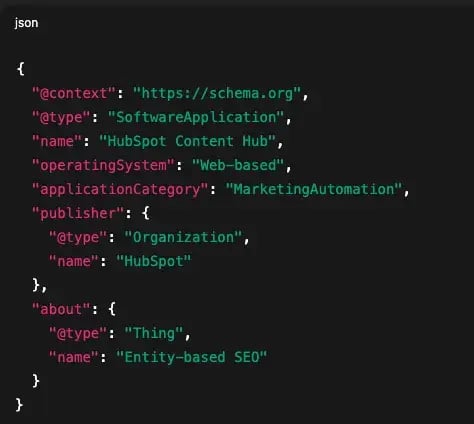
Unfastened gear like Google’s Structured Information Markup Helper generate this code robotically, and the Wealthy Effects Take a look at confirms it’s operating earlier than newsletter. The payoff? Higher possibilities of showing in wealthy snippets, AI-generated solutions, and information panels — the high-visibility spots that power actual site visitors.
Tips on how to Plan Subject Clusters With search engine optimization Entities
Subject clusters flip entity discoveries right into a structured editorial technique by way of mapping how ideas relate and reinforcing the ones relationships via content material. Entities shape the root of those clusters, linking similar concepts via shared context, inner linking, and constant topical framing.
Efficient clusters reflect how folks analysis topics: starting with a vast idea and shifting into increasingly more particular subtopics. Entity relationships naturally information this development by way of appearing which ideas belong in combination and the way deep each and every house must pass.
Right here’s what efficient entity-based clustering seems like in follow:
|
Core Pillar Subject (Entity) |
Supporting Entities / Subtopics |
Content material Kind |
Purpose / Intent |
Interior Linking Instance |
|
Buyer Courting Control (CRM) |
Touch Control, Lead Scoring, Gross sales Forecasting, Pipeline Automation |
Weblog posts, tutorials, comparability guides |
Train and draw in top-funnel site visitors |
Each and every subtopic hyperlinks again to the CRM pillar web page and cross-links to the others the place related |
|
Advertising Automation |
E-mail Sequences, A/B Checking out, Segmentation, Personalization |
Weblog posts, ebooks, video walkthroughs |
Information readers from consciousness to attention |
“E-mail Sequences” publish hyperlinks to “A/B Checking out Very best Practices” and the principle “Advertising Automation Equipment” pillar |
|
Information Integration |
API Control, ETL Processes, Information Hygiene, Information Governance |
Case research, how-to articles, whitepapers |
Construct accept as true with and authority |
Each and every supporting piece hyperlinks as much as the “Information Integration Technique” pillar and references related “CRM” or “Automation” posts |
Clusters transform most respected after they without delay tell content material introduction. Each and every entity turns right into a content material alternative with transparent intent and an outlined set of inner hyperlinks. As an example, a web page about e-mail sequences naturally connects to A/B trying out, lead nurturing, and the wider advertising automation pillar. Those connections apply patterns that readers be expecting and serps praise.
HubSpot’s Content material Hub operationalizes this construction at scale by way of reworking entity insights into reusable temporary templates and keeping up editorial consistency throughout increasing content material libraries. Whether or not the output is a weblog publish, case find out about, or video, the platform is helping be certain that each and every piece strengthens the wider entity map.
Clusters additionally lend a hand determine gaps. When competition rank for entity relationships lacking from present content material, the ones gaps transform a integrated roadmap for long run editorial making plans and quarterly content material building.
Professional tip: Take a look at those search engine optimization absolute best practices for extra pointers and methods.
Tips on how to Measure and File on Entity-Based totally search engine optimization Technique
Measuring entity-based search engine optimization specializes in whether or not serps acknowledge and praise topical authority throughout similar ideas, now not at the efficiency of particular person key phrases. The most powerful signs display enlargement throughout clusters, progressed semantic protection, and larger visibility within the SERP options that depend on contextual figuring out.
Monitor cluster-level efficiency in Google Seek Console.
Google Seek Console supplies probably the most direct view of entity-led growth. As an alternative of keeping apart keyword-level queries, observe impressions and clicks throughout whole clusters of pages tied to a shared idea. Emerging visibility throughout those interconnected pages indicators that Google understands the entity relationships and is treating the web site as an authoritative supply inside of that area.
Assessment inner hyperlink density and dating mapping.
Entity-rich websites reveal tight inner linking between similar subjects. As clusters develop, the density and consistency of those hyperlinks lend a hand seek techniques know the way ideas support each and every different. HubSpot’s Content material Hub robotically surfaces similar pages and suggests inner hyperlinks, making sure supporting content material connects again to pillar pages and to related subtopics. Through the years, this creates a semantic community that indicators intensity and authority.
Track SERP options influenced by way of entity readability.
Entity-optimized content material is much more likely to look in featured snippets, wisdom panels, and AI-generated solution bins — all of which depend on structured context slightly than key phrase matching. Will increase in those placements display that serps can obviously interpret the web page’s which means and its dating to different ideas.
Attach entity efficiency to engagement and results.
Entity authority steadily correlates with more potent behavioral metrics. As clusters mature, emerging impressions usually seem along upper engagement, more potent time-on-page, and extra constant conversion paths. When seek techniques perceive the relationships between subjects, the content material surfaces in additional related contexts — riding higher downstream efficiency.
Use AI Seek Grader for rising visibility indicators.
HubSpot’s AI Seek Grader provides a forward-looking measurement by way of appearing how a logo seems throughout AI-driven seek environments akin to ChatGPT, Gemini, and Perplexity. Those insights lend a hand resolve whether or not entity indicators are sturdy sufficient for LLM-based retrieval and the place further semantic reinforcement is also wanted.
Steadily Requested Questions About Entity-Based totally search engine optimization
Are entities the similar as key phrases?
No. Entities vary from key phrases as a result of entities have context and relationships. Key phrases are textual content strings that replicate how folks seek, whilst entities are the underlying ideas that the ones strings discuss with. As an example, “CRM platform” is a key phrase; HubSpot is an entity representing a selected product and group. Entities lend a hand seek techniques perceive which means and context slightly than matching textual content on my own.
Do I would like schema to have the benefit of entity search engine optimization?
Schema markup is useful however now not required for entity search engine optimization. Schema markup disambiguates entities for serps. It supplies particular, machine-readable definitions of the entities on a web page and the way they relate to each other. Schema will increase readability for serps and steadily improves visibility in featured snippets, wisdom panels, and AI-generated summaries.
How do I to find similar entities for my subject?
Equipment akin to Google’s Herbal Language API, Ahrefs, and Semrush floor entities usually related to a number one idea. Wikipedia, Other people Additionally Ask panels, and similar searches additionally disclose relied on entity connections. Interior linking additional reinforces the ones relationships by way of mapping how ideas give a boost to one any other inside of a cluster.
How do entities impact ratings?
When Google acknowledges sturdy entity protection, visibility improves throughout more than one similar queries slightly than only one time period. Entity-driven pages steadily display constant enlargement throughout whole clusters as a result of seek techniques know the way each and every piece suits inside of a broader subject.
What’s one of the best ways to measure entity search engine optimization effects?
Track impressions, clicks, and rating tendencies for entity-aligned clusters in Google Seek Console. Monitor inner hyperlink building and SERP function visibility to evaluate whether or not semantic authority is expanding. HubSpot’s AEO Grader presentations how obviously logo entities seem throughout AI seek studies.
How can I make my content material extra AI-friendly the usage of entities?
Transparent definitions, constant naming conventions, and structured inner hyperlinks make entity relationships particular for AI fashions. Breaking apart dense paragraphs, the usage of schema markup the place suitable, and keeping up constant terminology throughout property improves mechanical device interpretation. HubSpot’s Content material Hub helps this by way of standardizing briefs and reinforcing entity-aligned patterns throughout content material libraries.
Shift from key phrases to entity-based search engine optimization.
Entity-based search engine optimization displays how fashionable serps interpret content material via context and relationships. When the ones relationships are transparent, visibility improves throughout each conventional seek and AI-generated studies.
Content material Hub makes this construction scalable by way of figuring out entities, templatizing briefs, and keeping up semantic consistency throughout massive content material ecosystems. AEO Grader presentations how entity indicators carry out in AI environments akin to ChatGPT and Gemini — visibility that’s increasingly more vital as seek continues to conform.
The shift from key phrases to entities modified my technique to content material technique. When clusters shaped round herbal relationships slightly than remoted phrases, it was transparent why Google rewards content material that connects concepts. The most powerful performers weren’t the items filled with key phrases — they have been those that demonstrated how ideas relate.
As AI performs a larger section in data retrieval, development content material round entities guarantees long-term visibility and credibility. The function extends past rating for particular person queries; it facilities on generating content material that earns authority via authentic experience, significant relationships, and transparent semantic construction.
