

Right here’s a (possibly) mildly highly spiced scorching take: E mail advertising and marketing reporting is the spine of any performance-focused e-mail technique. With out it, you’re sending campaigns right into a void, not able to look what’s operating, what’s falling flat, and most significantly, what’s using income.
The highest reporting options in e-mail advertising and marketing tool cross a ways past open charges and click-throughs. Lately’s e-mail reporting equipment allow closed-loop reporting, connecting each e-mail touchpoint to pipeline results and buyer lifetime price. This implies entrepreneurs can after all resolution the query executives care about maximum: How does e-mail give a contribution to income?
On this information, I’m going to destroy down what e-mail advertising and marketing reporting if truth be told comes to — which KPIs to trace at each and every funnel level, the best way to construct a dashboard that surfaces actionable insights, and which e-mail advertising and marketing reporting equipment assist you to get there.
Let’s get began.
Desk of Contents
- What’s e-mail advertising and marketing reporting?
- E mail advertising and marketing reporting: What to trace
- The right way to construct an e-mail reporting dashboard the suitable method
- Templates for e-mail advertising and marketing reporting
- E mail advertising and marketing reporting equipment (at a look)
- E mail advertising and marketing reporting equipment
- Steadily requested questions (FAQ) about e-mail advertising and marketing reporting
- E mail advertising and marketing reporting ain’t so unhealthy in spite of everything
Contents
- 1 What’s e-mail advertising and marketing reporting?
- 2 E mail advertising and marketing reporting: What to trace
- 3 The right way to construct an e-mail reporting dashboard the suitable method
- 3.1 Step #1: Outline your reporting targets ahead of including a unmarried widget.
- 3.2 Step #2: Choose KPIs that align along with your funnel level.
- 3.3 Step #3: Construct your dashboard construction with hierarchy in thoughts.
- 3.4 Step #4: Attach e-mail information on your CRM and income assets.
- 3.5 Step #5: Arrange computerized indicators and benchmarks.
- 3.6 Step #6: Time table common critiques and iterate.
- 4 Templates for e-mail advertising and marketing reporting
- 5 E mail advertising and marketing reporting equipment (at a look)
- 6 E mail advertising and marketing reporting equipment
- 7 Steadily requested questions (FAQ) about e-mail advertising and marketing reporting
- 8 E mail advertising and marketing reporting ain’t so unhealthy in spite of everything
What’s e-mail advertising and marketing reporting?
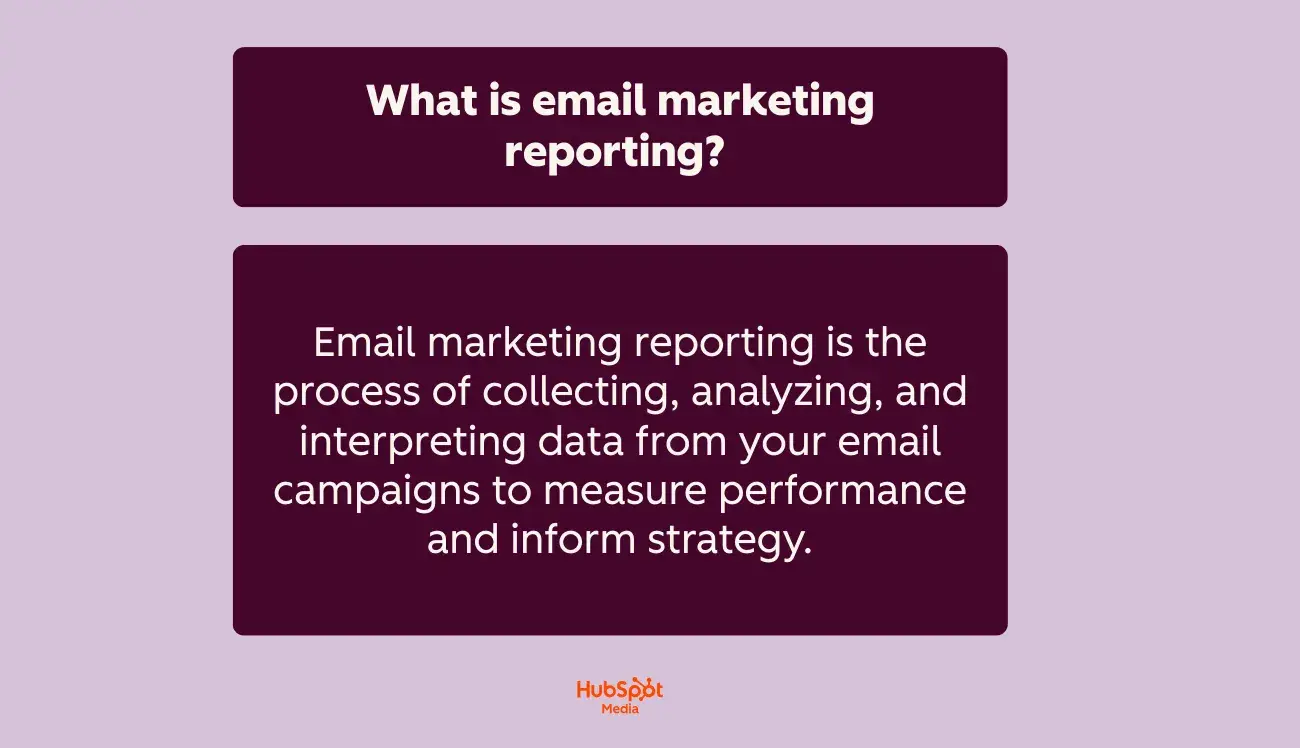
E mail advertising and marketing reporting is the method of gathering, examining, and decoding information out of your e-mail campaigns to measure functionality and tell technique. It transforms uncooked metrics, comparable to:
- Opens
- Clicks
- Conversions
Those information issues yield actionable insights that at once connect with pipeline enlargement, income technology, and buyer lifetime price.
Additionally, tough e-mail advertising and marketing reporting solutions 3 core questions:
- Are your emails attaining inboxes?
- Are recipients enticing along with your content material?
- (Maximum significantly) Are the ones engagements using measurable trade results?
Now, complete e-mail advertising and marketing reporting calls for the next:
- Monitoring deliverability metrics
- Engagement charges
- Earnings attribution
This implies tracking no longer simply surface-level job, however figuring out how each and every e-mail touchpoint contributes to a touch’s adventure from subscriber to buyer.
Moreover, the highest reporting options in e-mail advertising and marketing tool come with:
- Deliverability monitoring: This option displays inbox placement, leap charges, and sender popularity
- Engagement analytics: Those metrics duvet open charges, click-through charges, click on mapping, and unsubscribe traits
- Earnings attribution: Those metrics attach e-mail interactions to closed offers and pipeline price
- Target market segmentation insights: This capacity unearths which touch teams reply to express content material sorts
- A/B take a look at effects: This knowledge quantifies functionality variations between topic strains, ship occasions, and content material permutations
All-in-all, with out tough e-mail advertising and marketing reporting equipment, you’re necessarily sending campaigns right into a void. With them, each e-mail turns into a knowledge level that sharpens your figuring out of what drives income.
Now that we’ve coated what e-mail advertising and marketing reporting is and why it issues, within the subsequent phase, let’s communicate specifics: what metrics you’ll monitor to measure marketing campaign luck and end up trade have an effect on.
Professional Tip: HubSpot’s Reporting and Dashboard Device connects e-mail touchpoints to income results, multi-touch attribution fashions, and full-funnel visibility — permitting entrepreneurs to look precisely how e-mail contributes to CLV over the years.
E mail advertising and marketing reporting: What to trace
Now that we’ve coated what e-mail advertising and marketing reporting is, let’s discuss the way you’ll put it into apply.
As in the past discussed, e-mail advertising and marketing reporting calls for:
- Monitoring deliverability metrics
- Engagement charges
- Earnings attribution
On the other hand, the detailed breakdown under supplies entire visibility into marketing campaign well being and trade have an effect on.
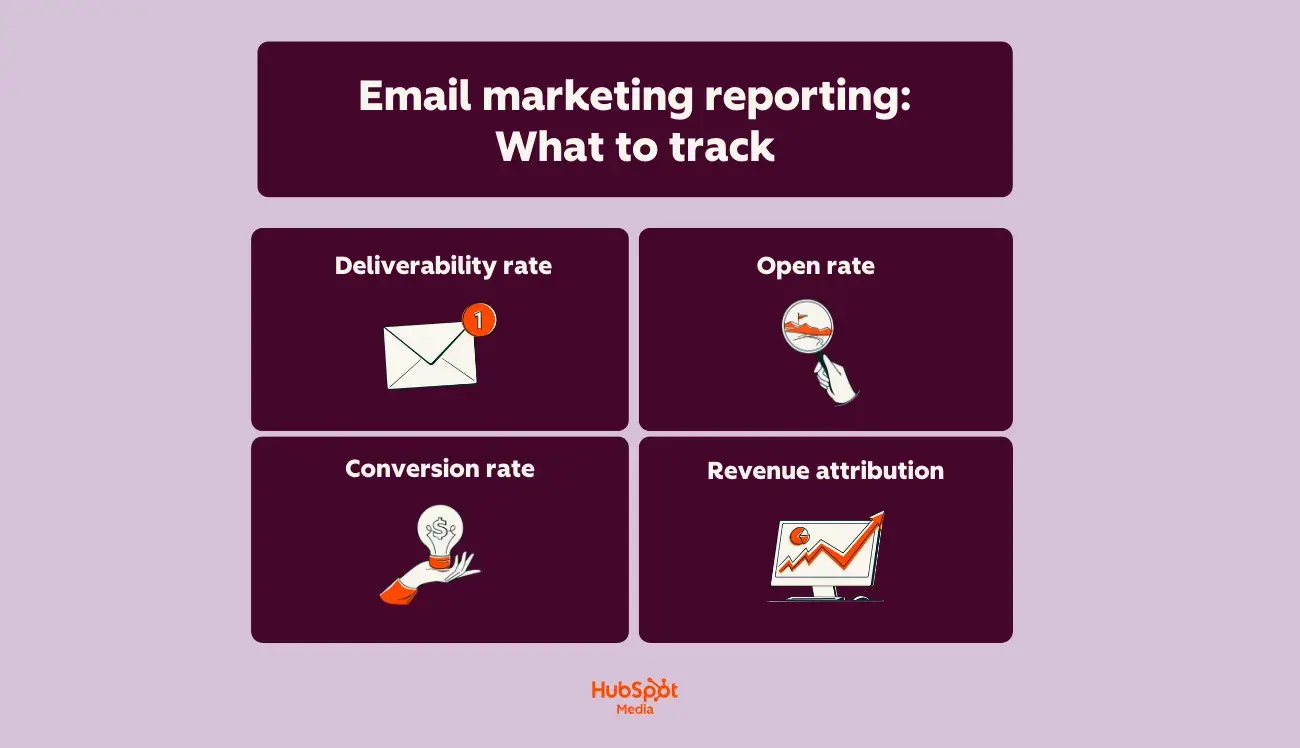
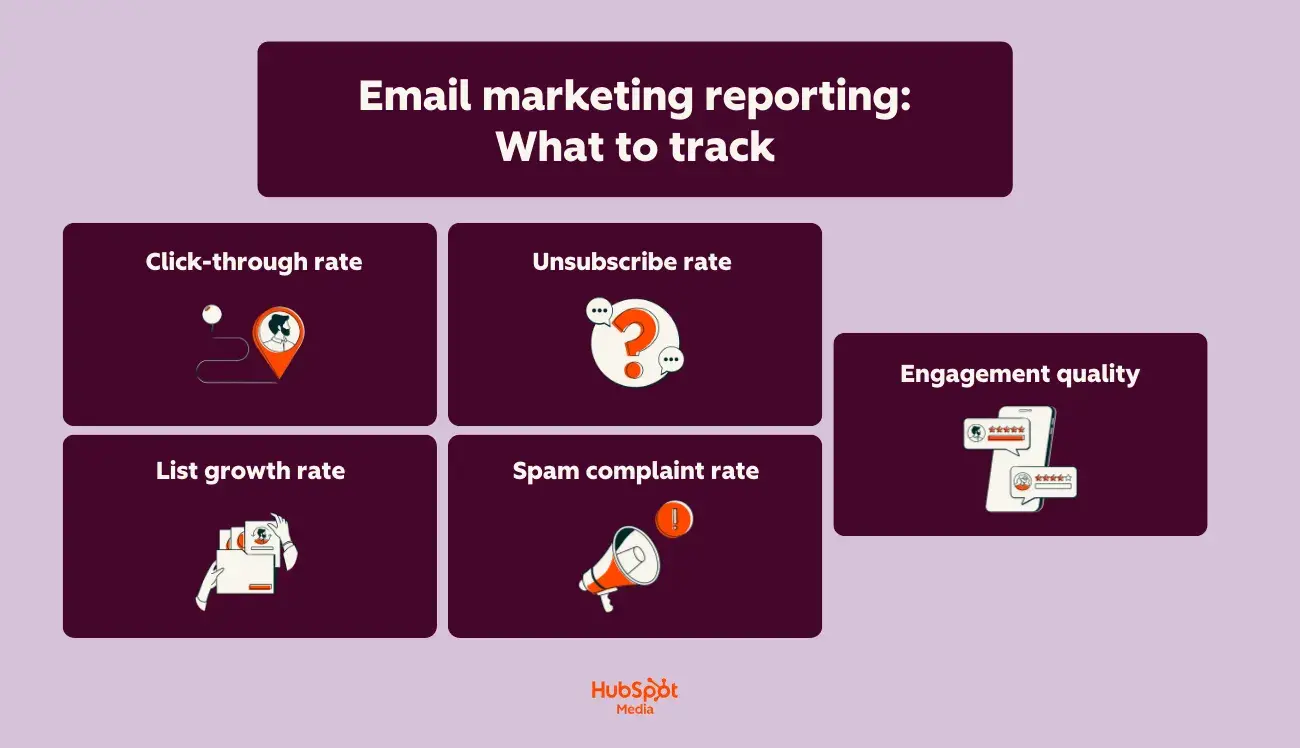
To construct a whole e-mail reporting framework, check out the next 9 metrics:
- Deliverability charge: This foundational metric measures the proportion of emails that effectively succeed in subscribers’ inboxes. (A deliverability charge under 95% alerts checklist hygiene or authentication problems that require rapid consideration.)
- Open charge: This engagement indicator signifies what number of recipients seen your e-mail. Open charges supply directional perception into topic line effectiveness and ship time optimization.
- Click on-through charge (CTR): This engagement indicator unearths the proportion of recipients who clicked a minimum of one hyperlink. This metric at once measures content material relevance and CTA effectiveness. Maximum e-mail reporting equipment (like HubSpot’s E mail Advertising Device) display click on mapping to spot which particular hyperlinks power engagement.
- Conversion charge: This action-based metric tracks recipients who entire a desired motion, comparable to filing a sort, making a purchase order, downloading, or asking for a demo. Smartly-executed e-mail advertising and marketing reporting combines real-time functionality information, viewers segmentation insights, and conversion monitoring to correctly characteristic those movements.
- Earnings attribution: This bottom-line metric connects e-mail touches to closed offers. The highest reporting options in e-mail advertising and marketing tool come with first-touch attribution, multi-touch fashions, pipeline affect reporting, and buyer lifetime price.
- Checklist enlargement charge: This well being indicator measures web subscriber acquisition after accounting for unsubscribes and bounces. To calculate your checklist enlargement charge, calculate per month: (new subscribers − misplaced subscribers) ÷ general checklist measurement × 100. (Wholesome lists develop 2-5% per month.)
- Unsubscribe charge: This retention metric measures the proportion of recipients who unsubscribe out of your emails after a marketing campaign ship. Unexpected spikes point out content-audience misalignment, over-sending, or deficient checklist segmentation.
- Unsolicited mail criticism charge: This measures how ceaselessly recipients mark your emails as junk mail. This charge should keep under 0.1% to offer protection to the sender’s popularity. E mail advertising and marketing reporting equipment will have to flag campaigns exceeding this threshold right away.
- Engagement high quality: This complex metric is going past opens and clicks to measure significant interplay. It encompasses time spent studying emails, forwarding and sharing charges, answer charges for conversational campaigns, and repeat engagement from the similar contacts.
Subsequent, let’s stroll via the best way to construct an e-mail reporting dashboard — all with those metrics as your basis.
Professional Tip: HubSpot’s Advertising Hub supplies complete e-mail reporting dashboards, A/B checking out analytics, and contact-level engagement monitoring, so you’ll observe the KPIs discussed above from a unmarried platform attached on your CRM information.
The right way to construct an e-mail reporting dashboard the suitable method
A well-built e-mail reporting dashboard turns scattered information into transparent, actionable insights. What’s much more, complex e-mail reporting platforms be offering:
- Local CRM integration
- Customized dashboard advent
- Go-channel attribution features
However provided that you put them up strategically from the beginning. Right here’s the best way to construct yours the suitable method — take a look at the next steps:
Step #1: Outline your reporting targets ahead of including a unmarried widget.
Your dashboard will have to resolution particular trade questions, no longer simply show each to be had metric. Get started via figuring out what selections your e-mail reporting will tell.
Ask your self:
- Are you optimizing for engagement, conversions, or income?
- Who will use this dashboard — advertising and marketing managers, executives, or marketing campaign experts?
- What timeframes topic maximum: day by day functionality, weekly traits, or per month benchmarks?
Step #2: Choose KPIs that align along with your funnel level.
No longer each metric belongs on each dashboard. Fit your KPIs to what you’re if truth be told looking to measure.
Right here’s the way you’ll assess e-mail advertising and marketing reporting according to your funnel level:
- Best-of-funnel campaigns (newsletters, nurture sequences): Prioritize open charges, click-through charges, and checklist enlargement
- Mid-funnel campaigns (product training, case research): Focal point on conversion charges, content material engagement intensity, and lead scoring adjustments
- Backside-of-funnel campaigns (gross sales enablement, demos): Observe income attribution, pipeline affect, and deal pace
Professional Tip: HubSpot’s Reporting and Dashboard Device connects e-mail touchpoints to income results, multi-touch attribution fashions, and full-funnel visibility — making it simple to look how each and every marketing campaign kind contributes to closed offers.
Step #3: Construct your dashboard construction with hierarchy in thoughts.
The highest reporting options in e-mail advertising and marketing tool imply not anything in case your dashboard format creates confusion. Prepare data from high-level insights right down to granular main points.
Right here’s a construction I like to recommend:
- Row 1: Government abstract – general sends, general engagement charge, income attributed to e-mail this era
- Row 2: Deliverability well being — inbox placement, leap charges, junk mail lawsuits
- Row 3: Engagement functionality — opens, clicks, and conversions via marketing campaign kind
- Row 4: Checklist and viewers metrics — enlargement charge, phase functionality, unsubscribe traits
Step #4: Attach e-mail information on your CRM and income assets.
Time for a advertising and marketing fact test (that you just didn’t ask for): E mail reporting in isolation handiest tells part the tale.
Efficient e-mail analytics combines:
- Actual-time functionality information
- Target market segmentation insights
- Conversion monitoring
On the other hand, all of this calls for connecting your e-mail platform to touch data and deal information.
With HubSpot’s Advertising Hub, your e-mail reporting dashboard routinely pulls out of your CRM. This implies you’ll see which emails influenced particular offers, monitor engagement via lifecycle level, and measure true buyer lifetime price via acquisition supply.
Step #5: Arrange computerized indicators and benchmarks.
Don’t wait till your weekly overview to catch issues. E mail advertising and marketing reporting equipment will have to notify you when metrics fall outdoor appropriate levels.
Subsequently, configure indicators for:
- Deliverability shedding under 95%
- Unsolicited mail criticism charges exceeding 0.1%
- Spikes in unsubscribe charges
- Conversion charges falling under your rolling moderate
Step #6: Time table common critiques and iterate.
Your dashboard isn’t a set-it-and-forget-it software. Time table weekly check-ins to check functionality and per month deep-dives to evaluate whether or not your tracked metrics nonetheless align with trade targets.
All the way through each and every overview, be sure you:
- Establish top-performing campaigns and analyze what made them paintings
- Flag underperforming segments for checking out or suppression
- Replace benchmarks according to fresh functionality traits
- Upload or take away widgets as your e-mail technique evolves
Construction your e-mail advertising and marketing reporting dashboard appropriately from the beginning saves hours of remodel later. Plus, with HubSpot’s attached reporting ecosystem, each e-mail despatched turns into a knowledge level that ties at once to the pipeline and income.
Professional Tip: HubSpot’s Breeze AI complements e-mail reporting with predictive send-time optimization, computerized functionality summaries, and actionable suggestions — serving to you see patterns and alternatives extra temporarily all over those critiques.
Templates for e-mail advertising and marketing reporting
Constant reporting helps to keep stakeholders knowledgeable and is helping you see traits ahead of they transform issues. Those 3 templates provide you with ready-to-use codecs for various audiences and cadences — so that you spend much less time development studies and extra time performing on insights.
As in the past discussed, e-mail advertising and marketing reporting calls for monitoring deliverability metrics, engagement charges, and income attribution. Additionally, the templates I’ve equipped under prepare those information issues into transparent, stakeholder-friendly codecs.
Have a look:
Template #1: Weekly E mail Pulse Test
Easiest for: Advertising staff syncs, marketing campaign managers, fast functionality snapshots.
Right here’s the desk you’ll use:
|
Metric |
This Week |
Closing Week |
% Trade |
|
Emails despatched |
|||
|
Deliverability charge |
|||
|
Open charge |
|||
|
Click on-through charge |
|||
|
Conversion charge |
|||
|
Unsubscribe charge |
Then, be sure you upload context with qualitative notes, together with:
- Best-performing e-mail: [Campaign name] — [Key metric that stood out]
- Spaces of outrage: [Any metrics trending downward or below benchmark]
- Subsequent week’s focal point: [One or two priorities based on this week’s data]
General, this template works nicely for e-mail reporting all over status staff conferences. Its layout is scannable, constant, and action-oriented.
Professional Tip: If you happen to’re the use of HubSpot’s Advertising Hub, you’ll be capable to seize e-mail reporting dashboard information, A/B checking out analytics, and contact-level engagement monitoring multi function position, making it simple to tug those numbers in mins.
Template 2: Per month Government Abstract
Easiest for: Management updates, cross-functional stakeholders, funds discussions.
Quantity & Succeed in:
- Overall emails despatched: [Number]
- Reasonable deliverability charge: [%]
- Checklist measurement (finish of month): [Number]
- Internet checklist enlargement: [+/- Number] ([%] alternate)
Engagement Abstract:
- Reasonable open charge: [%] (benchmark: [%])
- Reasonable CTR: [%] (benchmark: [%])
- Overall clicks: [Number]
Industry Affect:
- Conversions attributed to e-mail: [Number]
- Earnings attributed to e-mail: [$]
- Pipeline influenced via e-mail: [$]
- Best-converting marketing campaign: [Name]
Key Insights:
- [Insight about what worked]
- [Insight about audience behavior]
- [Recommendation for next month]
This template is simple to duplicate and paste, making it easy to customise and percentage when vital.
Template #3: Marketing campaign Put up-Ship Record
Easiest for: Particular person marketing campaign research, A/B take a look at documentation, stakeholder recaps.
First, come with the next data:
- Marketing campaign Identify: [Name]
- Ship Date: [Date]
- Target market Phase: [Segment name and size]
- Marketing campaign Purpose: [Primary objective]
Then, dive into the nitty-gritty components of your e-mail advertising and marketing marketing campaign:
Deliverability:
- Despatched: [Number]
- Delivered: [Number] ([%])
- Bounced: [Number] (Arduous: [#] / Cushy: [#])
Engagement:
- Opens: [Number] ([%])
- Distinctive clicks: [Number] ([%])
- Click on-to-open charge: [%]
- Best clicked hyperlink: [URL or CTA description]
Conversions & Attribution:
- Number one conversion motion: [Description]
- Conversions: [Number]
- Conversion charge: [%]
- Earnings attributed: [$]
A/B Check Effects (if acceptable):
- Variable examined: [Subject line / Send time / CTA / etc.]
- Variant A: [Result]
- Variant B: [Result]
- Winner: [A or B] — [Why]
Takeaways:
- What labored: [Specific element]
- What to check subsequent: [Hypothesis]
In the end, those templates are supposed to function beginning issues on your staff’s e-mail reporting workflow. Be happy to edit them according to your particular KPIs and stakeholder wishes.
E mail advertising and marketing reporting equipment (at a look)
|
Instrument |
Easiest For |
Key Options |
Pricing |
Unfastened Trial |
|
B2B groups desiring e-mail reporting attached to the gross sales pipeline and income attribution |
Local CRM integration Multi-touch attribution reporting Customized dashboard builder Click on mapping Checklist well being tracking Breeze AI for predictive optimization |
Starter: $9/month Skilled: $800/month Undertaking: $3,600/month |
Sure, 14 days |
|
|
E-commerce manufacturers desiring direct income attribution tied to product catalog information |
Earnings-per-recipient monitoring Predictive analytics (CLV, churn chance) Phase functionality comparability Product-level attribution Benchmark information |
Unfastened: $0/month E mail (1,001 to at least one,500 profiles): $45/month E mail (1,501 to two,500 profiles): $65/month *Word: Pricing for Klaviyo is according to the selection of lively profiles. |
No (unfastened tier to be had) |
|
|
Small to mid-sized companies searching for user-friendly e-mail reporting |
Marketing campaign functionality snapshots Comparative reporting Click on maps Trade benchmark comparisons AI-driven content material optimizer |
Unfastened: $0/month Necessities: $13/month Same old: $20/month Top rate: $350/month *Word: Pricing for Mailchimp is according to the selection of contacts. |
Sure, 14 days |
|
|
Undertaking organizations invested in Salesforce desiring unified gross sales and repair information |
Einstein AI analytics Go-channel adventure reporting Customized SQL file builder Deliverability tracking Account-based reporting |
Salesforce Starter: $25/month Advertising Cloud Enlargement Version: $1,500/month Advertising Cloud Complex Version: $3,250/month |
No |
|
|
Groups working refined automation workflows requiring sequence-level functionality visibility |
Automation funnel reporting Web site monitoring integration Deal attribution Break up checking out studies Engagement tagging |
Starter: $15/month Plus: $49/month Professional: $79/month Undertaking: $145/month |
Sure, 14 days |
|
|
Groups prioritizing e-mail design optimization, accessibility compliance, and engagement high quality research |
E mail shopper and instrument reporting Learn time monitoring Engagement scoring Accessibility tests Unsolicited mail filter out checking out |
Customized pricing handiest, demo name required (see right here) |
No |
E mail advertising and marketing reporting equipment
The correct e-mail advertising and marketing reporting equipment turn out to be uncooked marketing campaign information into strategic insights. Complex e-mail reporting platforms be offering local CRM integration, customized dashboard advent, and cross-channel attribution features, however each and every software brings its personal strengths, relying to your wishes.
Listed here are six platforms with robust e-mail reporting features:
1. HubSpot (Advertising Hub)
Easiest for: B2B groups that want e-mail reporting attached to gross sales pipeline and income attribution in a single platform.
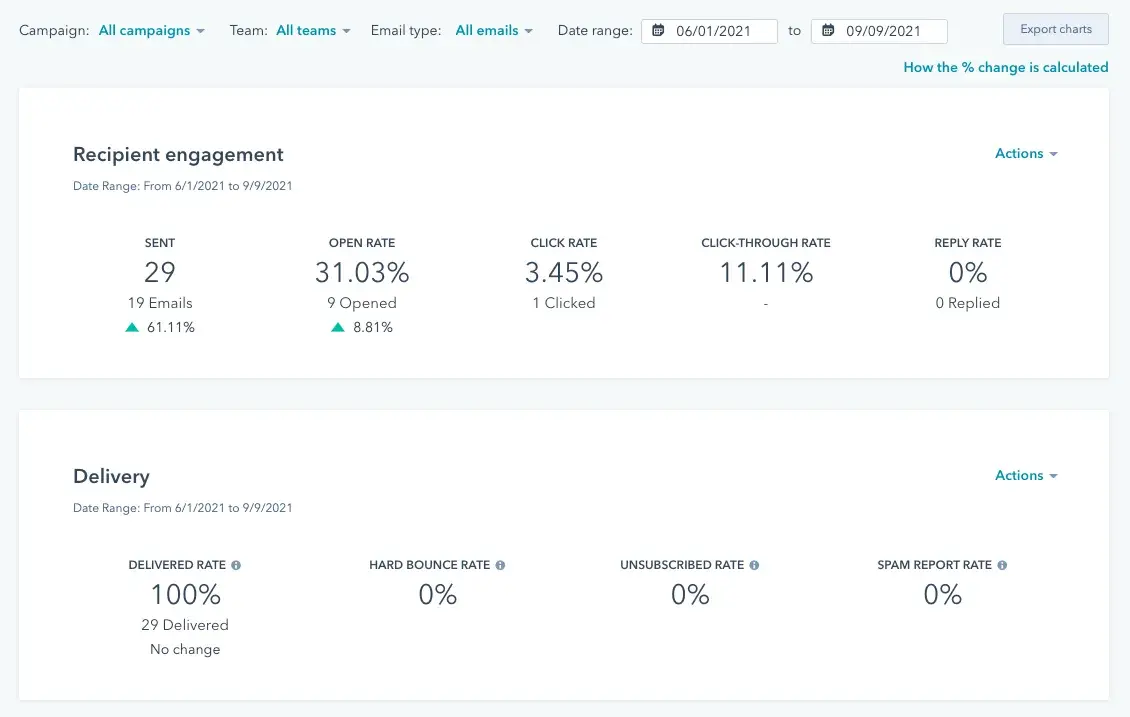
HubSpot’s Advertising Hub supplies complete e-mail reporting dashboards, A/B checking out analytics, and contact-level engagement monitoring — all attached at once on your CRM.
HubSpot’s key e-mail advertising and marketing reporting options:
- Local CRM integration ties each e-mail interplay to touch data, offers, and income
- Multi-touch attribution reporting (that displays how e-mail influences the pipeline at each and every funnel level)
- Customized dashboard builder with drag-and-drop widgets
- Checklist well being tracking (monitoring enlargement, churn, and phase functionality over the years)
HubSpot pricing (Advertising Hub):
- Starter: $9/month
- Skilled: $800/month
- Undertaking: $3,600/month
2. Klaviyo
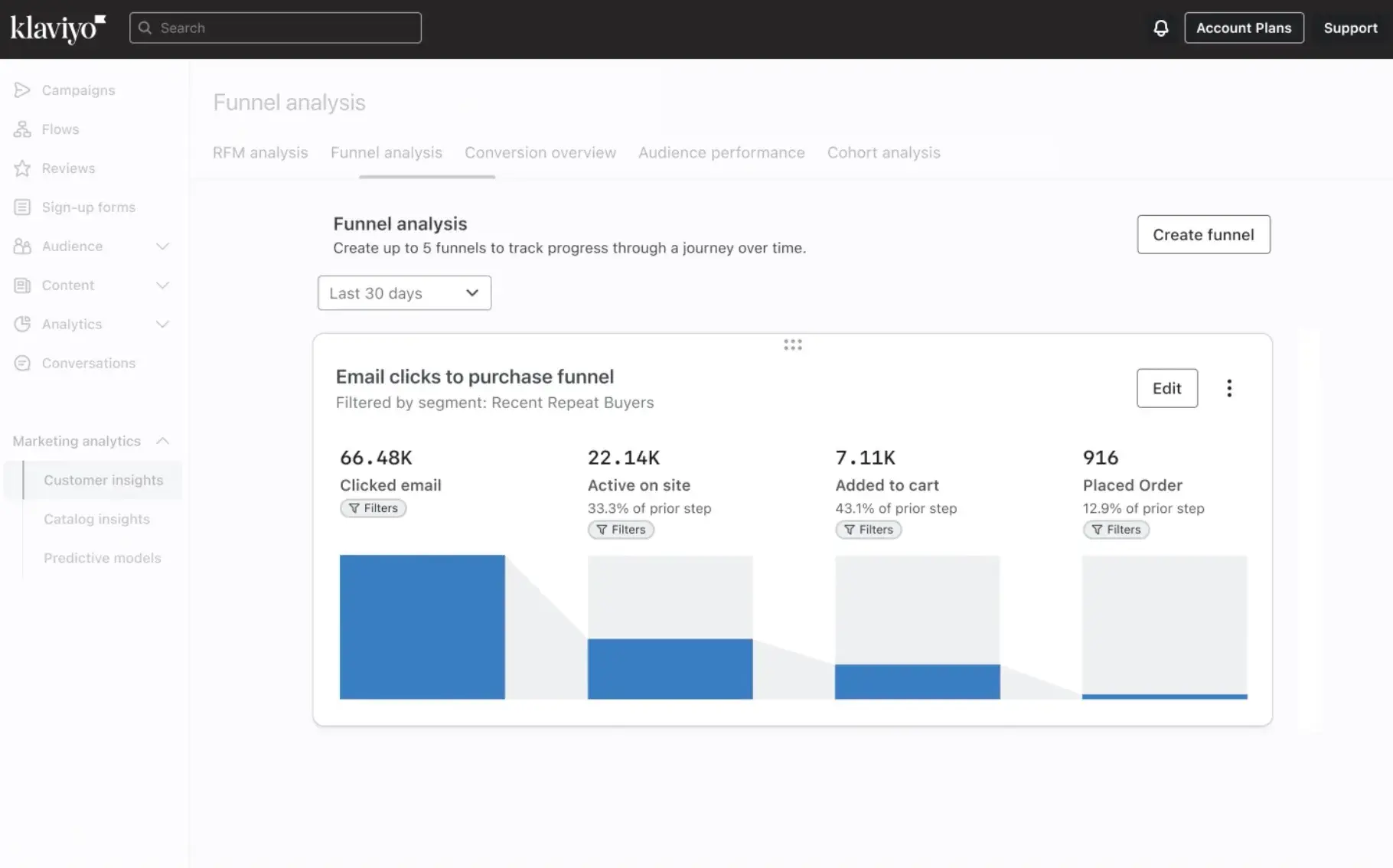
Easiest for: E-commerce manufacturers that want direct income attribution tied to product catalog information.
Klaviyo focuses on e-commerce e-mail reporting with deep integrations into Shopify, WooCommerce, and different on-line storefronts.
Klaviyo’s key e-mail advertising and marketing reporting options:
- Earnings-per-recipient monitoring
- Predictive analytics (together with buyer lifetime price and churn chance rankings)
- Phase functionality comparability appearing engagement via buyer cohort
- Product-level attribution (i.e., figuring out which emails power particular SKU purchases)
- Benchmark information
- Unfastened: $0/month
- E mail (1,001 to at least one,500 profiles): $45/month
- E mail (1,501 to two,500 profiles): $65/month
*Word: Pricing for Klaviyo is according to the selection of lively profiles.
3. Mailchimp
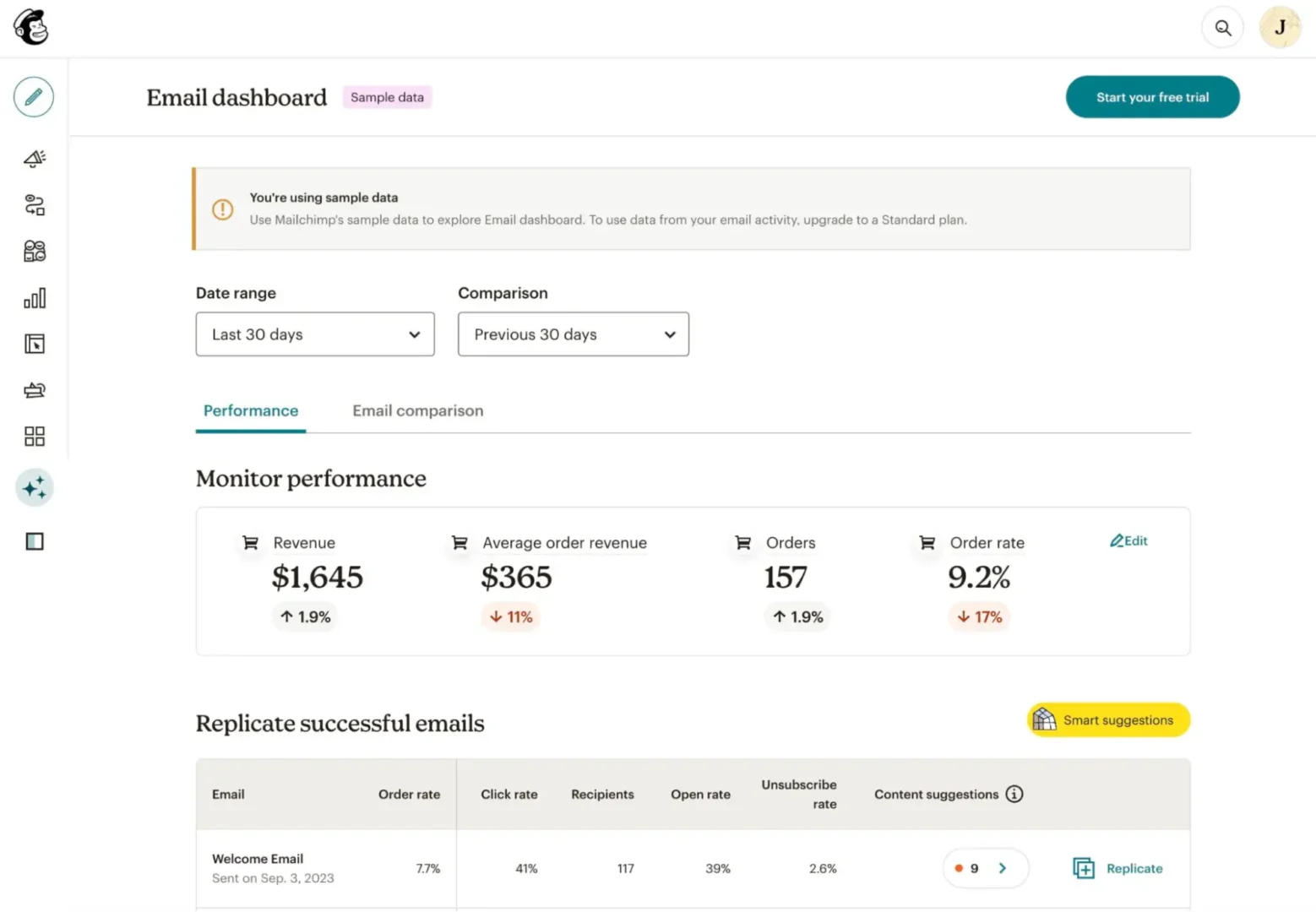
Easiest for: Small to mid-sized companies searching for user-friendly e-mail reporting and not using a steep studying curve.
Mailchimp provides available e-mail advertising and marketing reporting for small companies and rising groups with simple dashboards and trade benchmarking.
Mailchimp’s e-mail advertising and marketing reporting options:
- Marketing campaign functionality snapshots with open charge, CTR, and income monitoring
- Comparative reporting throughout campaigns to spot traits
- Click on maps and subscriber job timelines
- Trade benchmark comparisons
- Content material optimizer with AI-driven suggestions for topic strains and ship occasions
Mailchimp pricing (0-500 contacts):
- Unfastened: $0/month
- Necessities: $13/month
- Same old: $20/month
- Top rate: $350/month
*Word: Pricing for Mailchimp is according to the selection of contacts.
4. Salesforce Advertising Cloud
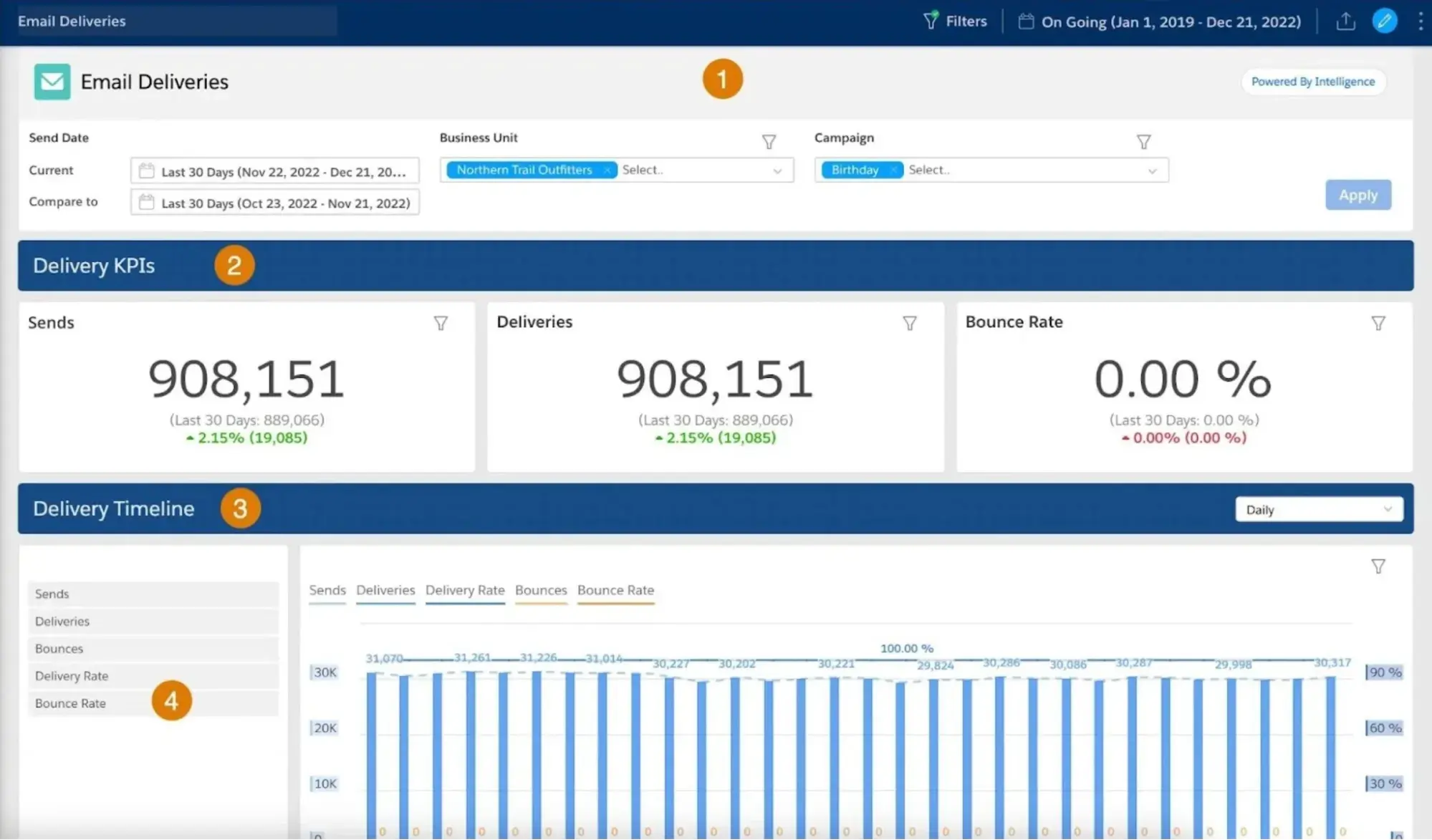
Easiest for: Undertaking organizations already invested in Salesforce who want e-mail reporting unified with gross sales and repair information.
Salesforce Advertising Cloud delivers enterprise-grade e-mail reporting with deep integration into the Salesforce CRM ecosystem.
Salesforce Advertising Cloud key e-mail advertising and marketing reporting options:
- Go-channel adventure reporting (connecting e-mail to SMS, push, and promoting touchpoints)
- Customized file builder with SQL question get admission to for complex research
- Deliverability tracking
- Account-based reporting
Salesforce Advertising Cloud pricing:
- Salesforce Starter: $25/month
- Advertising Cloud Enlargement Version: $1,500/month
- Advertising Cloud Complex Version: $3,250/month
5. ActiveCampaign
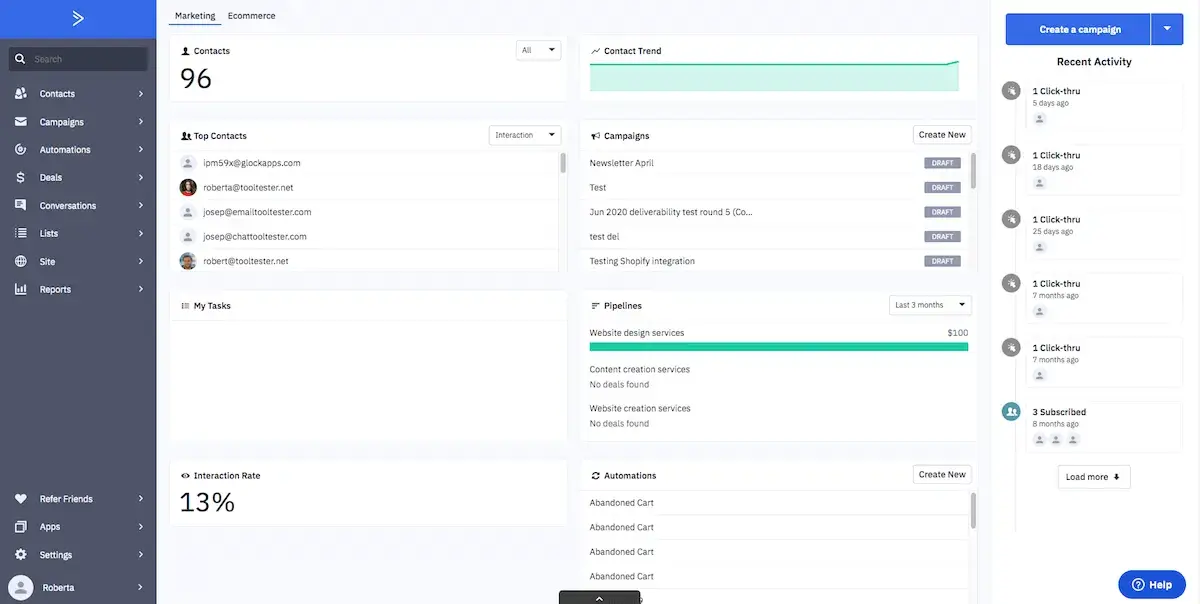
Easiest for: Groups working refined automation workflows who want visibility into sequence-level functionality.
ActiveCampaign combines e-mail reporting with automation functionality monitoring, appearing how particular person emails carry out inside complicated sequences.
ActiveCampaign’s key e-mail reporting options:
- Automation funnel reporting
- Web site monitoring integration connecting e-mail clicks to on-site conduct
- Deal attribution
- Break up checking out studies for topic strains, content material, and automation paths
- Engagement tagging
ActiveCampaign pricing (e-mail options handiest):
- Starter: $15/month
- Plus: $49/month
- Professional: $79/month
- Undertaking: $145/month
6. Litmus
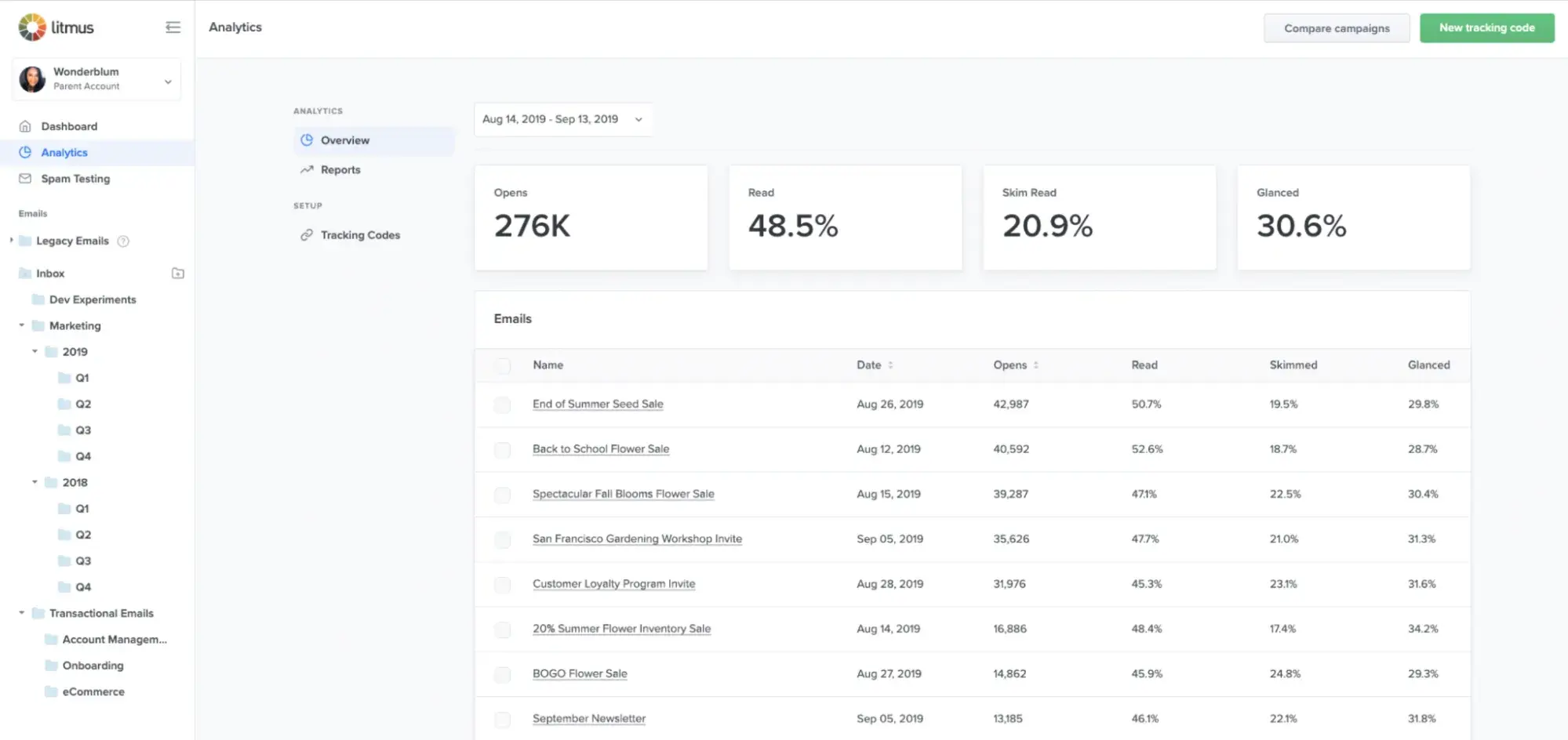
Easiest for: Groups prioritizing e-mail design optimization, accessibility compliance, and deep engagement high quality research.
Litmus specializes in e-mail analytics with an emphasis on rendering, accessibility, and engagement high quality metrics past opens and clicks.
Litmus’ key e-mail reporting options:
- E mail shopper and instrument reporting
- Learn time monitoring
- Engagement scoring (that categorizes subscribers as readers, skimmers, or deleters)
- Accessibility checking
- Unsolicited mail filter out checking out
- Customized pricing handiest, demo name required (see right here)
Steadily requested questions (FAQ) about e-mail advertising and marketing reporting
Which benchmarks will have to I consider once I’m in a distinct segment marketplace?
Trade-wide benchmarks ceaselessly omit the mark for area of interest markets because of restricted pattern sizes and viewers variability. Your maximum dependable e-mail advertising and marketing reporting benchmarks are inner.
On the other hand, I counsel development your individual baseline via:
- Monitoring your rolling 90-day moderate for each and every core metric (open charge, CTR, conversion charge, unsubscribe charge)
- Segmenting benchmarks via marketing campaign kind — promotional emails, newsletters, and transactional sends carry out in a different way
- Documenting seasonal patterns particular on your viewers
- Evaluating functionality throughout viewers segments slightly than in opposition to exterior information
Additionally, use third-party benchmarks directionally, no longer prescriptively. In case your area of interest persistently sees 15% open charges whilst trade studies counsel 25%, your inner development information issues greater than the distance.
How can I temporarily QA a unexpected drop in open or click on charges?
You most likely guessed this, however I’ll say it anyway: A unexpected functionality drop alerts a selected factor.
To paintings via it, use this diagnostic tick list:
Deliverability issues:
- Did your leap charge spike? Test for checklist high quality problems or a nasty information import
- Did junk mail lawsuits building up? Evaluation fresh content material for possible triggers
- Has your sending area or IP popularity modified? Use equipment like Google Postmaster to ensure
Target market or segmentation problems:
- Did you ship to a brand new or other phase than standard?
- Was once the checklist not too long ago wiped clean, taking out engaged contacts?
- Did you by accident come with a suppression checklist or exclude your maximum lively subscribers?
Content material or technical mistakes:
- Did the topic line include spam-trigger phrases or damaged personalization tokens?
- Have been hyperlinks damaged, inflicting clicks to head untracked?
- Did pictures fail to load, decreasing engagement cues?
Exterior elements:
- Did a significant match (vacation, information cycle) shift viewers consideration?
- Did Apple MPP or e-mail shopper updates have an effect on monitoring accuracy?
The highest reporting options in e-mail advertising and marketing tool — irrespective of which platform you’re the use of — will have to come with real-time indicators when metrics fall outdoor commonplace levels. On the other hand, in case you’re the use of HubSpot, its Reporting and Dashboard Device means that you can examine the underperforming ship in opposition to fresh campaigns facet via facet, serving to you isolate the variable that modified.
E mail advertising and marketing reporting ain’t so unhealthy in spite of everything
Your data-driven e-mail technique is inside succeed in; you simply have to begin measuring what issues.
Even though e-mail advertising and marketing has grown extra complicated, the basics of robust reporting stay unchanged. That stated, each a hit e-mail advertising and marketing reporting framework wishes:
- Transparent KPIs tied to trade results
- Constant monitoring and research
- Authentic connection between engagement and income
The correct e-mail advertising and marketing reporting equipment disclose whether or not your funding in campaigns interprets into pipeline enlargement, conversions, and buyer lifetime price — no longer simply self-importance metrics.
As I’ve already discussed (time and time once more all through this submit), e-mail advertising and marketing reporting calls for monitoring deliverability metrics, engagement charges, and income attribution. Whilst you construct this basis appropriately, each ship turns into a chance to be told, optimize, and end up have an effect on.
HubSpot’s Advertising Hub helps your e-mail reporting technique via:
- Connecting functionality to income via unified dashboards that tie opens and clicks to closed offers and pipeline price
- Segmenting engagement information dynamically (so you’ll analyze functionality via viewers conduct, lifecycle level, and marketing campaign kind)
- Integrating along with your CRM to centralize e-mail metrics along touch data, gross sales job, and attribution information
Whether or not you’re sending weekly newsletters or computerized nurture sequences, your emails deserve reporting that captures their true trade have an effect on.
Able to construct e-mail reporting that proves ROI? Get began with HubSpot’s E mail Advertising Device to create skilled campaigns, monitor the metrics that topic, and fix each ship to income — all from one platform.
