Get the fireworks able! With 7.0, WordPress enters a daring new generation.
It’s most likely the platform’s greatest jump lately. Now, you'll be able to collaborate together with your workforce in genuine time—identical to with Google Doctors—and leverage an “agentic structure” able to engage with Massive Language Fashions (LLMs).
However that’s just the start. Along with real-time collaboration, WordPress 7.0 refines the admin interface and introduces new blocks and developer equipment, such because the iframed publish editor and PHP-only blocks.
Make your self a cup of espresso and get comfy as a result of that is going to be a protracted and thrilling learn.
With 7.0, WordPress has taken a big evolutionary jump. Disregard the running a blog platform of its early days. Lately, WordPress is a collaborative platform natively able for synthetic intelligence.
This bold undertaking aimed to supply a competent, safe infrastructure enabling WordPress customers and plugin builders to engage with Massive Language Fashions (LLMs) in a standardized method.
The brand new architectural paradigm paves the way in which for “agentic WordPress”. It’s a shift in opposition to agentic usability the place WordPress is natively in a position to interacting with exterior AI Brokers by way of standardized, machine-friendly interfaces.
There’s so much to mention, however sooner than coming into the main points of the AI integration, listed here are some initial definitions.
WordPress AI structure: Fundamental ideas
To know the AI structure of WordPress 7.0, it is very important to spot 4 vital parts.
AI Shopper: A provider-agnostic AI infrastructure that gives a standardized method for WordPress PHP and JS code to engage with generative AI fashions. For the reason that AI Shopper is provider-agnostic, the gadget can function independently of any explicit AI service.
AI Supplier: The entity or corporate that develops, owns, and manages Massive Language Fashions (LLMs), equivalent to Anthropic, Google, and OpenAI.
Skills API: A brand new useful interface designed to permit plugins, topics, and WordPress core to reveal their functions in each human- and machine-readable codecs, enabling AI brokers to engage with WordPress options (e.g., developing posts or including an excerpt) in a structured method. That is what makes WordPress 7.0 natively agentic.
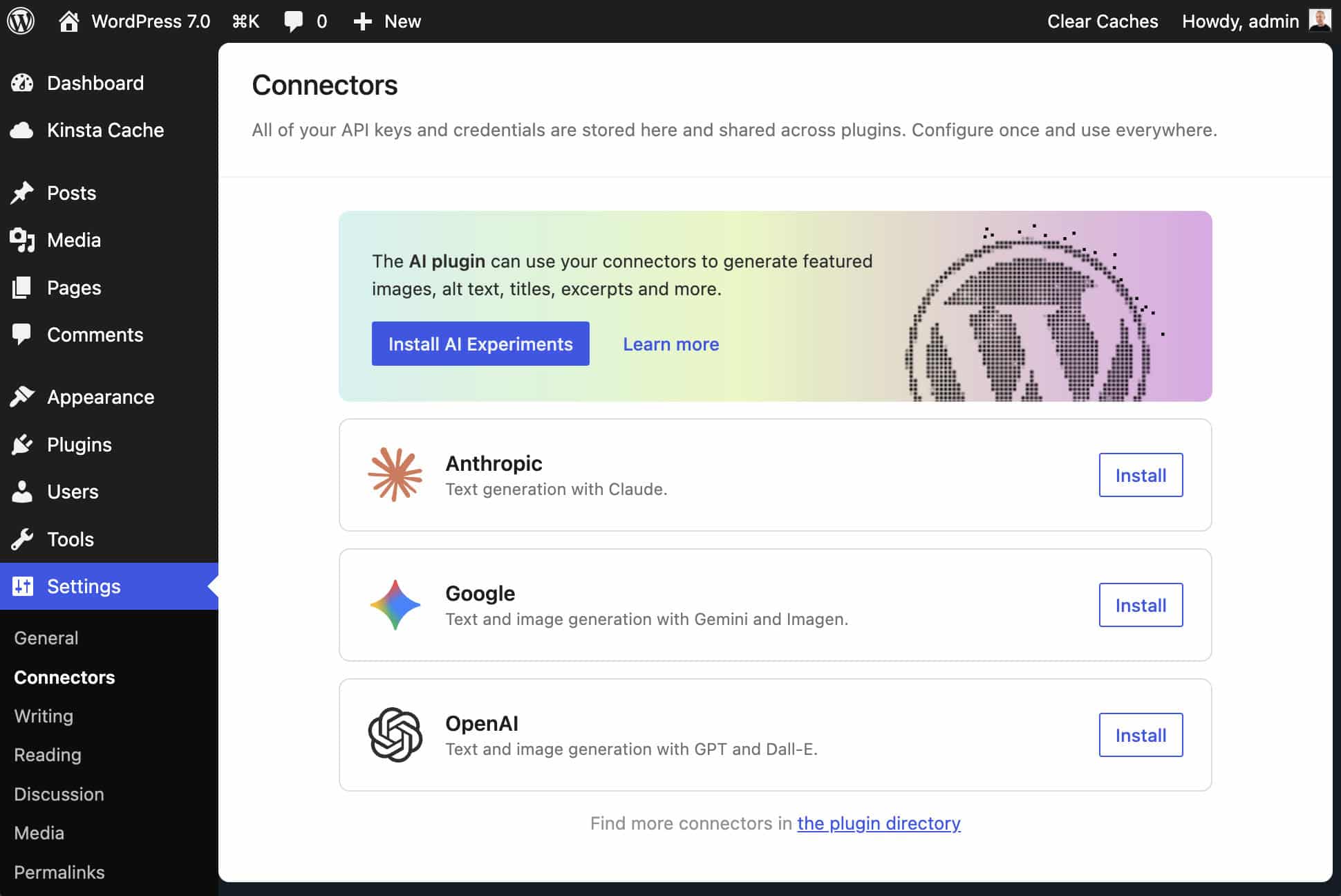
Connectors display in WordPress 7.0.
Connectors
Earlier variations of WordPress required a plugin for every AI service you sought after to make use of for your web site. WordPress 7.0 introduces a unified interface for managing AI Connectors beneath Settings > Connectors.
You not want to paste your API keys in more than one puts. Input your keys as soon as at the Connectors display, and all suitable plugins can use that connection during the AI Shopper.
Moreover, the brand new interface permits you to transfer between AI suppliers from a unmarried location with out risking breaking anything else.
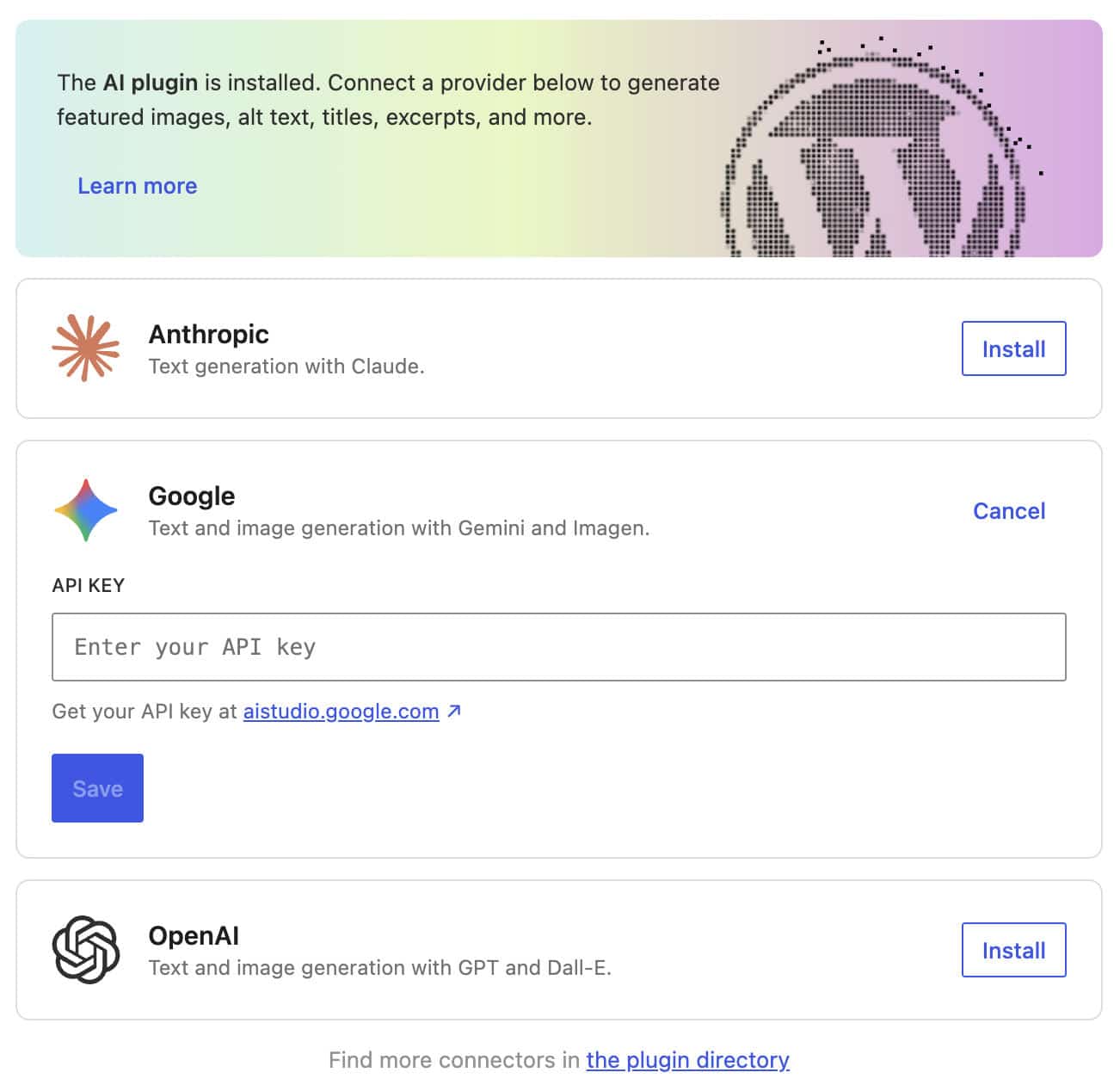
Within the Connectors interface, click on the Set up button to your AI service and input your API key. Save your settings, and also you’re able to engage with the AI service for your WordPress web site.
Including an API key within the Connectors interface
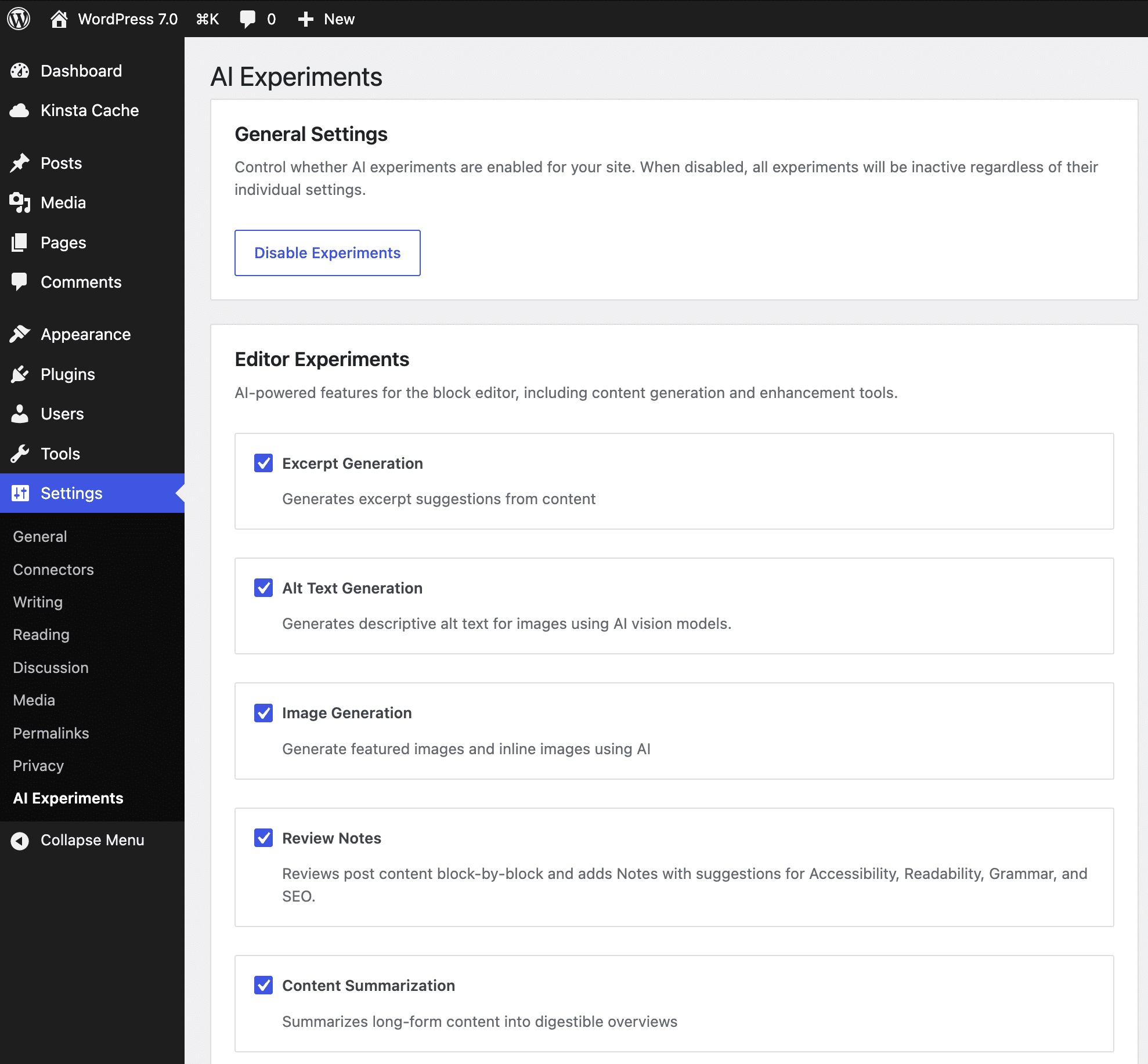
In case you’re now not positive the place to start, set up and turn on the AI Experiments plugin. This plugin permits you to upload AI-generated featured pictures, alt textual content, excerpts, and extra.
AI Experiments plugin settings
The brand new AI integration now not solely introduces a brand new consumer interface but additionally permits builders to sign up new AI suppliers by way of the Connectors API.
Builders can now sign up and organize connectors the usage of the brand new core lessons and strategies. After being registered, every connector seems as a card at the Connectors display.
The brand new API additionally supplies 3 public purposes.
wp_is_connector_registered(): Assessments if a connector is registered.
wp_get_connector(): Retrieves a unmarried connector’s records.
wp_get_connectors(): Retrieves all registered connectors.
As well as, the brand new motion hook wp_connectors_init lets you override the metadata of registered connectors.
Construction with the AI Shopper
The Connectors display supplies the AI interface. The AI Shopper is the engine beneath the hood—a unified abstraction layer that standardizes how WordPress interacts with AI. Whether or not it’s OpenAI, Anthropic, or Google Gemini, your code stays the similar. WordPress handles the interpretation, permitting you to concentrate on your software’s good judgment.
$ai_response = wp_ai_client_prompt( "Create a certified publish about WordPress" )
	->generate_text();

if ( is_wp_error( $ai_response ) ) {
	wp_die( $ai_response->get_error_message() );
}

echo wp_kses_post( $ai_response );
The next instance displays the way you outline the reaction schema to make the information able to make use of.
$taxonomy_schema = array(
	'kind'       => 'object',
	'homes' => array(
		'class' => array( 'kind' => 'string' ),
		'tags'     => array(
			'kind'  => 'array',
			'pieces' => array( 'kind' => 'string' )
		),
	),
	'required'   => array( 'class', 'tags' ),
);

$post_body = "Operating from a small tavern in Crete was once a game-changer. I noticed that Greece is changing into without equal hub for far flung staff in 2026.";

$json = wp_ai_client_prompt( "In accordance with this article, recommend probably the most suitable class and 3-5 related tags: $post_body" )
	->using_temperature( 0.1 )
	->as_json_response( $taxonomy_schema )
	->generate_text();

if ( is_wp_error( $json ) ) {
	go back $json;
}

$suggested_taxonomies = json_decode( $json, true );
On this code,
With as_json_response(), WordPress guarantees the output is natural JSON that conforms to the desired schema ($taxonomy_schema).
using_temperature() controls the AI’s reaction, making it kind of deterministic (or random). A low temperature (0.1) yields better precision, whilst a excessive temperature encourages a extra inventive reaction.
The $suggested_taxonomies array supplies the kinds and tags generated through the AI. You'll mechanically assign those in your publish.
A structured output guarantees predictable effects and gives a super structure to be used with the Skills API. As an example, the code above may well be used to mechanically create a publish with the desired class and tags.
The API doesn’t simply reinforce textual content. Because of the generate_image() manner, the AI Shopper too can generate pictures.
You'll request more than one effects with a unmarried name. As an example, you'll be able to request 3 textual content or symbol choices through passing a numeric price to the generate_text() or generate_image() strategies: calling generate_image( 3 ) returns 3 permutations of the similar symbol.
The API additionally supplies a collection of strategies that go back more information. Those strategies go back a GenerativeAiResult object containing wealthy metadata, equivalent to token utilization, the service, and the fashion that replied to the instructed:
generate_text_result()
generate_image_result()
convert_text_to_speech_result()
generate_speech_result()
generate_video_result()
As you'll be able to see, those strategies be offering a variety of extra options, together with reinforce for text-to-speech, speech, and video conversion.
Different API strategies come with:
using_max_tokens(): Prohibit the duration of the reaction (e.g. ->using_max_tokens( 500 ))
using_model_preference(): Set a selected fashion (e.g. ->using_model_preference( 'gemini-2.5-flash' ))
Actual-time collaboration (RTC) within the Block Editor is without doubt one of the maximum eagerly awaited options coming to the core. WordPress 7.0 introduces the facility to edit the similar publish or web page synchronously with more than one customers, very similar to a Google Document.
In essence, WordPress 7.0 transitions from a single-user platform to a multi-user one. This represents a basic shift for editorial groups running with WordPress.
Allow real-time collaboration on content material, together with posts, pages, and templates.
Allow offline modifying and information synchronization.
Supply an optimized building revel in so builders gained’t have to fret about collaborative modifying, for the reason that records is collaborative and synced through default.
This preliminary implementation introduces numerous new options affecting each editor customers and builders. Let’s dive in.
Actual-time collaboration within the Block Editor: What’s new for customers
In case you paintings in a workforce, you not need to watch for your colleague to go out the editor to study content material or make adjustments, as a result of you'll be able to now collaborate in genuine time on content material manufacturing.
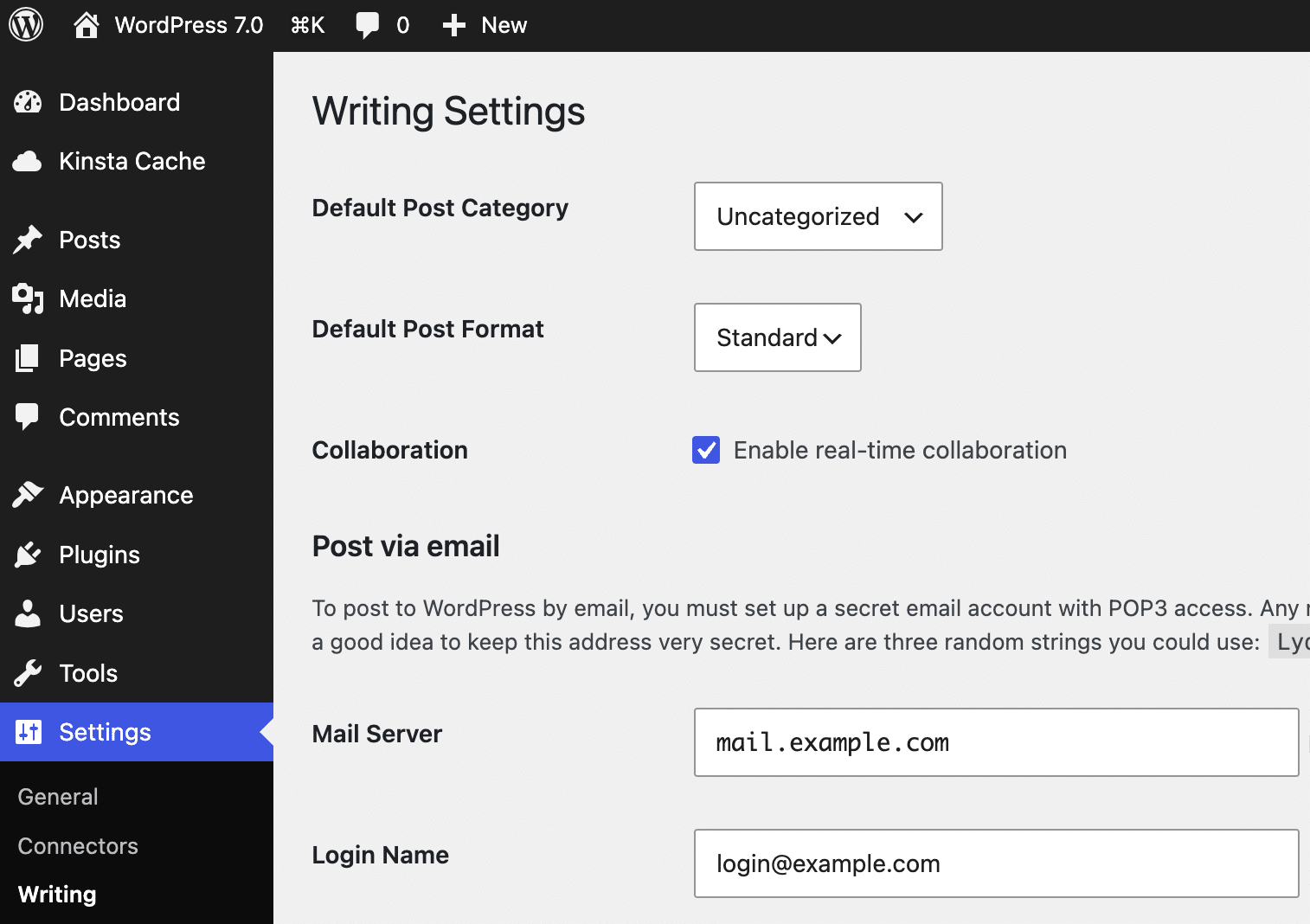
To begin, ensure that the Allow real-time collaboration choice is checked in Writing settings.
Allow real-time collaboration in WordPress 7.0.
Subsequent, open the publish editor with different contributors of your workforce, or open more than one classes with other customers, and get started exploring.
Those are the important thing issues of collaborative modifying.
Consciousness
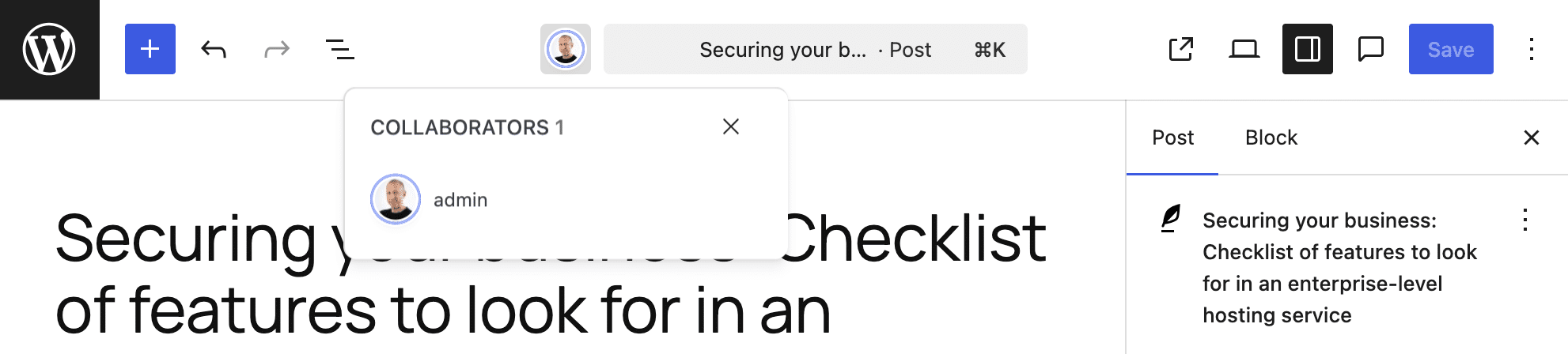
When more than one customers collaborate at the similar publish or web page, the avatars of the opposite customers seem within the best toolbar of the block editor.
Collaborator avatars seem on the best of the editor.
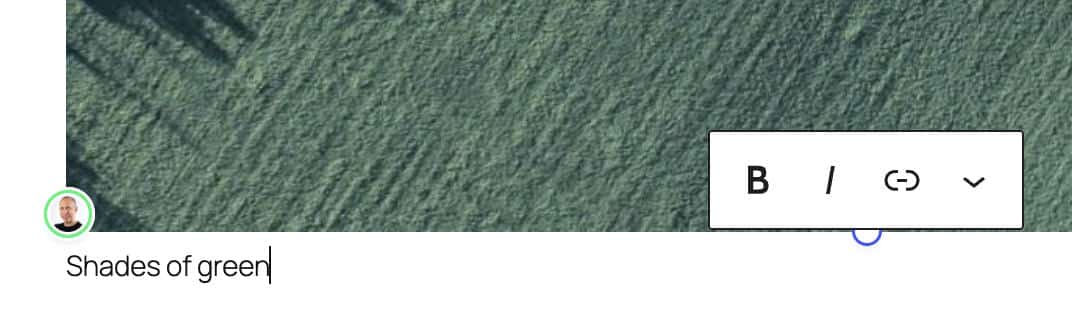
Adjustments made through every collaborator shall be seen to the remainder of the workforce in close to real-time. When a consumer is operating on a textual content part, their avatar may also seem within the block toolbar and transfer along side the cursor.
Some other consumer is modifying a Paragraph block.Some other consumer is modifying an Symbol block.
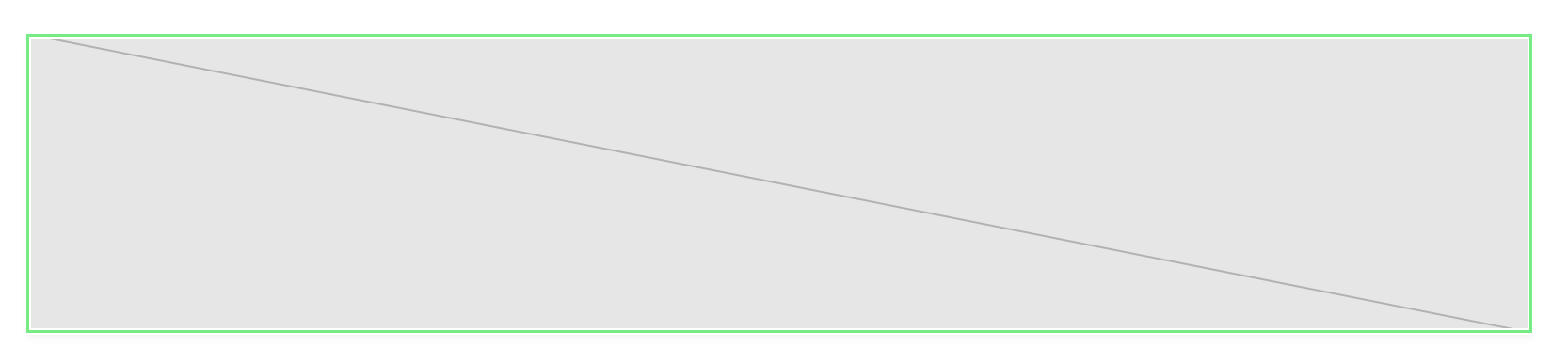
As well as, when a consumer provides a brand new block, it's going to be highlighted with a coloured border.
A picture block added through any other consumer seems with a coloured border.
Sync with the backend
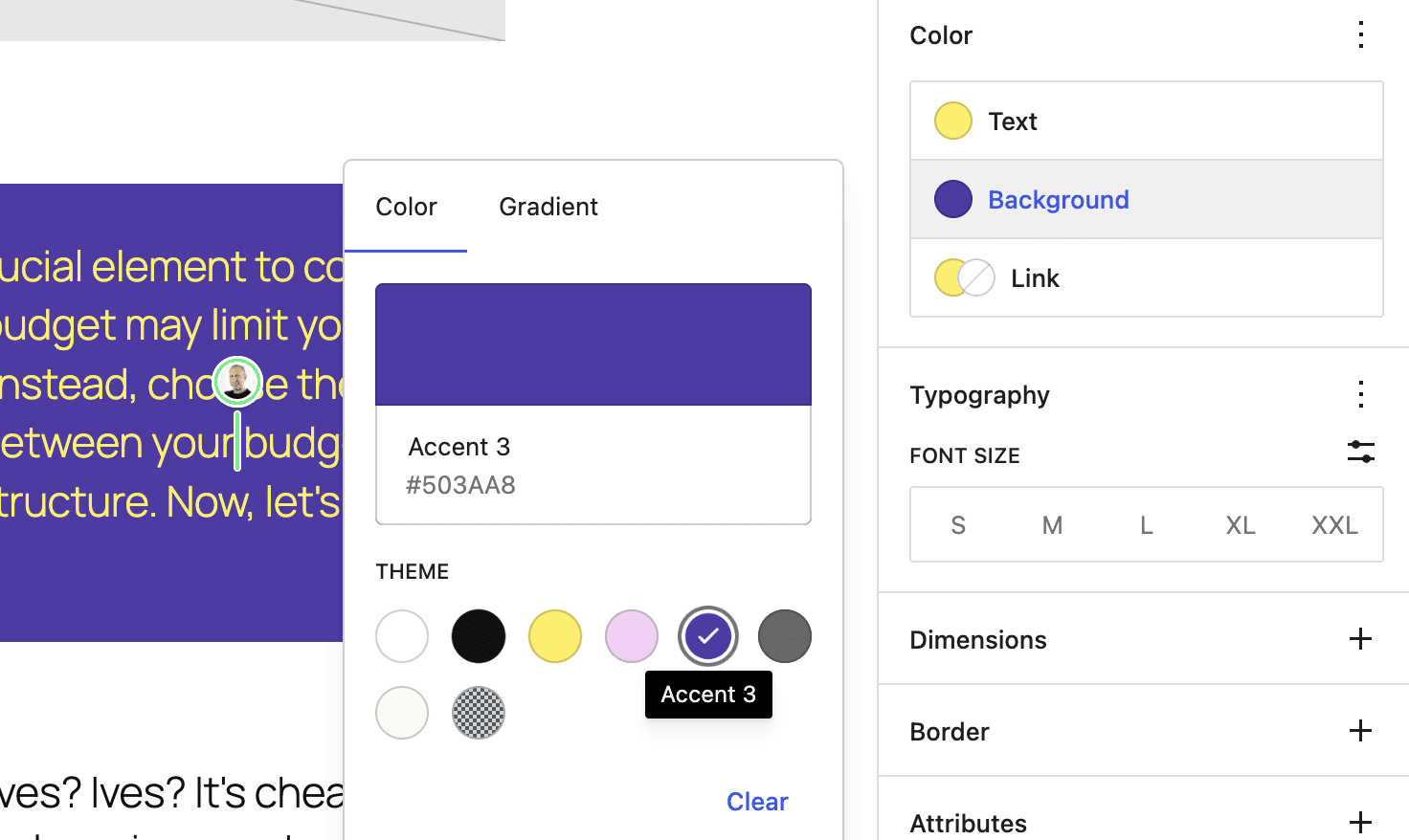
Because of Yjs integration, the gadget handles conflicts intelligently the usage of CRDT. If two customers paintings at the similar block or write the similar notice on the similar time, the gadget easily synchronizes the adjustments. Adjustments to dam homes, equivalent to colours and fonts, also are treated seamlessly.
Enhancing block taste settings in collaboration in WordPress 7.0.
Offline modifying and information syncing
The gadget works easily even while you’re offline. So, if you're running in spaces with gradual connections or move offline for a couple of mins, you'll be able to nonetheless write. When the sign returns, your adjustments shall be merged with others’ adjustments, and there shall be no undesirable overwrites.
Undoing an operation (Cmd+Z) will solely undo your newest adjustments, now not the ones made through your colleagues a 2d previous.
You gained’t have to fret about continuously saving your paintings to percentage it with others. Synchronization happens nearly in genuine time. Different customers who're hooked up and dealing at the similar content material will see your adjustments nearly immediately.
Actual-time collaboration within the Block Editor: An creation for builders
The brand new WordPress’ real-time collaboration gadget is based on Yjs, “a high-performance CRDT for development collaborative programs that sync mechanically.”
Yjs is a JavaScript library for managing records, equivalent to WordPress content material, that must be edited concurrently through more than one other people in genuine time. It's the sync engine for real-time collaboration within the editor.
It exposes its interior CRDT fashion as shared records varieties that may be manipulated at the same time as. Shared varieties are very similar to commonplace records varieties like Map and Array. They may be able to be manipulated, hearth occasions when adjustments occur, and mechanically merge with out merge conflicts.
Prior to WordPress 7.0, posts had been saved as a unmarried, static HTML string. Yjs makes use of the Delta Layout to explain the content material and adjustments made through every contributor. Deltas are a knowledge structure that describes paperwork with out the complexity of HTML, together with formatting knowledge.
As an example, imagine the textual content “Hi WordPress.” The next JSON object describes a transformation in font weight:
[
	{ "retain": 6 }, // Skip "Hello " (6 characters)
	{ "retain": 9, "attributes": { "bold": true } } // Apply bold to the next 9 characters
]
If a consumer provides “7.0” to the top of the string, the ensuing JSON object is as follows:
[
	{ "retain": 15 },
	{ "insert": " 7.0" }
]
The usage of Yjs and enforcing the Delta Layout gives a number of benefits:
It prevents all kinds of conflicts. If more than one customers are modifying the similar paragraph and even the similar notice, WordPress can determine who wrote every letter. This permits for granular revisions and paves the way in which for block-level revision restores.
It guarantees surgical precision and speedy synchronization. In case you edit a unmarried notice in a 20,000-word article, solely that small exchange is registered. This allows speedy synchronization of content material for all hooked up customers.
The similar means lets in block settings (equivalent to colours or structure choices) to be synchronized as shared map attributes.
Infrastructure and information shipping: Why your host issues
Having more than one customers paintings concurrently at the WordPress backend can pressure your web site’s assets, so it’s necessary to grasp what occurs at the back of the scenes right through collaborative modifying.
As discussed previous, the editor interface and the Yjs engine give you the basis for real-time collaboration. On the other hand, we haven’t but defined how records is carried between customers. This procedure is controlled through the Delivery Layer, which transmits your adjustments out of your browser to the server after which to different customers modifying the similar piece of content material.
HTTP Polling is valued for its common reinforce — it really works on each PHP server and shared webhosting atmosphere with out further setup — however it's much less environment friendly because of the excessive overhead of continuing HTTP requests.
WebSockets excel at useful resource potency and occasional latency, with adjustments showing immediately, however they require specialised device that's not to be had on elementary hosts.
WebRTC is extremely environment friendly for small teams of customers as a result of browsers ship records at once to each other with out a central server for synchronization. On the other hand, it's regarded as unreliable.
In the long run, the verdict was once made to enforce the HTTP Polling resolution. Whilst this guarantees collaboration on any server, it comes with upper overhead and is the least “real-time” choice. WordPress is designed to run on the entirety from entry-level shared webhosting to giant endeavor infrastructures, which is why this resolution was once selected.
On the other hand, the shipping layer is designed to get replaced or prolonged. Web hosting suppliers or specialised plugins can substitute the default polling gadget with a high-performance WebSocket service.
New blocks and design equipment
WordPress 7.0 introduces new blocks and design equipment that may considerably toughen the modifying revel in. Right here’s what’s new and the way your inventive workflows exchange.
New Breadcrumbs block
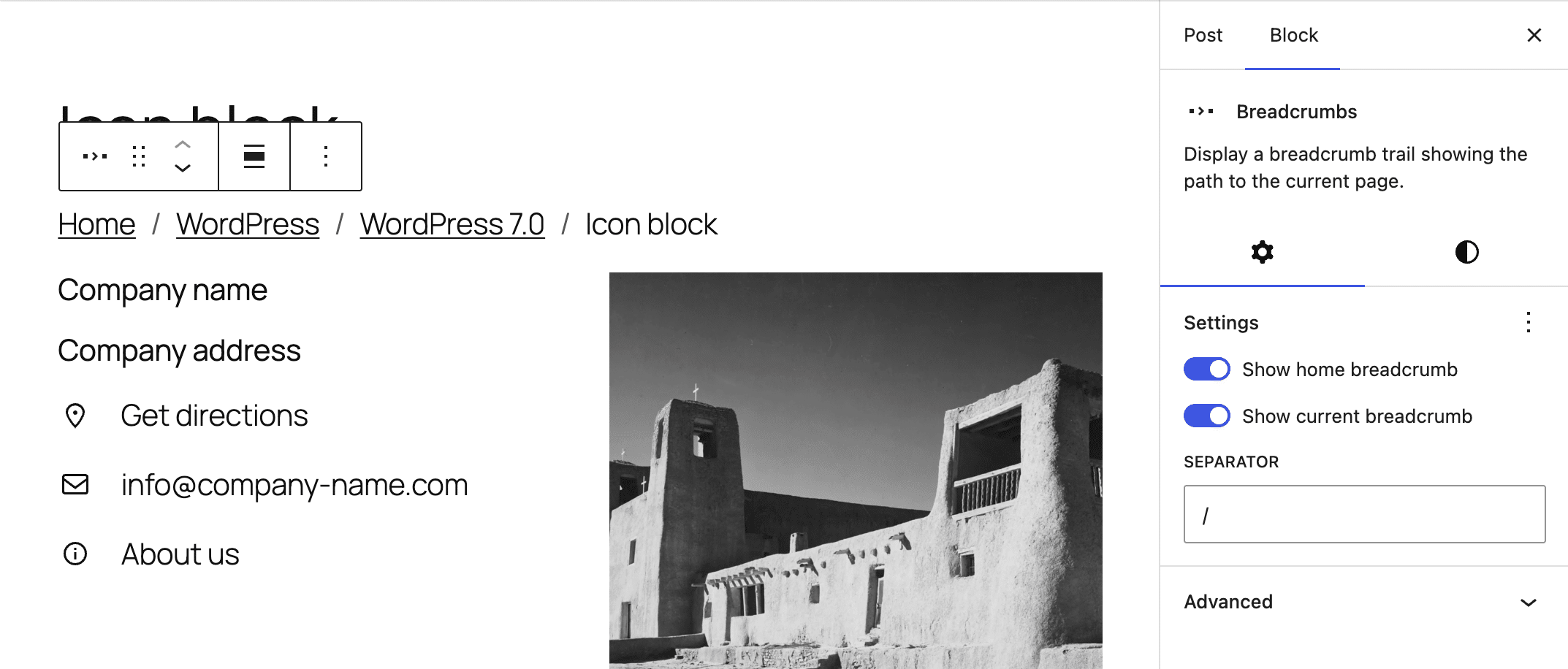
WordPress 7.0 introduces a brand new Breadcrumbs block that displays the web page’s displayed hierarchy.
At its core, the brand new block features a dynamic part that queries the WordPress records construction to mechanically determine the present location of web site audience in accordance with the web page hierarchy (father or mother/kid) or publish taxonomy phrases.
Within the symbol underneath, the Breadcrumbs block shows the class hierarchy of an ordinary weblog publish.
The Breadcrumbs block shows the publish’s class hierarchy.
The Breadcrumbs block additionally helps the Question Loop. While you upload a Breadcrumbs block to a Question Loop block, the block shows the trails of particular person posts extracted from the question.
The Breadcrumbs block has some configuration choices that enable you:
Display/disguise the hyperlink to the house web page as the start line of navigation.
Display/disguise the present breadcrumb.
Trade the breadcrumb separator.
Display breadcrumbs at the house web page.
Desire publish hierarchy (default) or taxonomy time period hierarchy.
The Breadcrumbs block helps Gutenberg design equipment and introduces two filters that allow builders to programmatically keep watch over breadcrumbs.
The brand new block_core_breadcrumbs_post_type_settings filter out lets in builders to specify which taxonomy and time period will have to be utilized in breadcrumbs when a publish has more than one taxonomies or phrases.
Within the following instance, the filter out is used to show tags as a substitute of classes:
add_filter( 'block_core_breadcrumbs_post_type_settings', serve as( $settings, $post_type ) {
	if ( 'publish' === $post_type ) {
		$settings['taxonomy'] = 'post_tag';
	}
	go back $settings;
}, 10, 2 );
The block_core_breadcrumbs_items filter out we could builders alter, upload, or take away pieces from the overall breadcrumb path sooner than it's rendered. Listed below are some use instances:
Exchange the House icon with a picture (an SVG, your corporate emblem, and many others.) to avoid wasting house or make the block output extra in line with your web site’s branding.
Shorten the name of a publish within the breadcrumbs if it’s too lengthy.
Inject tradition classes or phrases, for instance, through forcing a step into the breadcrumb path.
The next code makes use of the brand new filter out to truncate breadcrumb labels when the duration exceeds 20 characters:
add_filter( 'block_core_breadcrumbs_items', serve as( $pieces ) {
	foreach ( $pieces as $key => $merchandise ) {
		if ( mb_strlen( $merchandise['label'] ) > 20 ) {
			// Truncate the string to 17 characters and append '...'
			$pieces[$key]['label'] = mb_strimwidth( $merchandise['label'], 0, 17, '...' );
		}
	}
	go back $pieces;
}, 10, 1 );
For a deeper evaluate of Breadcrumbs block filters and different code examples, see the dev observe.
New Icon block
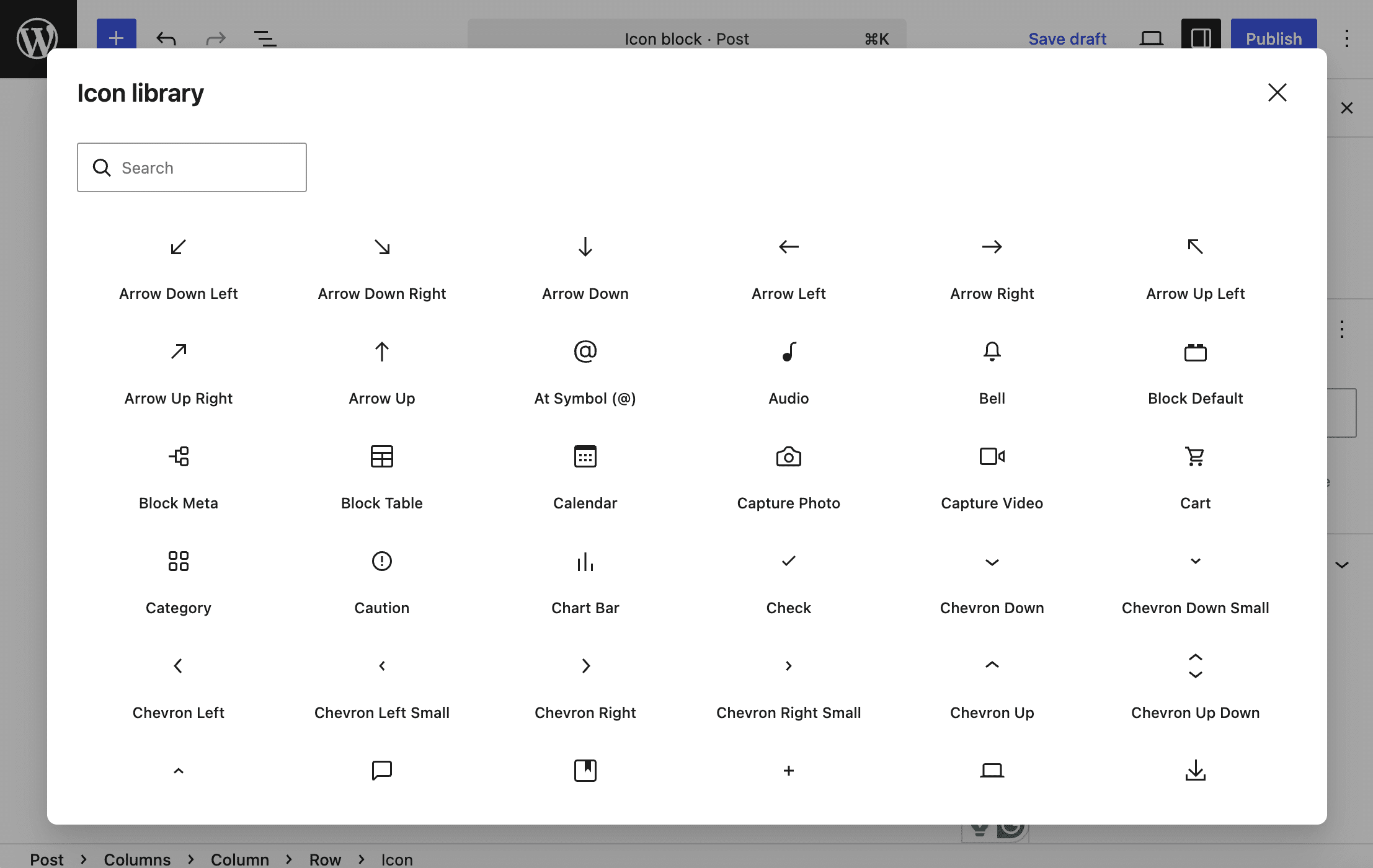
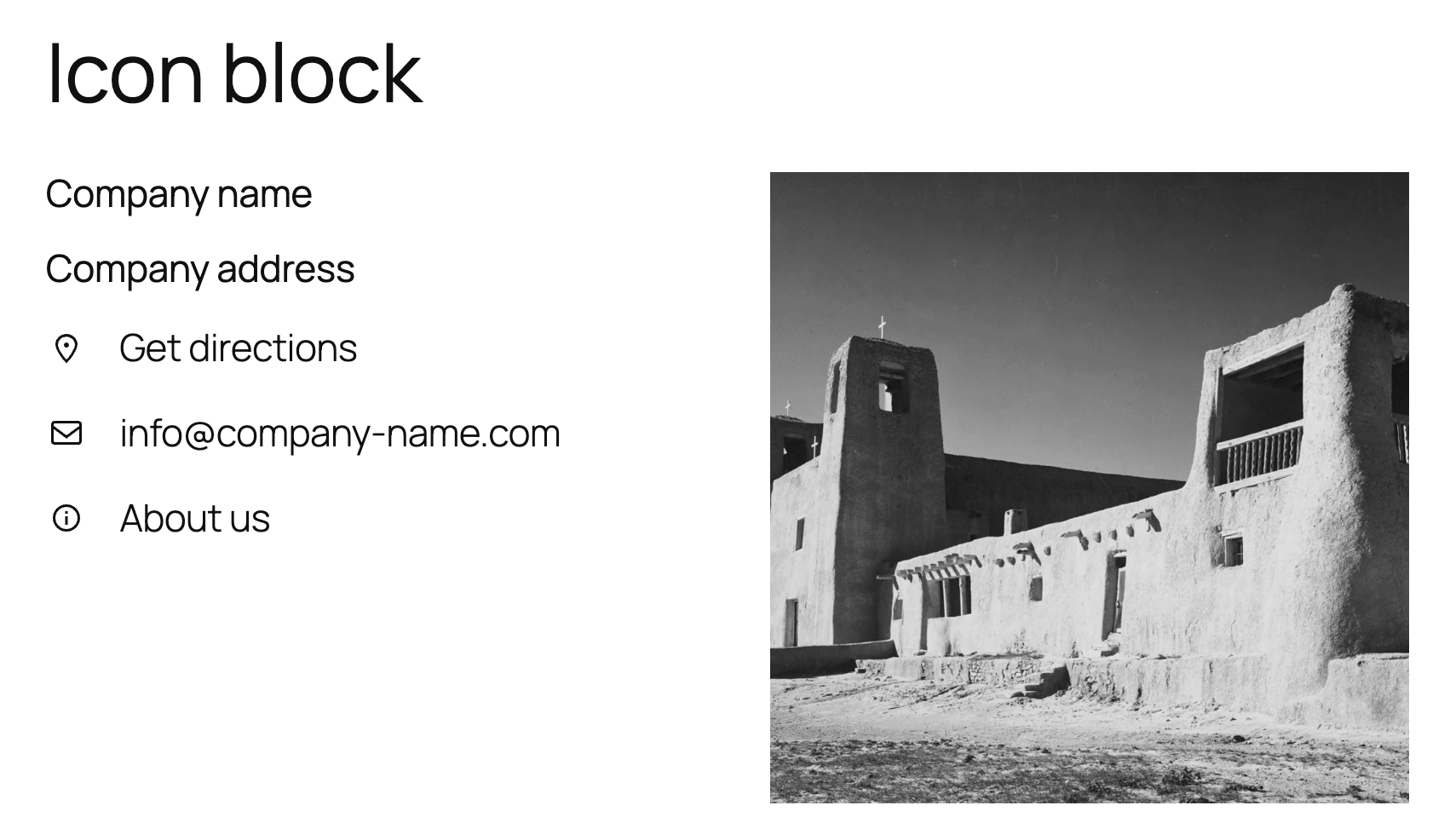
A brand new Icon block permits you to upload SVG icons into your content material. The brand new block targets to supply a local usual resolution for managing markup and making sure accessibility consistency, with out requiring the set up of third-party plugins simply so as to add a couple of icons.
Lately, the brand new Icon block comes with a default set from which you'll be able to choose your icons. On the other hand, there are plans so as to add the facility for customers to sign up third-party icon units one day.
The Icon library in WordPress 7.0
The block is in accordance with a brand new server-side SVG Icon Registration API. This guarantees that updates to the icon registry are propagated to all customers with out mistakes. The creation of the brand new Icon block is paired with a brand new /wp/v2/icons API endpoint.
Including icons in your content material is beautiful simple with the brand new core Icon block.
Customizable navigation overlays
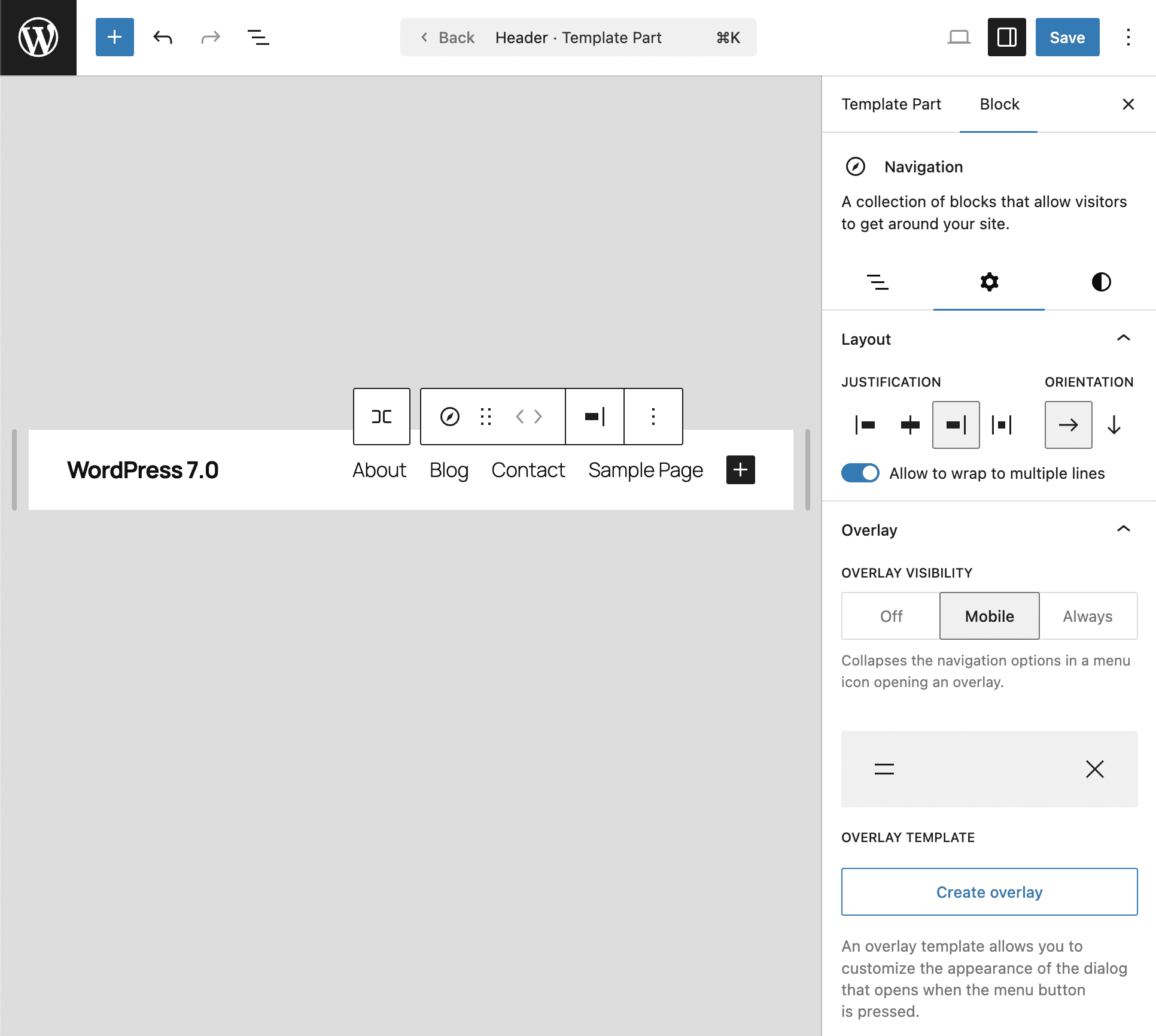
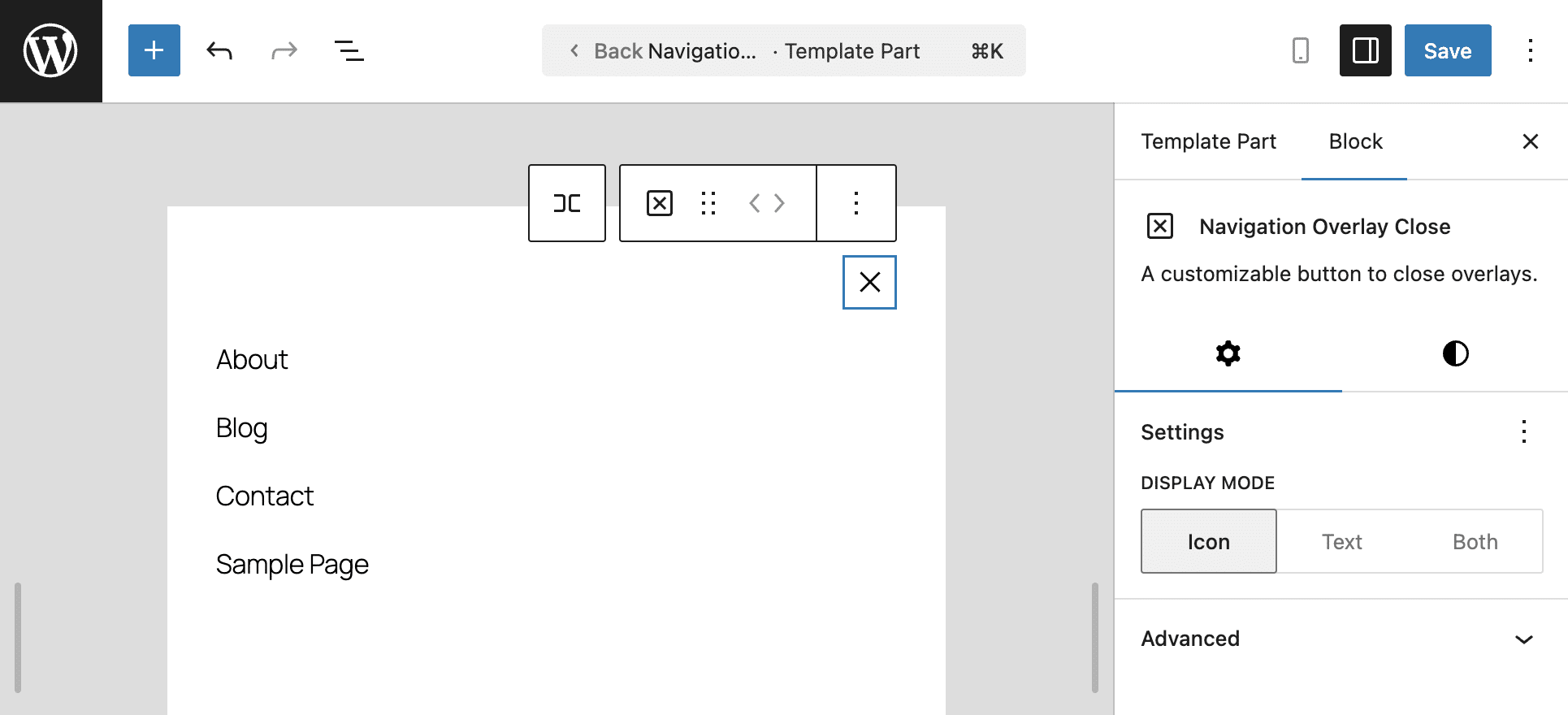
Prior to WordPress 7.0, cellular navigation menus had been mounted, and also you couldn’t exchange the design, structure, or default content material. WordPress 7.0 introduces customizable Navigation Overlays, providing you with complete keep watch over over your navigation menus. You'll create a menu overlay the usage of blocks and patterns, and a brand new Navigation Overlay Shut block so as to add an in depth button any place within the navigation overlay.
Technically, navigation overlays are template portions, and when you’ve created yours, you’ll to find it within the Patterns phase of the Website online Editor sidebar. Each and every overlay is assigned to a Navigation block, however you'll be able to assign more than one Navigation blocks to the similar overlay.
Principally, they’re a block canvas that may cling any form of block. You'll upload a Navigation block, however it’s utterly as much as you which ones blocks you upload. They may well be social icons, a seek box, your web site emblem, and a lot more.
Navigation overlays can solely be used within the Navigation block. To forestall unintended use in different portions of a template, they're excluded from the block inserter.
Create a Navigation Overlay in WordPress 7.0.
You'll create a tradition navigation overlay from the Overlays phase within the Navigation block sidebar within the Website online Editor.
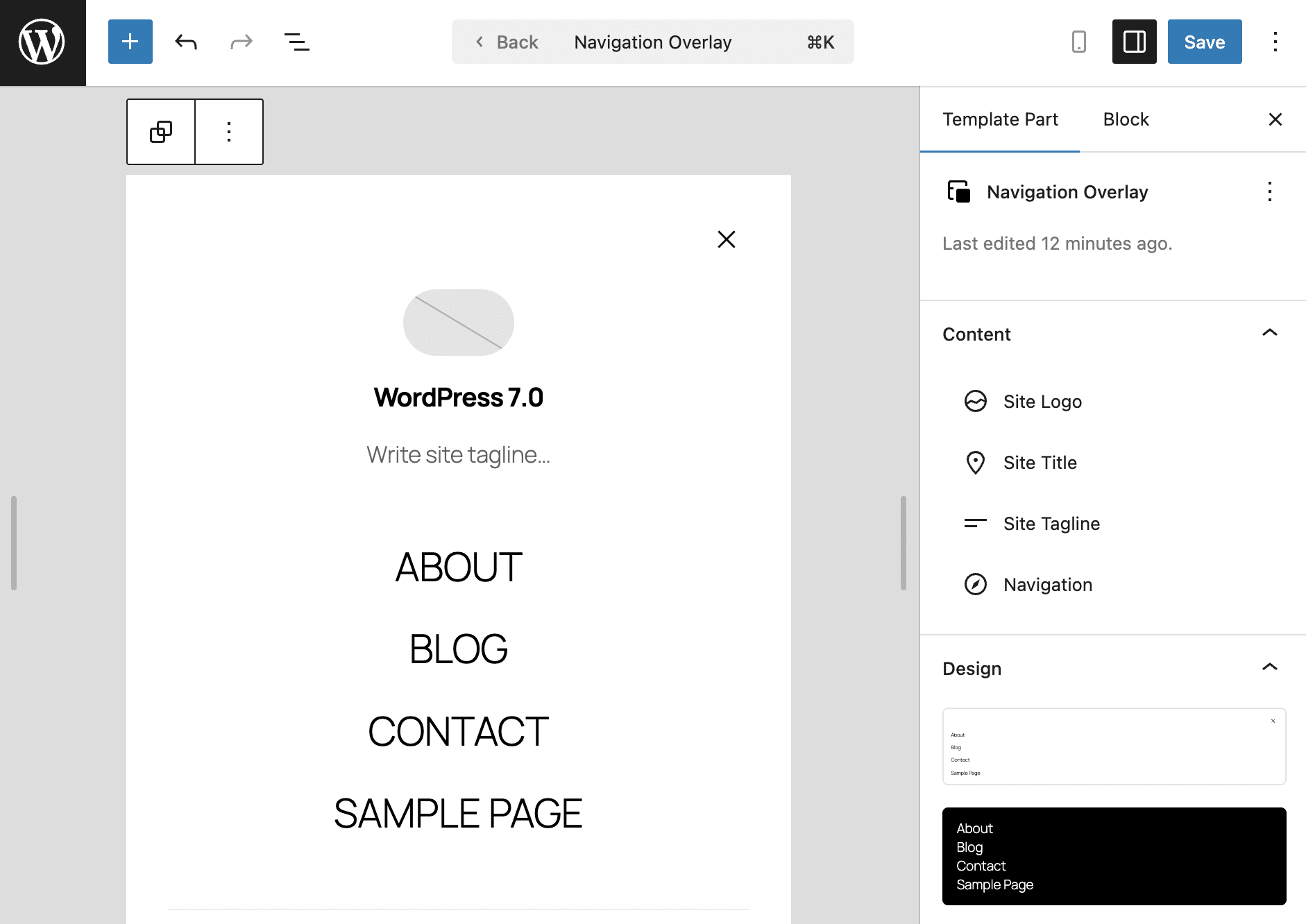
When you choose the Navigation block, the template phase sidebar shows the Navigation Overlay settings divided into two sections. The Content material phase displays the block varieties incorporated within the overlay, whilst the Design phase gives a variety of predefined designs.
Navigation Overlay template phase settings.
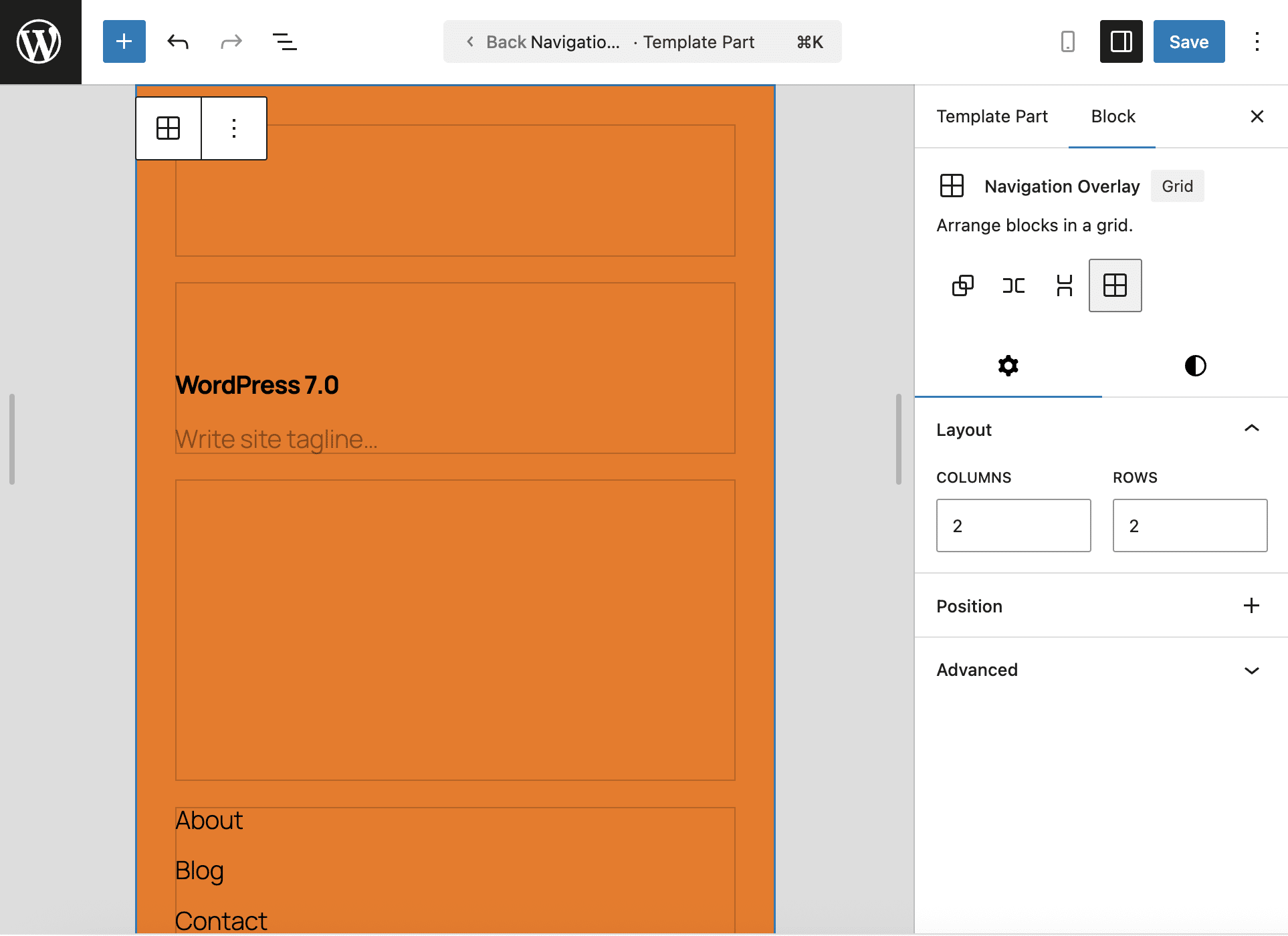
The block sidebar is split into two tabs, one for settings and the opposite for kinds for the Navigation Overlay template phase.
Configuring blocks in a Navigation Overlay.
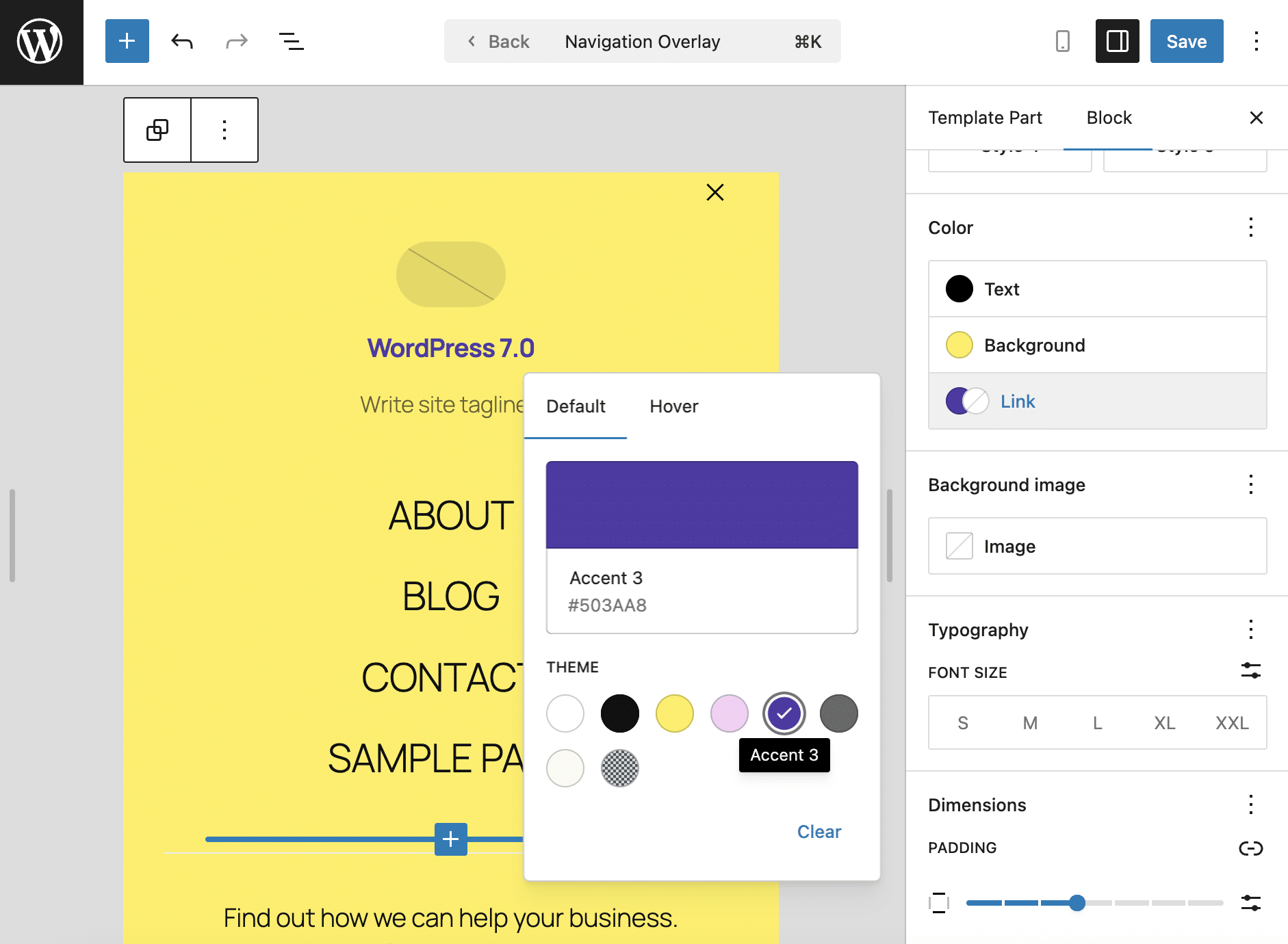
The Types tab of the Navigation Overlay block tab is the place you'll be able to customise the illusion of your overlay through atmosphere colours, background symbol, typography, measurement, border, and shadow.
Navigation Overlay taste settings
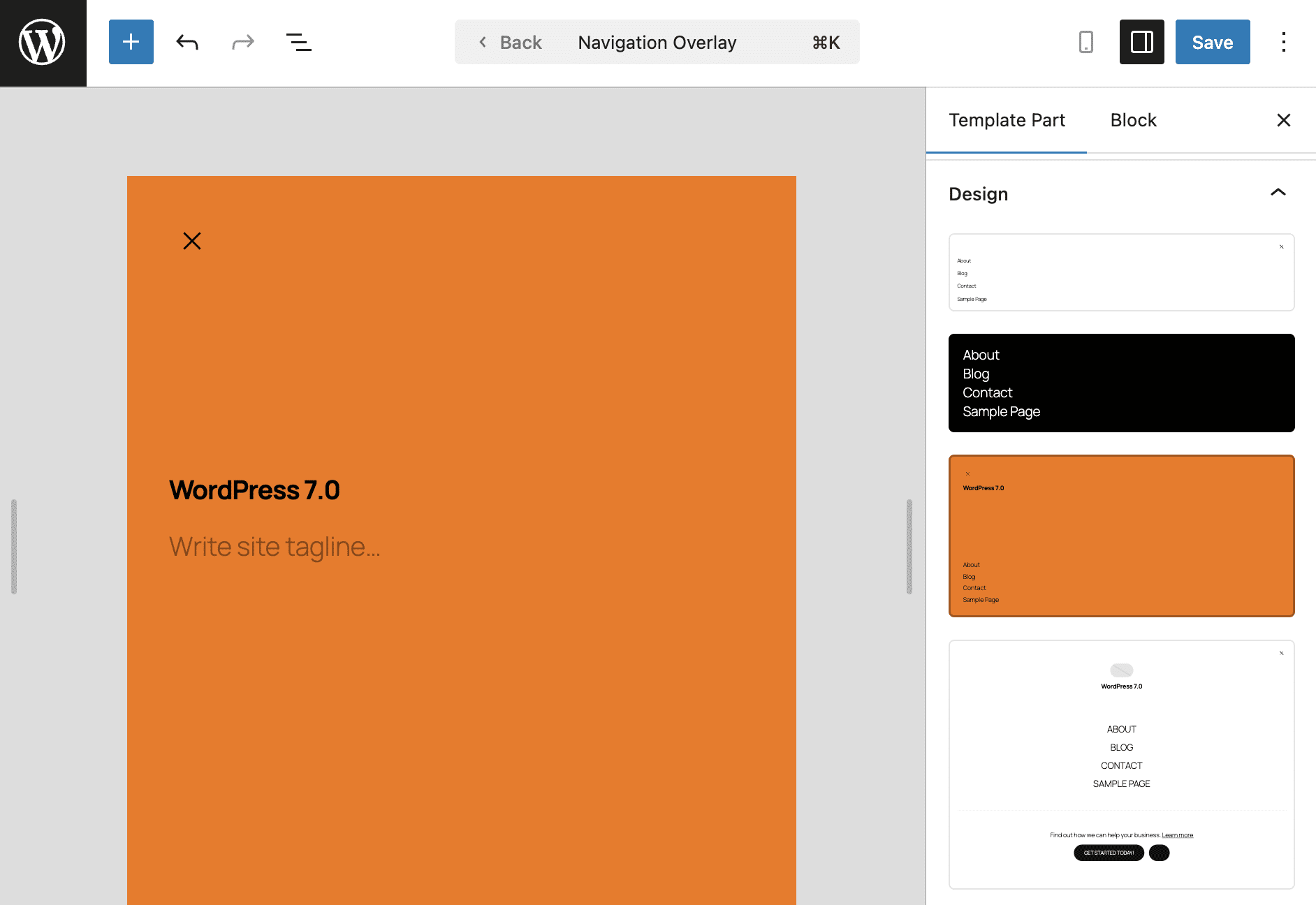
Theme builders can simply upload pre-built navigation overlays to their topics. You'll supply each a default overlay template phase (the overlay itself) and a collection of overlay patterns (pre-built designs that seem when modifying a navigation overlay).
The Designs phase of the Template Phase sidebar supplies a collection of pre-built patterns.
A number of new additions to the Paragraph block be offering better flexibility in textual content styling.
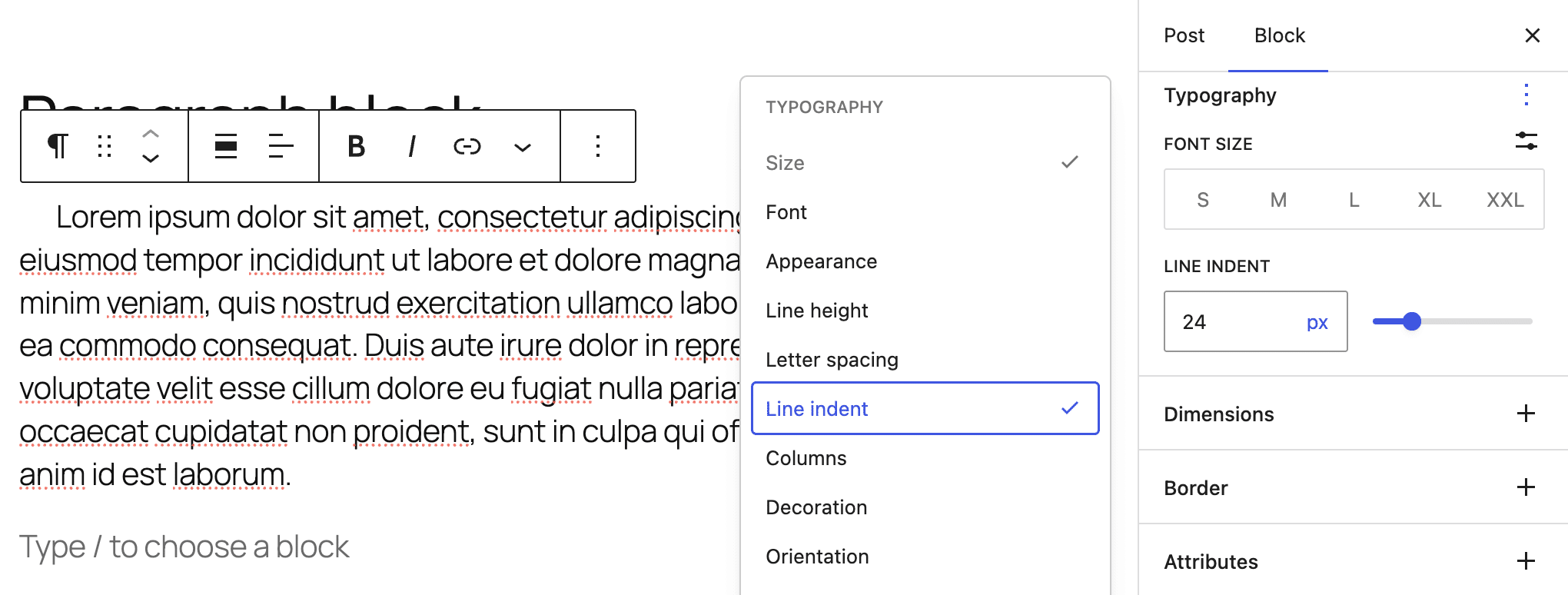
First, a brand new choice within the Typography settings permits you to set the first-line indent.
Line indent keep watch over in WordPress 7.0
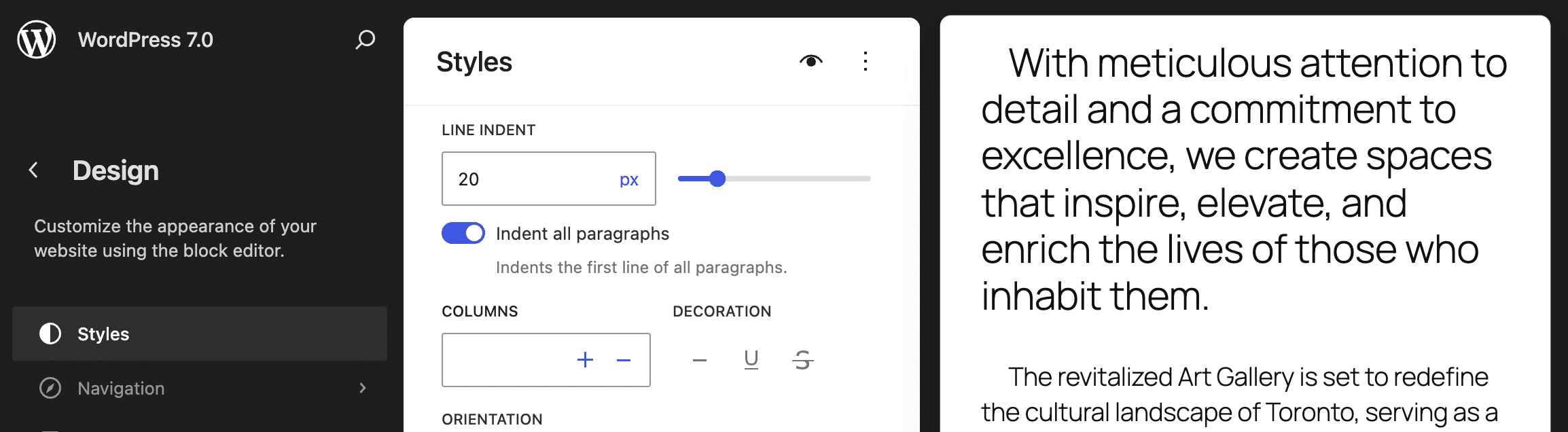
You'll keep watch over textual content indent for particular person paragraphs, or you'll be able to use it on all paragraphs by way of the International Taste settings beneath Editor > Types > Blocks > Paragraph.
Line indent keep watch over in International Types
Theme builders can allow/disable and granularly keep watch over line indent inside the theme.json report the usage of the brand new textIndent assets.
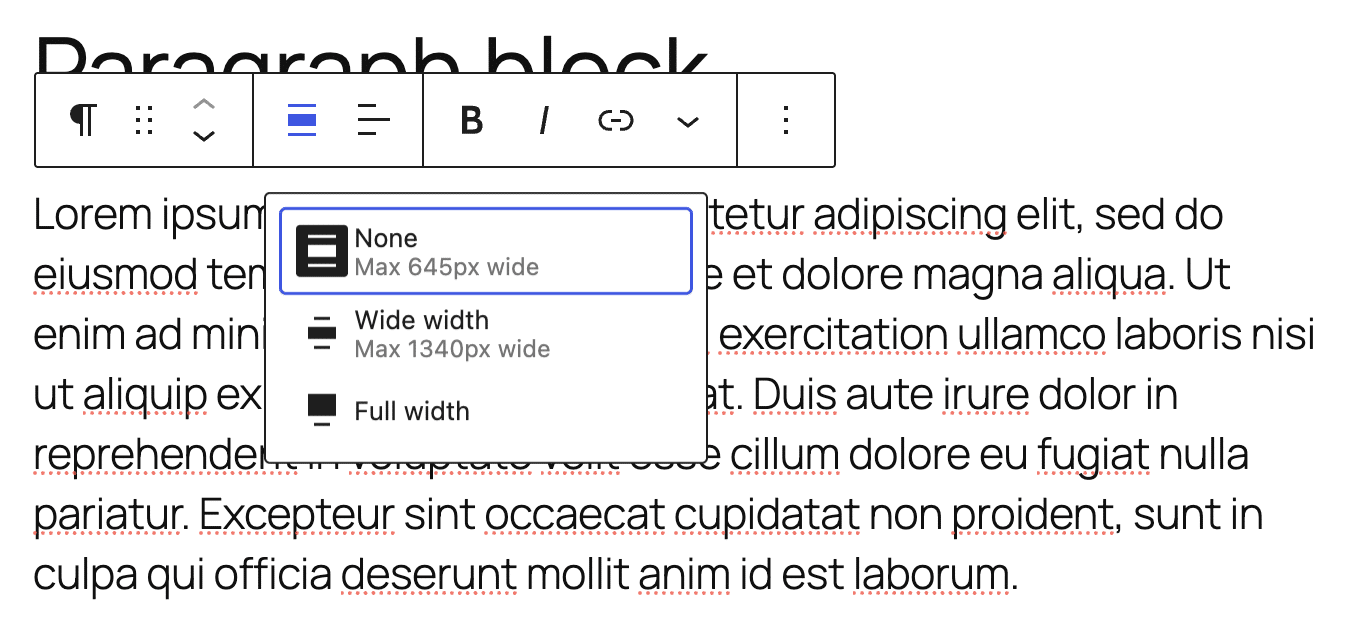
The Paragraph block now additionally helps huge and whole alignment. The next symbol displays the brand new Align keep watch over.
The Paragraph block now helps huge and whole alignment.
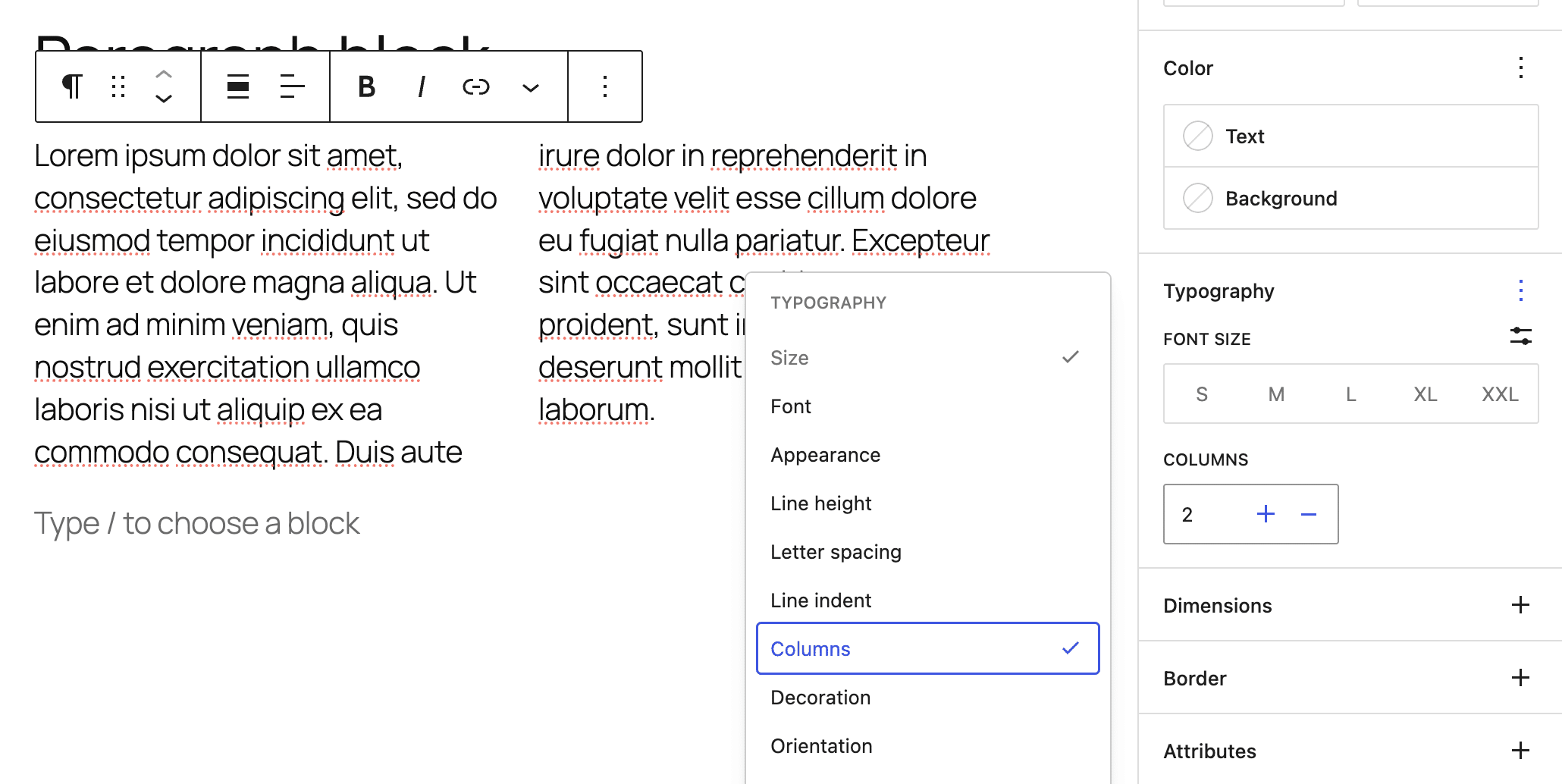
Some other helpful addition to the Paragraph block is the reinforce of textual content columns. This new choice is to be had beneath the Typography settings within the block sidebar.
The Paragraph block now helps textual content columns.
Embedded background movies for the Duvet Block
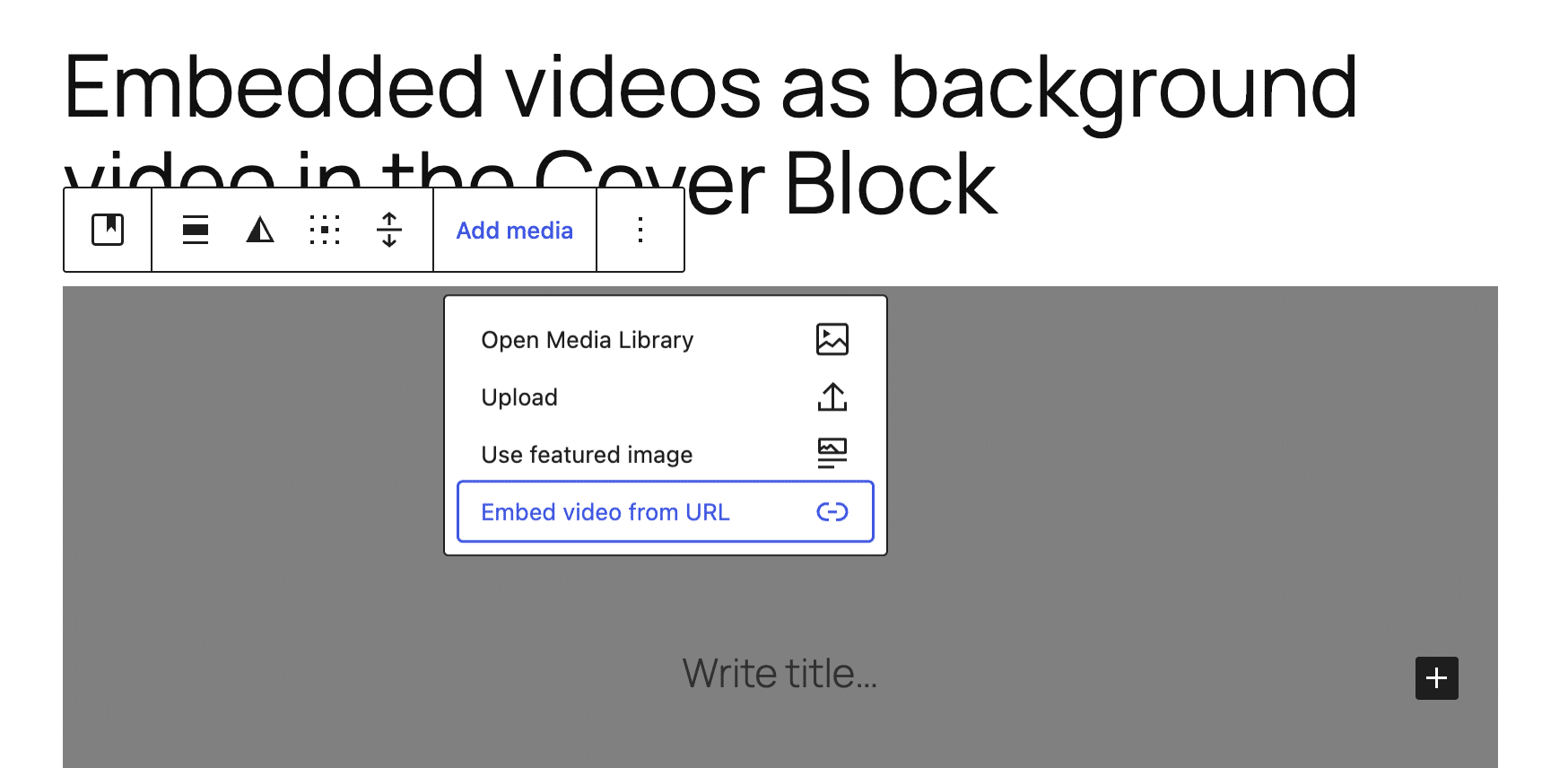
With WordPress 7.0, you'll be able to use embedded movies, equivalent to the ones from YouTube or Vimeo, as background movies for the Duvet block. Prior to now, you have to solely use uploaded movies.
So as to add a hosted video, click on Upload Media within the Duvet block toolbar, then choose Embed Video from URL.
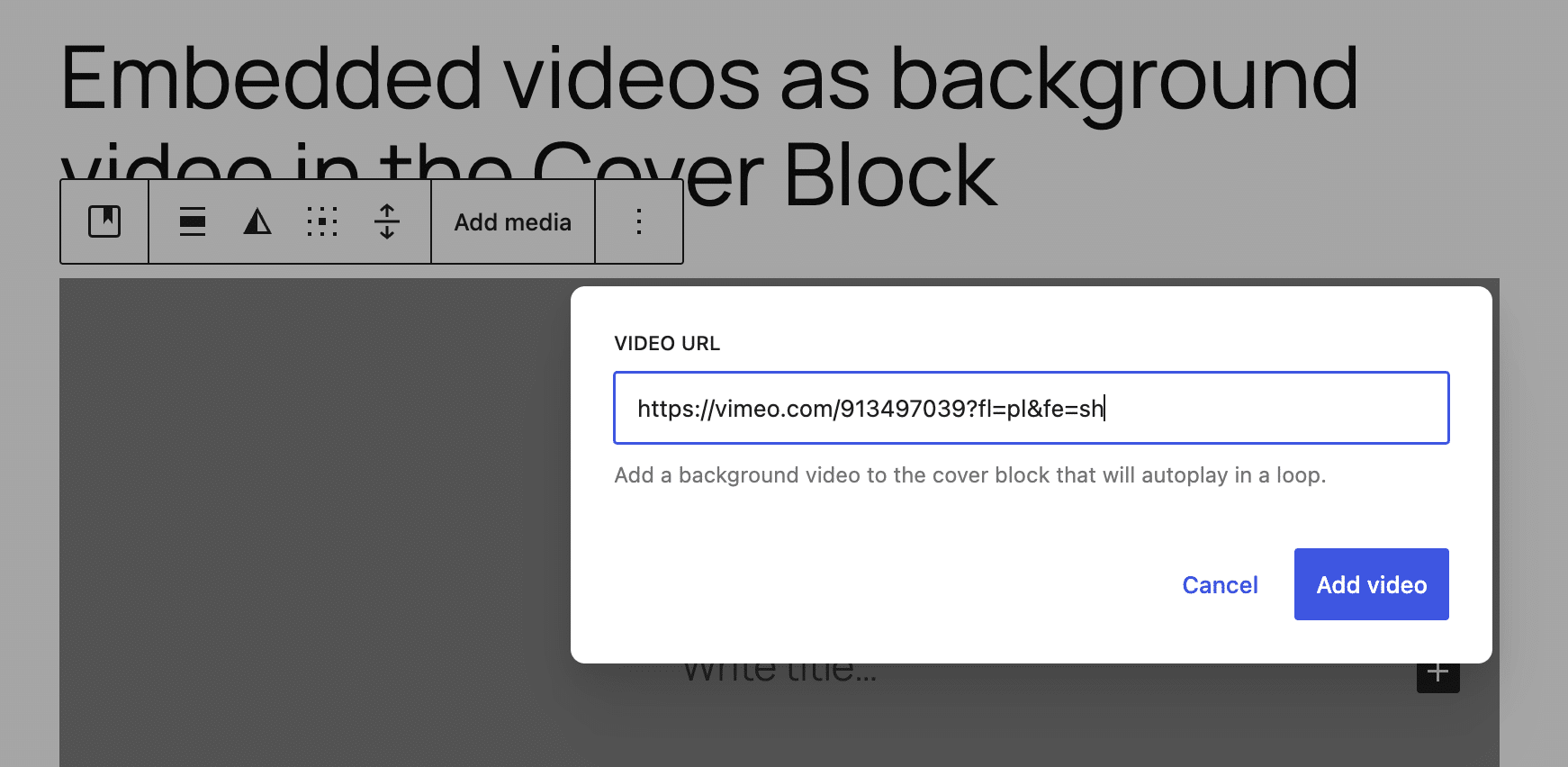
Input video URL for the Duvet block.
You are going to then be requested to go into the video URL.
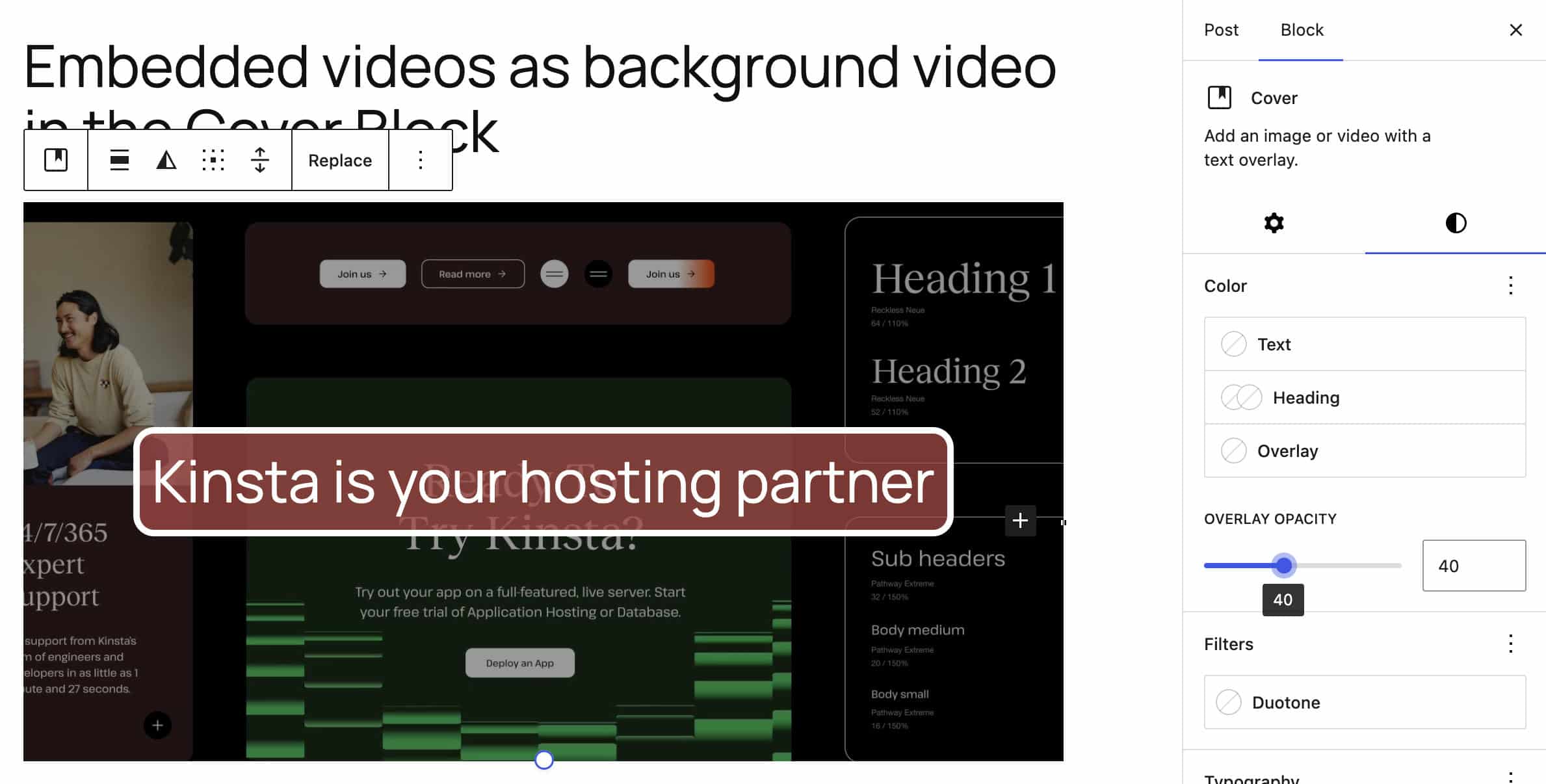
Embedded video as background video for the Duvet Block.
Your embedded video will seem because the background video to your Duvet block, each within the editor and at the frontend.
Responsive Grid block
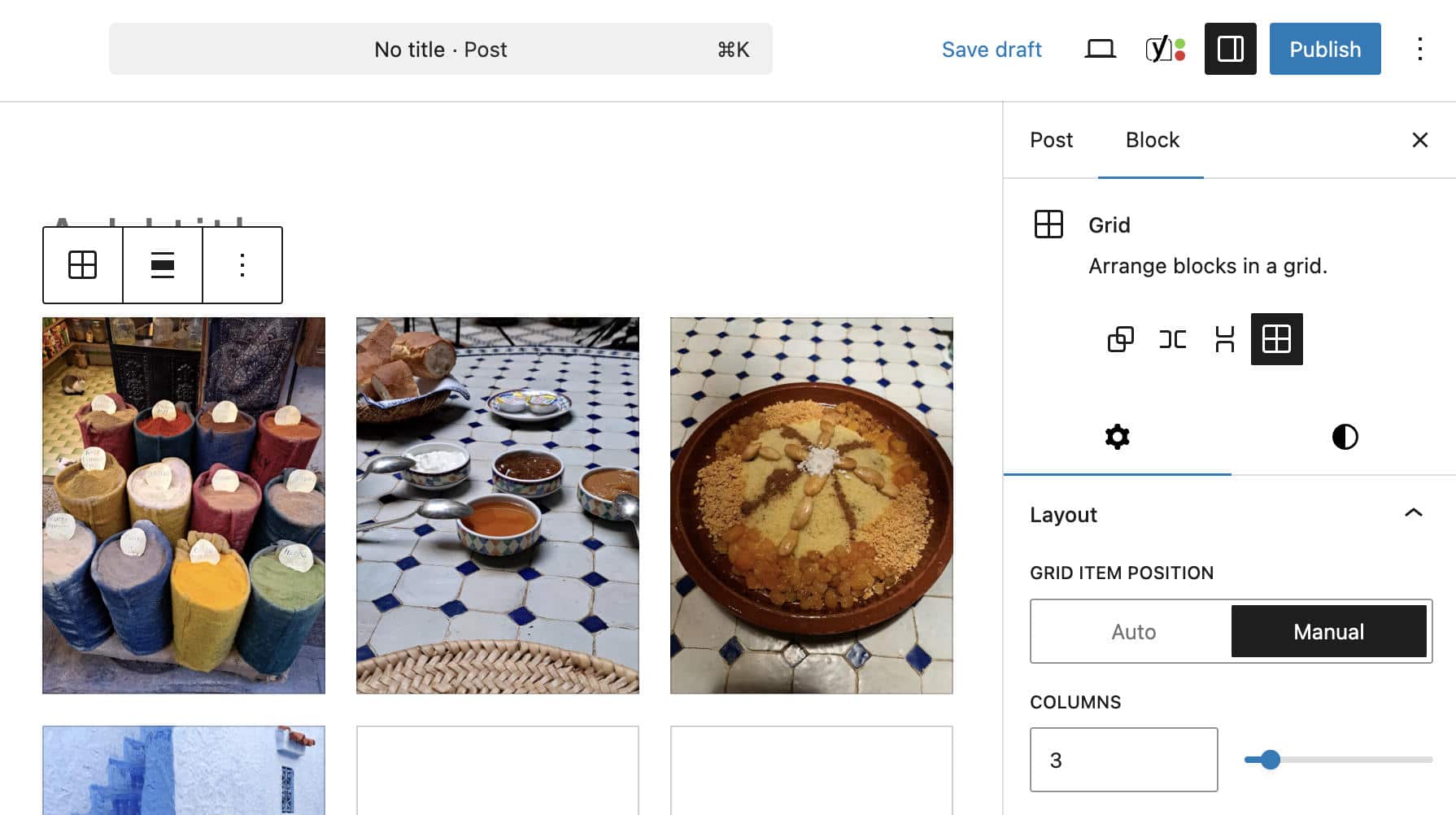
The Grid block has been up to date to be natively responsive. In earlier variations of WordPress, customers may just solely choose from Auto and Handbook modes. In Auto mode, you have to set the minimal column width to make the block responsive. In Handbook mode, you have to set the choice of columns, which remained mounted.
Grid block settings in WordPress 6.9.
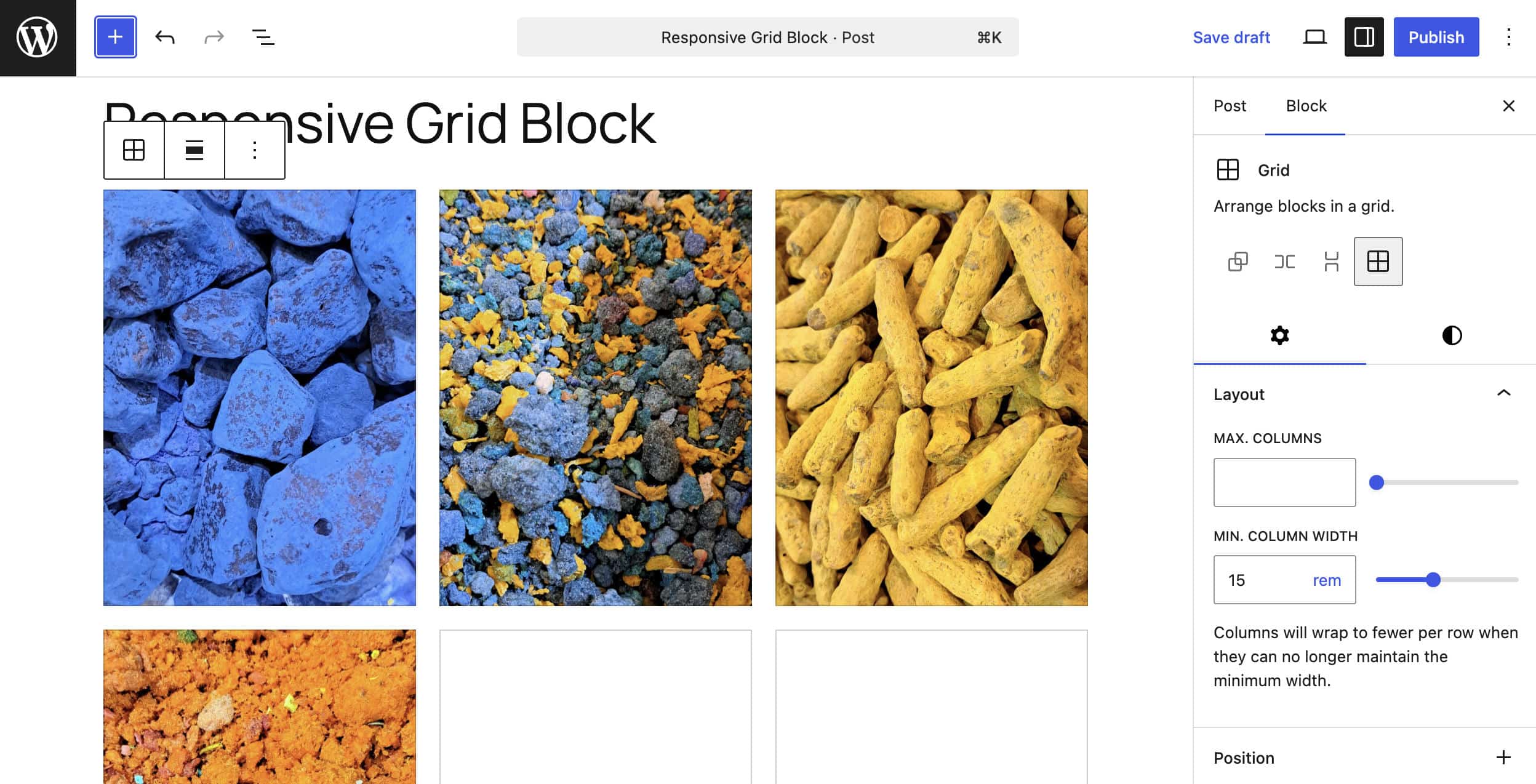
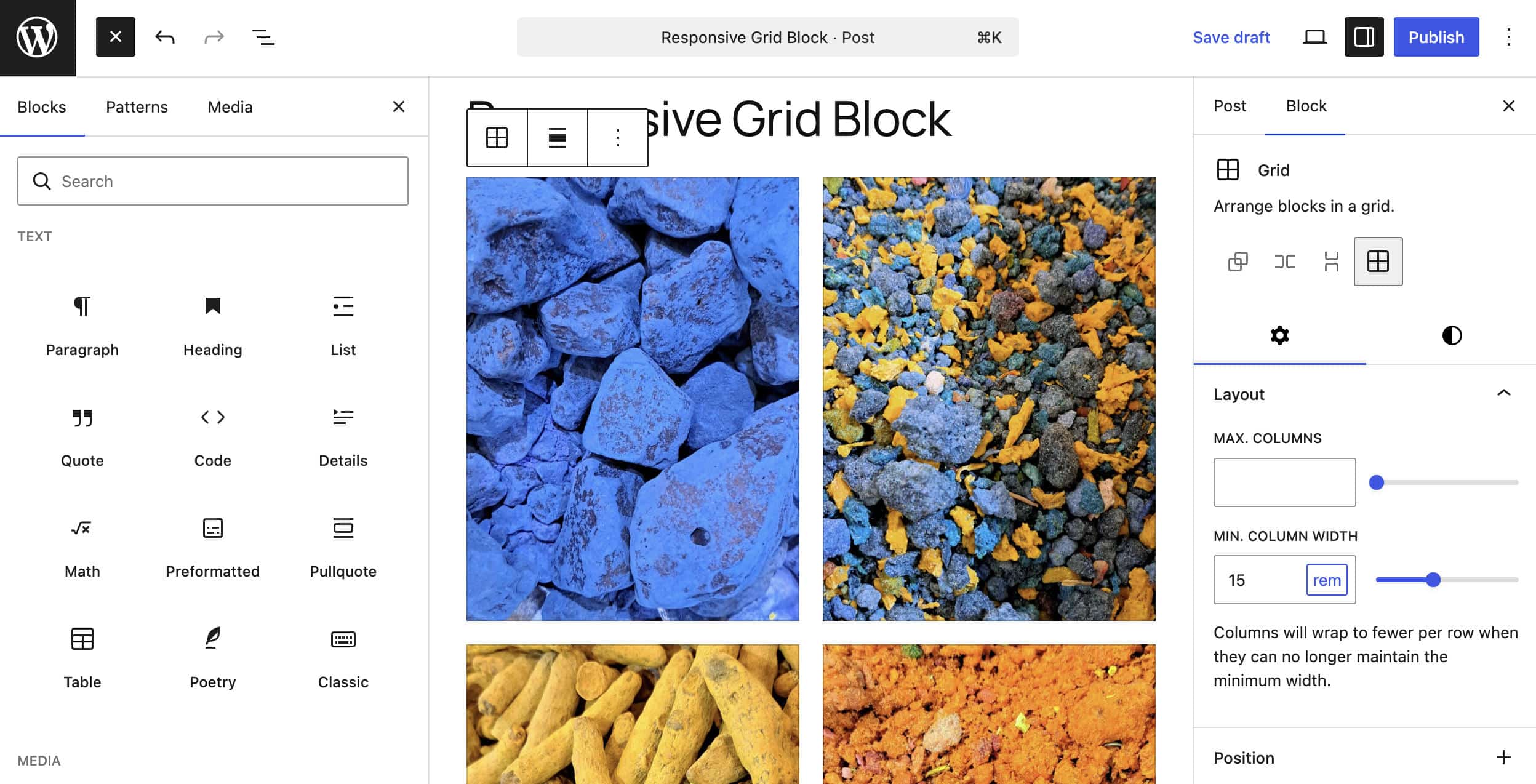
Beginning with WordPress 7.0, the Grid block is natively responsive. The choice of columns now behaves as the utmost, and you'll be able to fine-tune the minimal column measurement and the utmost choice of columns whilst preserving the block responsive.
The Grid block on a big display.The Grid block on a small display.
Customized CSS reinforce for particular person blocks
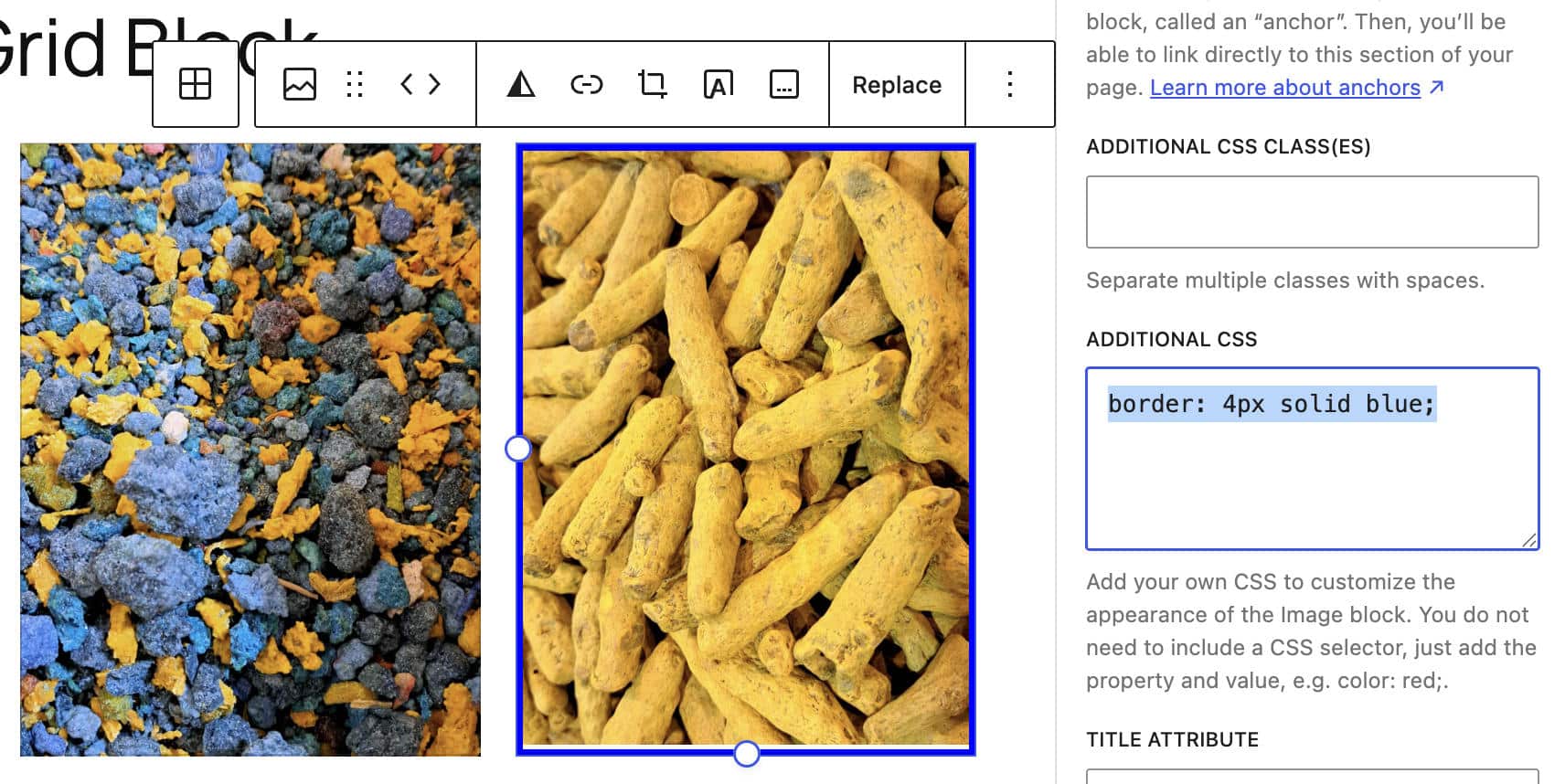
Customized CSS reinforce for particular person blocks in WordPress 7.0.
While you upload tradition kinds to a block, WordPress mechanically provides the has-custom-css category. In case you check up on the block within the code editor, you can see a block of code very similar to the next:
The tradition taste quite a bit after each WordPress defaults and International Types, making sure that adjustments you're making is not going to impact the illusion of different cases of the similar block.
Block visibility in accordance with the viewport
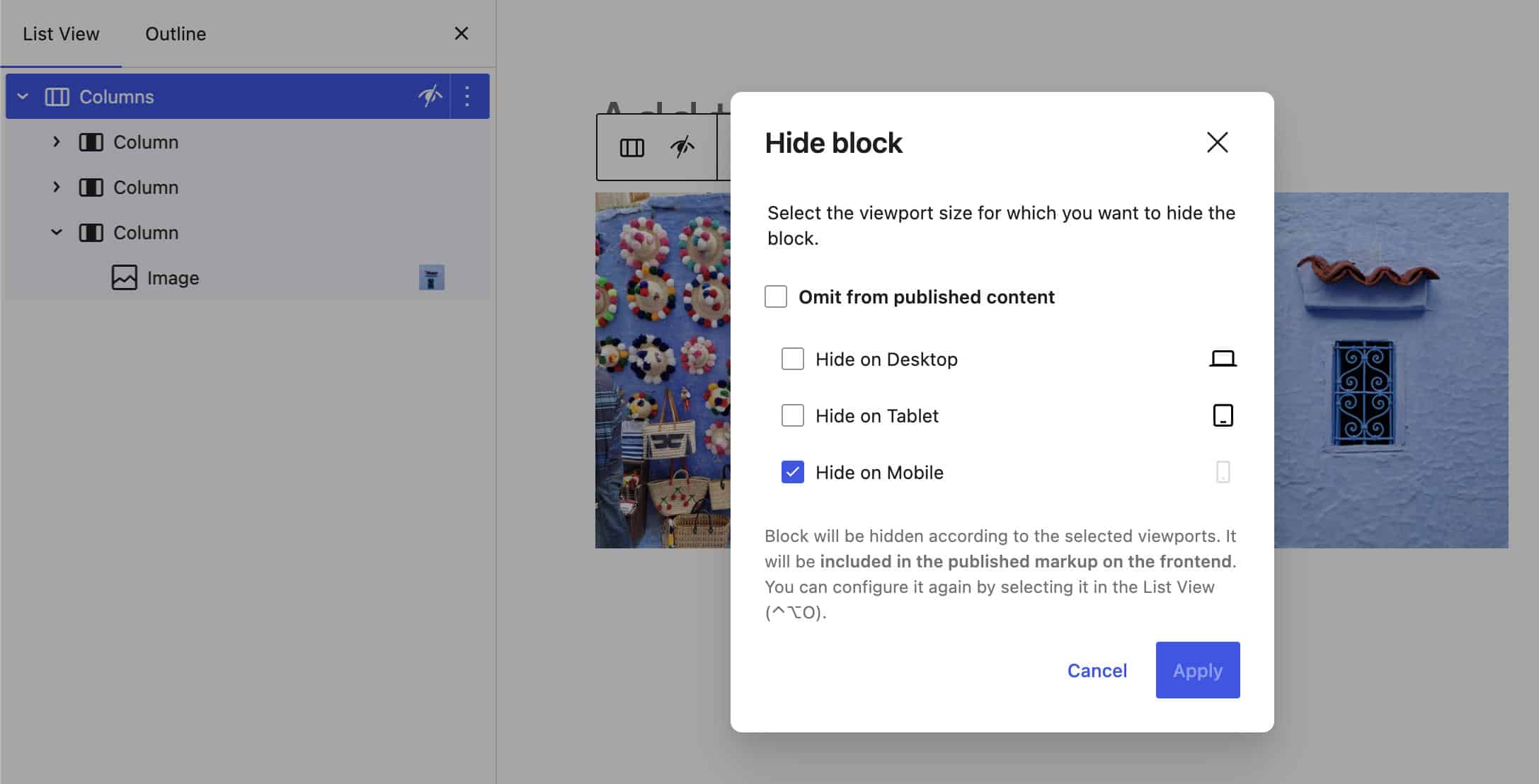
In WordPress 7.0, you'll be able to disguise or display blocks in my opinion relying on whether or not the consumer is on a cellular software, pill, or desktop.
This primary iteration provides the brand new viewport assets to blockVisibility.
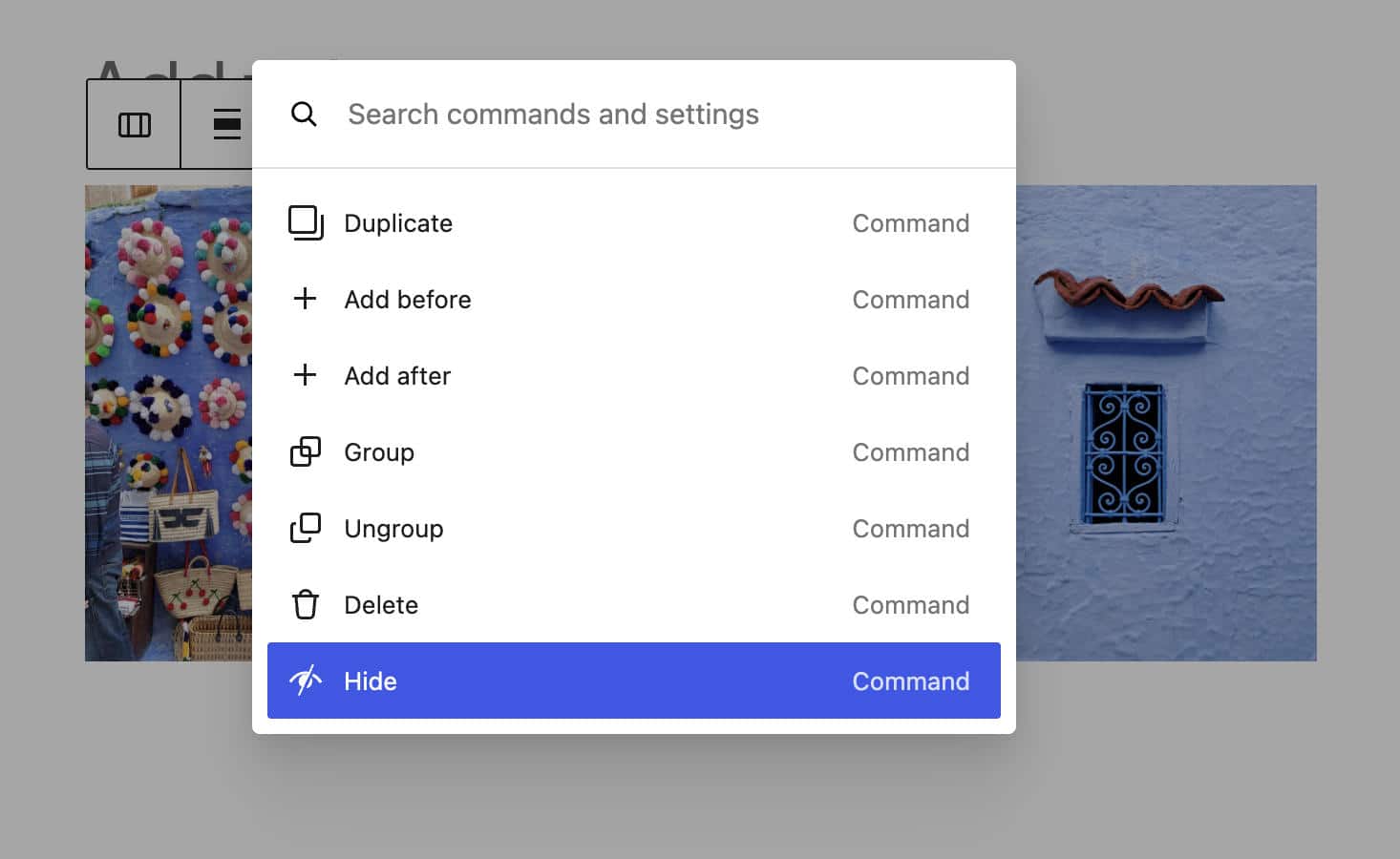
You'll allow visibility keep watch over through including the JSON object above to the block at once within the Code editor or by way of the Command palette.
Allow the block visibility keep watch over from the command palette.
After getting enabled block visibility keep watch over, you'll be able to get entry to the block visibility choices through opening the modal from the block toolbar, the block inspector sidebar, or the command palette.
The block visibility modal in WordPress 7.0
Long term releases will have to come with configurable breakpoints and integration with theme.json for block visibility.
Styling choices for the Math block
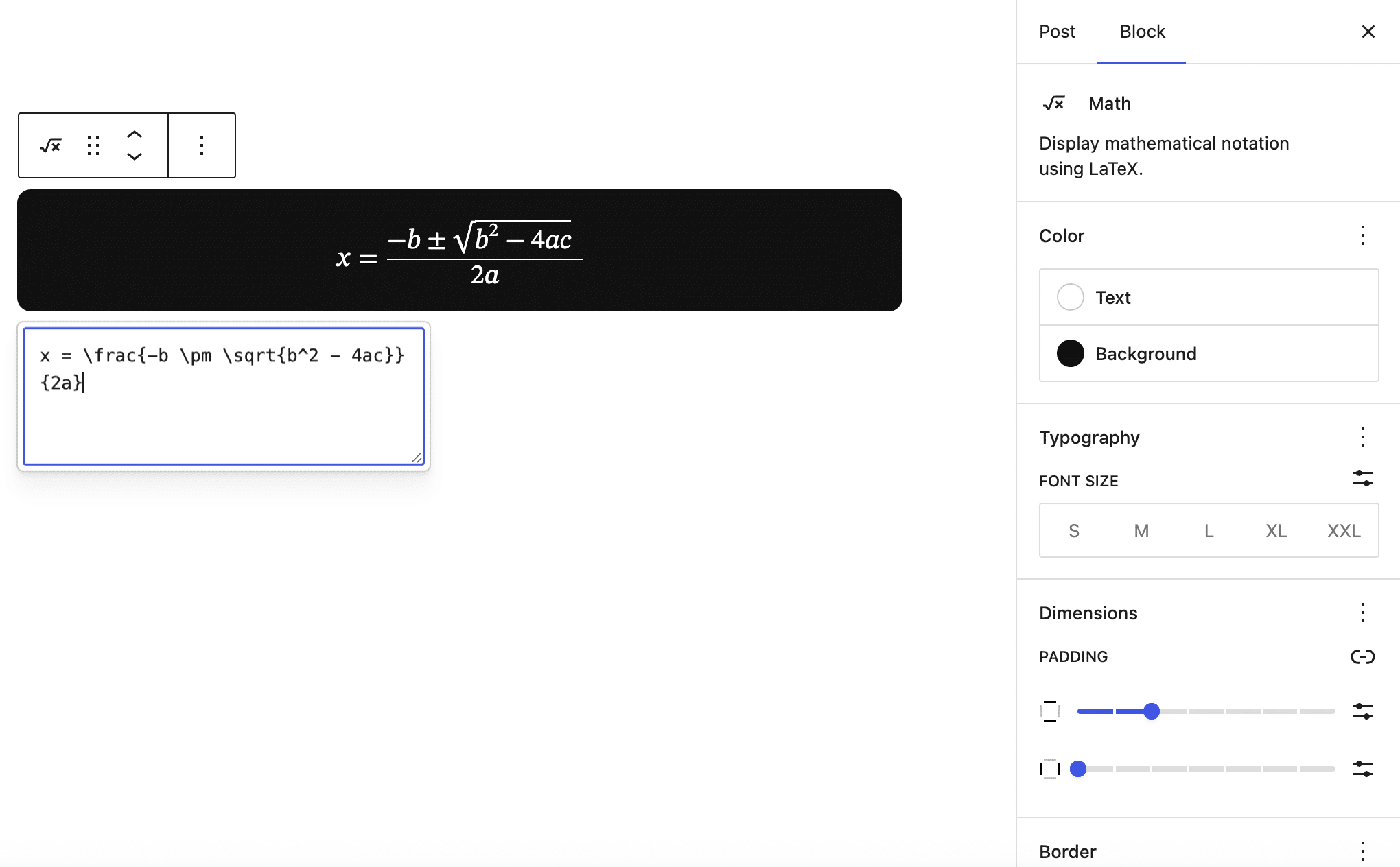
Prior to WordPress 7.0, customers may just now not customise the illusion of the Math block. The brand new WordPress model provides Colour, Typography, Dimensions, and Border styling choices for the Math block.
The next symbol supplies an instance of Math block styling:
Styling choices for the Math block.
HTML block updates
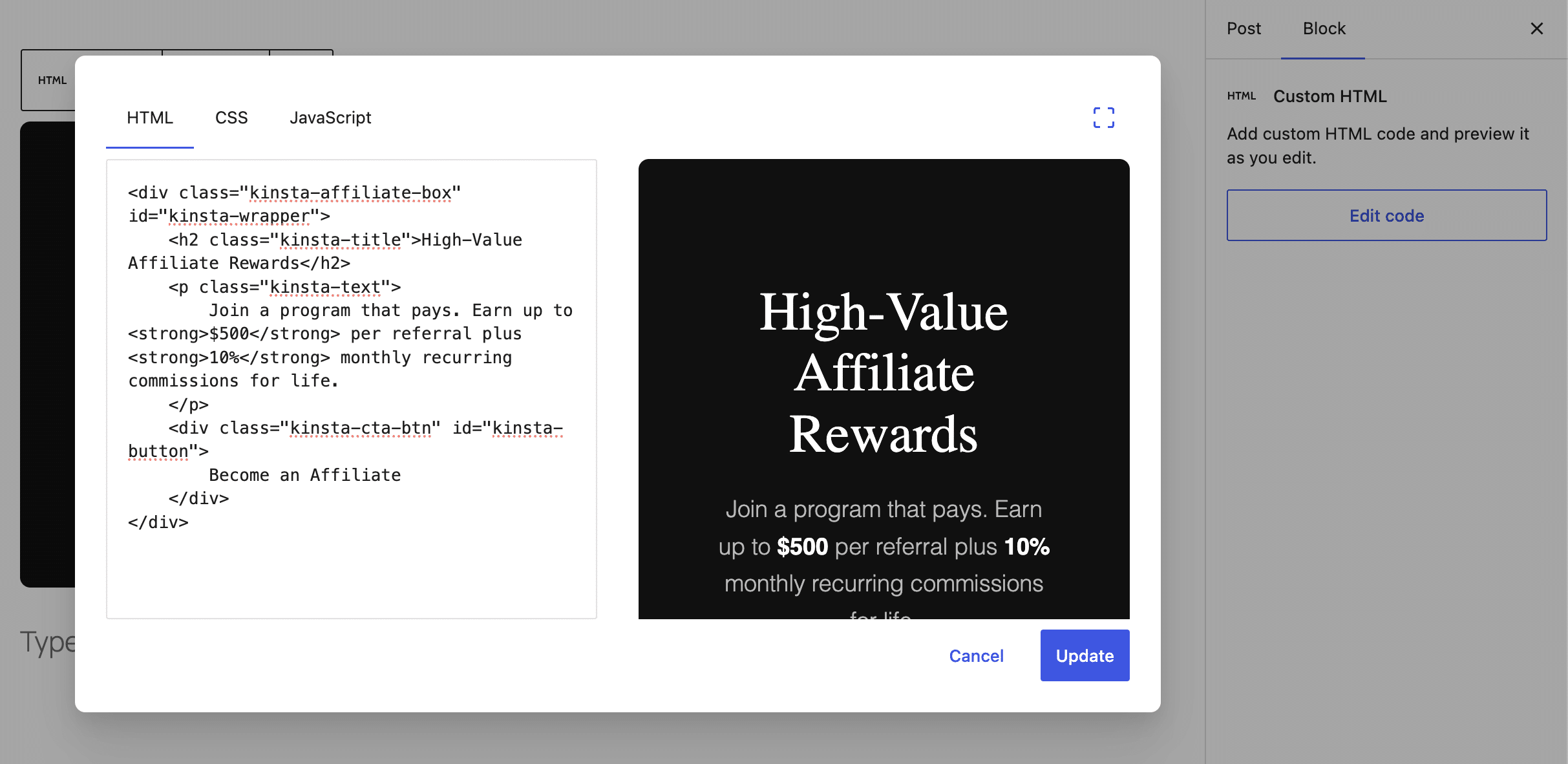
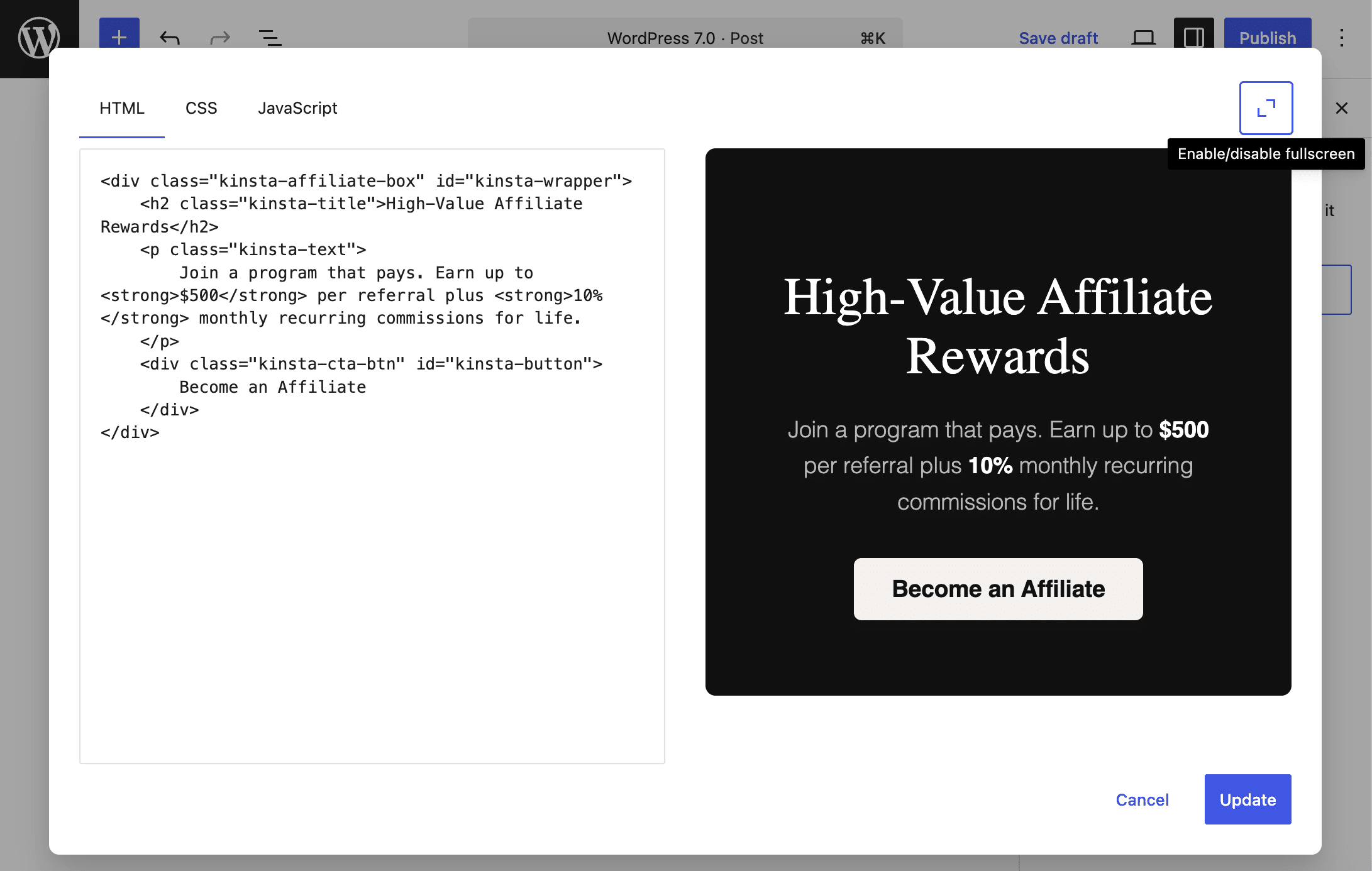
The HTML block has been totally redesigned. Now, while you insert an HTML block into your content material, a modal window seems with 3 separate tabs for getting into your HTML, CSS, and JavaScript.
Including code to the HTML block in WordPress 7.0.
If you want more room, a button within the upper-right nook of the modal window permits you to allow or disable full-screen mode.
The HTML block’s modal in full-screen mode.
Symbol block enhancements
The picture block has been up to date with a number of enhancements that provide better customization choices.
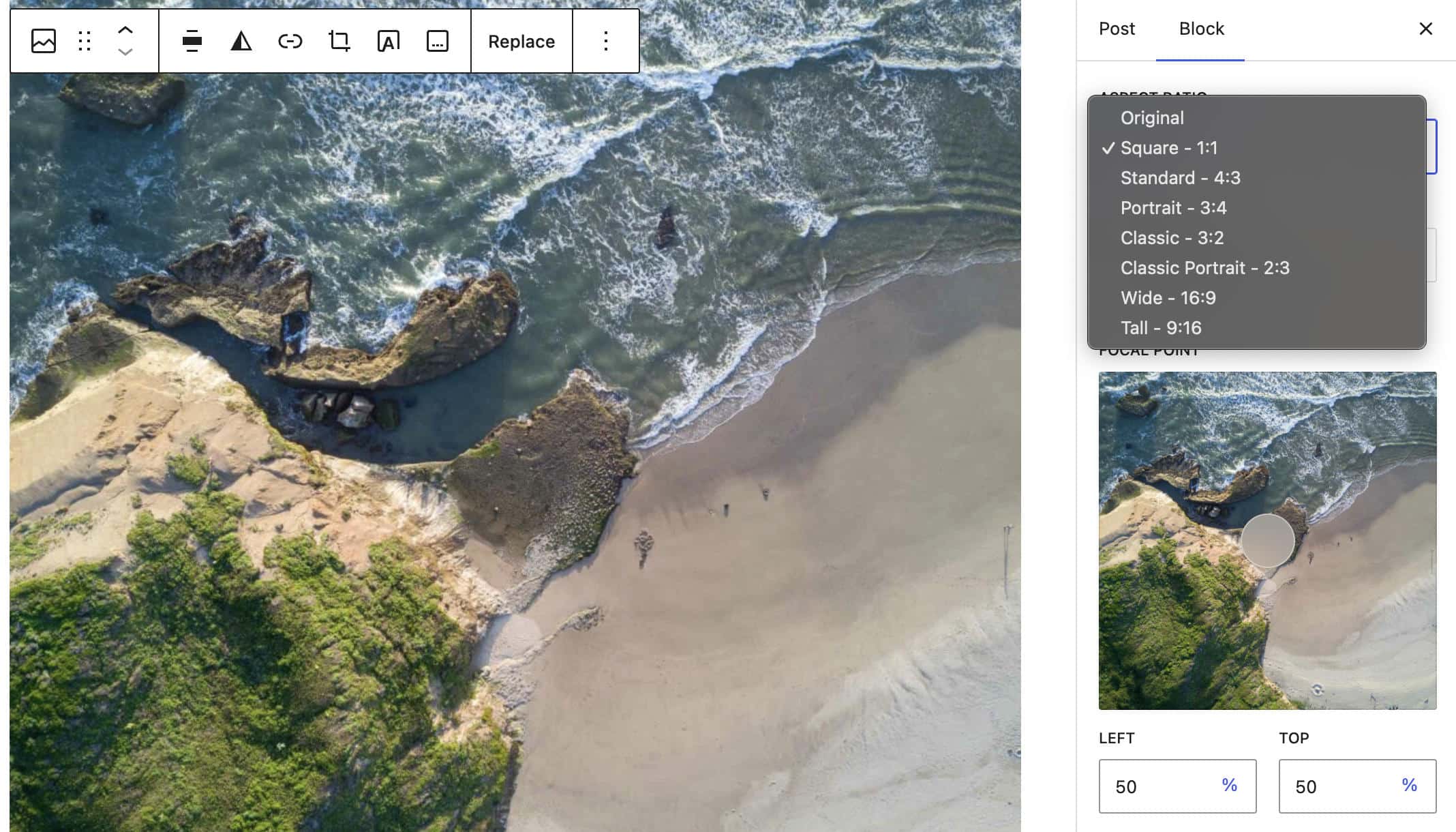
The Symbol block now helps Side ratio keep watch over for huge and whole alignment (PR #74519). This new characteristic is to be had within the Types tab of the block settings sidebar.
Side ratio keep watch over for the Symbol block in WordPress 7.0.
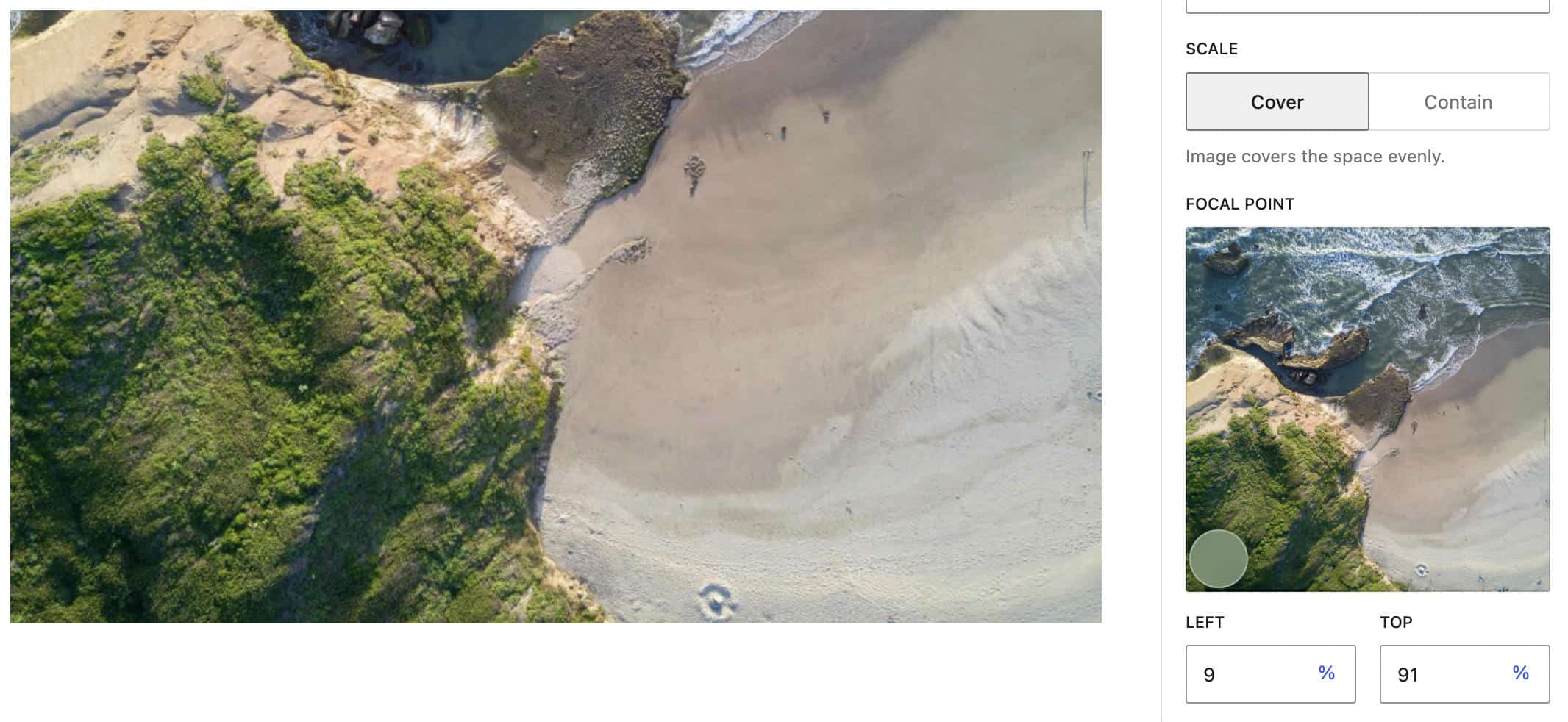
Some other helpful addition is the point of interest keep watch over. With this new characteristic, you'll be able to modify the seen portion of a picture when it's cropped. (PR #73115)
Symbol point of interest keep watch over in WordPress 7.0.
The in-editor symbol cropper part has been moved to a selected bundle, and now it may be used around the app, and now not solely within the block editor (PR #73277)
Enhanced admin revel in
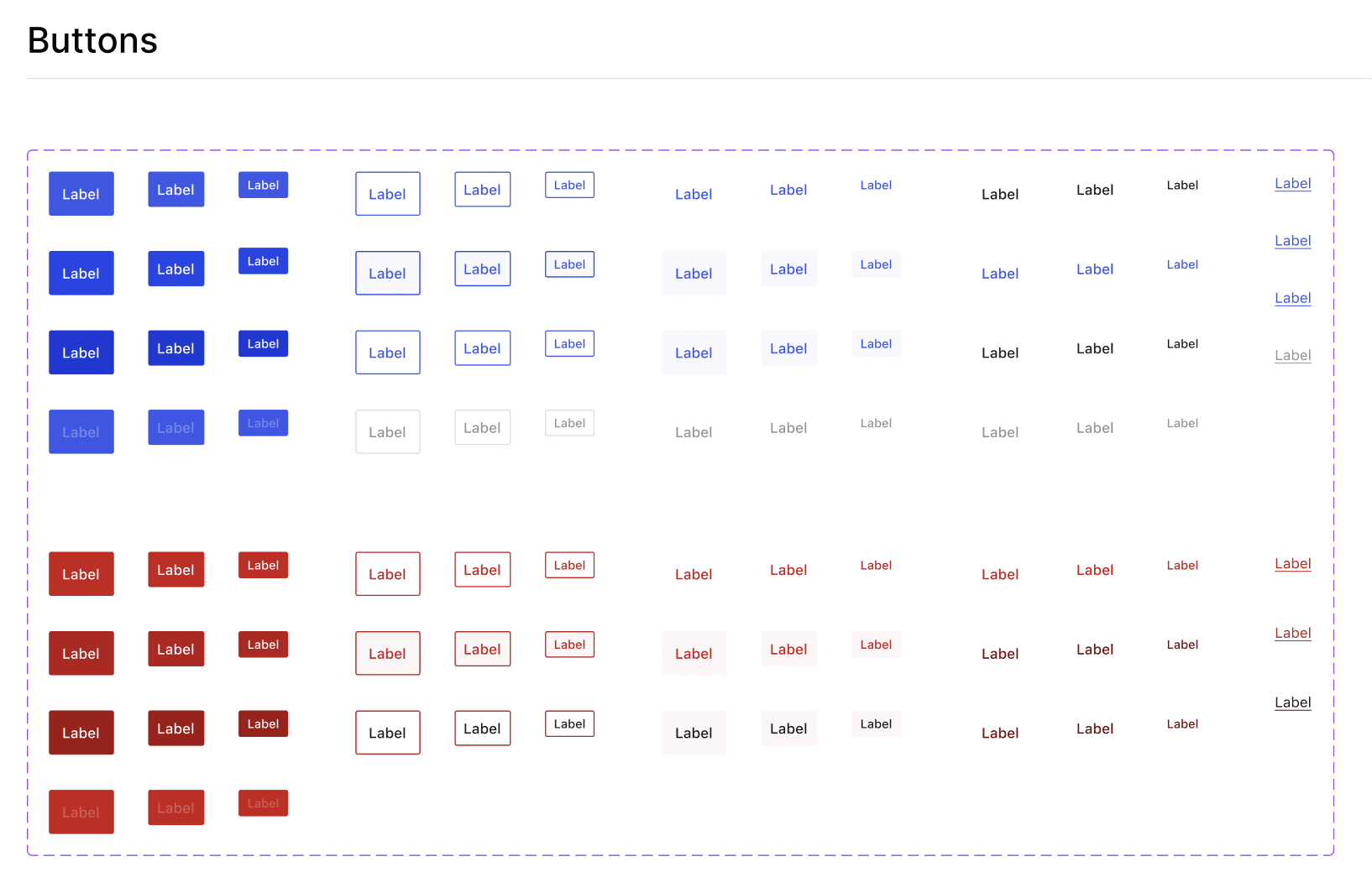
With the discharge of WordPress 7.0, the WordPress admin space has been redesigned and modernized. It’s a considerable growth to the admin revel in aimed toward making the web site’s navigation smoother, extra constant, and visually interesting.
Visible enhancements
While you open the WordPress 7.0 admin panel, you’ll instantly understand how other the interface parts glance. Those adjustments were extensively mentioned and had been deemed important to modernize the dashboard’s look and cut back inconsistencies between the outdated dashboard and the block editor.
The function is to modernize the admin’s look, cut back inconsistencies between outdated displays and the more moderen block editor / web site editor displays, and higher align it with the WordPress design gadget as a complete.
The visible redesign desirous about a chain of core parts that seem all over the WordPress admin space. As Fabian Kaegy identified, those are purely visible adjustments with out a architectural or useful updates.
You'll discover the brand new menus, buttons, and transitions in WordPress 7.0 within the respectable WordPress Design Gadget on Figma.
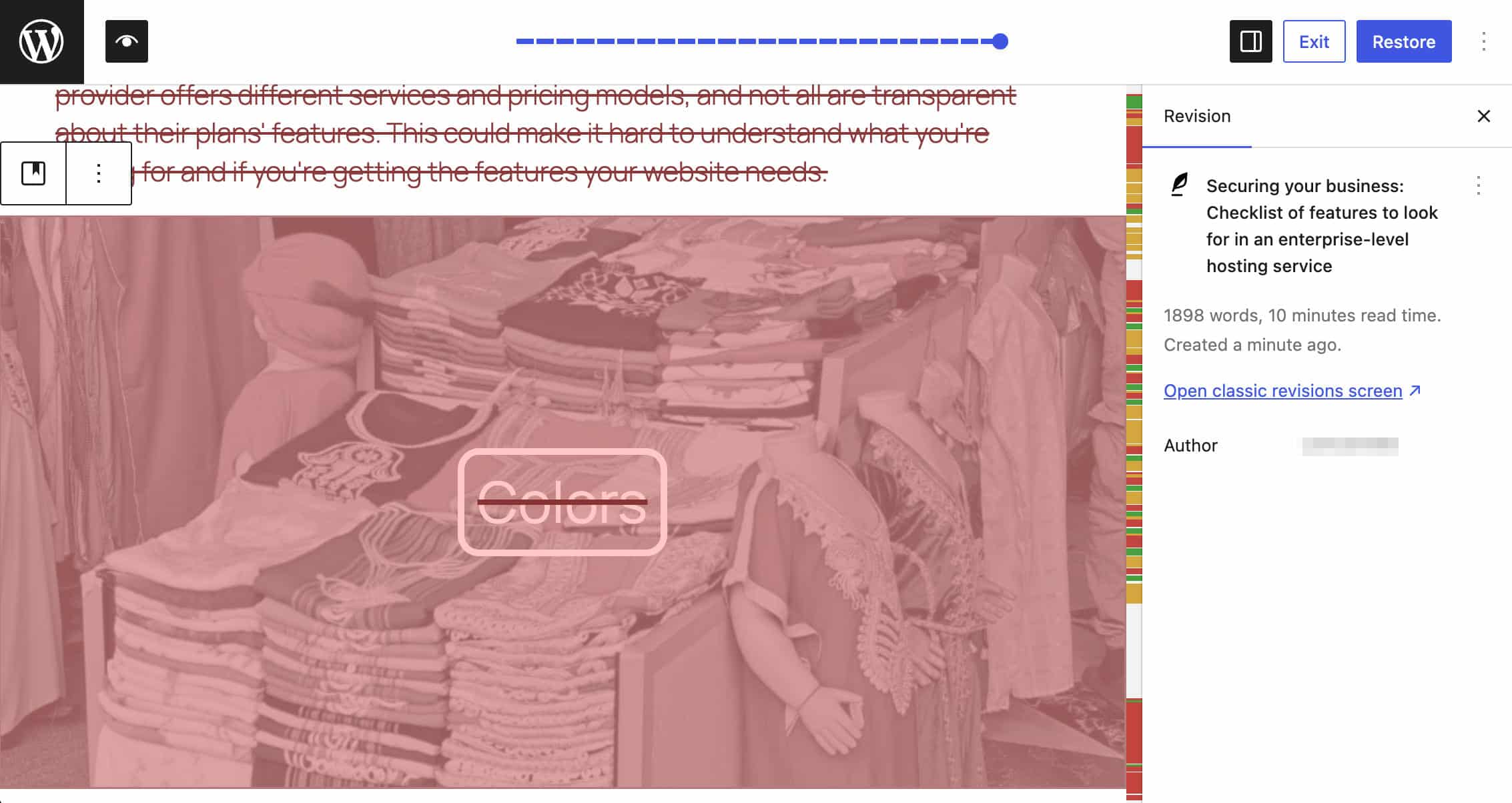
Revisions are actually introduced as previews in an editor-like interface that highlights visible variations. You not want to learn all of the article to look what has modified, as a result of variations between variations of the similar content material are actually highlighted on the block point. The gadget additionally identifies taste adjustments, making it simple to identify changes to the colour palette, typography, dimensions, and so forth.
Revisions now be offering a visible preview of adjustments on the block point.
Yellow highlights a block or textual content that has been changed.
Pink highlights a block or textual content that has been deleted.
Inexperienced identifies a block or textual content that has been added.
With revisions, you'll be able to see the whole energy of Yjs as a result of when restoring a prior model, the gadget restores solely the adjustments made to the file on a per-block foundation, now not all of the content material.
The gadget is predicted to be progressed with long term updates, and we will be able to be expecting new, tough options. For a extra detailed evaluate of what has been achieved and what we will have to see one day, take a look at this publish through Mathias Ventura from 2023, in addition to problems #60096 and #61161.
View Transitions
With WordPress 7.0, the boot bundle—the part answerable for initializing the editor and managing transitions between other admin displays—receives a important improve. Because of this new infrastructure, navigating between dashboard displays not calls for abrupt web page reloads, however options chic transitions that considerably toughen the admin revel in.
Technically talking, through enforcing the View Transitions API inside the boot bundle, WordPress can now orchestrate zoom and slide animations right through state adjustments. This avoids remounting the canvas on course adjustments, making sure a fluid transition for root navigation.
Adjustments for builders
WordPress 7.0 is greater than only a visible replace; it introduces structural adjustments that significantly simplify the advance workflow. Key highlights come with lowered tradition CSS because of a extra tough theme.json, extra predictable structure control during the expanded use of iframes, and new declarative equipment for admin interfaces, with progressed DataViews, DataForm, and Box API, and a brand new Shopper-side Skills API that gives a standardized method to divulge and have interaction with software functions by way of JavaScript.
In case you’re a developer, listed here are probably the most important technical adjustments coming with WordPress 7.0 you will have to find out about.
Pseudo-class reinforce in theme.json
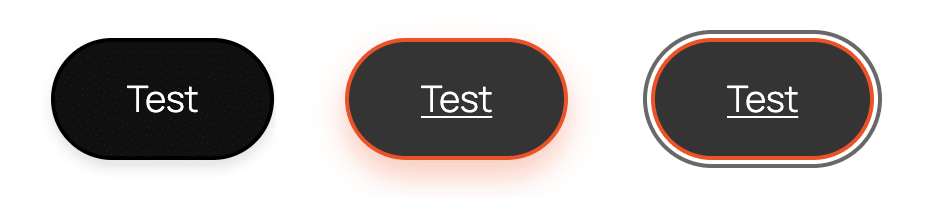
Nice information for theme builders. Beginning with WordPress 7.0, you'll be able to use pseudo-class selectors (:hover, :concentration, :focus-visible, and :energetic) at once for your blocks and elegance permutations to your theme.json.
Prior to WordPress 7.0, pseudo-classes had been supported just for HTML parts like buttons and hyperlinks, and their use on the block point was once solely conceivable in tradition CSS.
To make use of pseudo-classes on the block point, you want to upload your taste configuration within the kinds phase of your theme.json report. Right here is an easy instance of the usage of pseudo-classes for a Button block (see additionally PR #71418):
Beginning with WordPress 7.0, the publish editor is loaded in an iframe if the content material incorporates solely blocks that use Block API model 3 or upper. Prior to 7.0, the publish editor was once solely iframed if all registered blocks (even the ones now not incorporated within the content material) used Block API v3+.
The principle good thing about loading the editor in an iframe is that it isolates the editor’s UI kinds from the theme’s content material kinds. With out an iframe, the editor and theme stylesheets coexist in the similar file, which incessantly ends up in compatibility problems and makes it tough for builders to succeed in visible consistency between the backend and frontend.
Key benefits of the iframed publish editor come with:
Taste isolation
No CSS bleeding: The iframe prevents WordPress admin kinds from “bleeding” into the editor canvas and vice versa, making sure that block appearances stay unaffected through the encompassing UI.
No use for CSS reset: Builders not want to manually reset WordPress admin CSS regulations to make the editor content material fit the frontend look.
No prefixing: Theme builders not want to upload prefixes or high-specificity selectors to their CSS regulations to keep away from breaking the admin interface.
Structure Consistency
Viewport-relative gadgets: With out iframes, gadgets like vw (viewport width) and vh (viewport peak) confer with all of the admin web page (together with the sidebar); they will have to be used solely at the editor canvas.
Local Media Queries: Media queries paintings natively inside the iframe, reflecting the editor canvas measurement slightly than all of the browser window.
Developer revel in
Simplified workflow: Theme and plugin authors can “lift over” frontend kinds to the editor with minimum or no adjustments.
Continual alternatives: Iframes stay the choice within the editor (e.g., decided on textual content) seen even if the consumer interacts with UI parts, equivalent to sidebar controls.
Predictability: The iframed editor additionally solves the issue of visible inconsistency, fighting the editor from all of sudden switching modes in accordance with put in plugins.
Backward compatibility
If a publish incorporates a block the usage of older API variations, the iframe is mechanically got rid of to verify backward compatibility. To benefit from those enhancements, block builders are inspired to replace their blocks to Block API model 3+.
PHP-only block registration
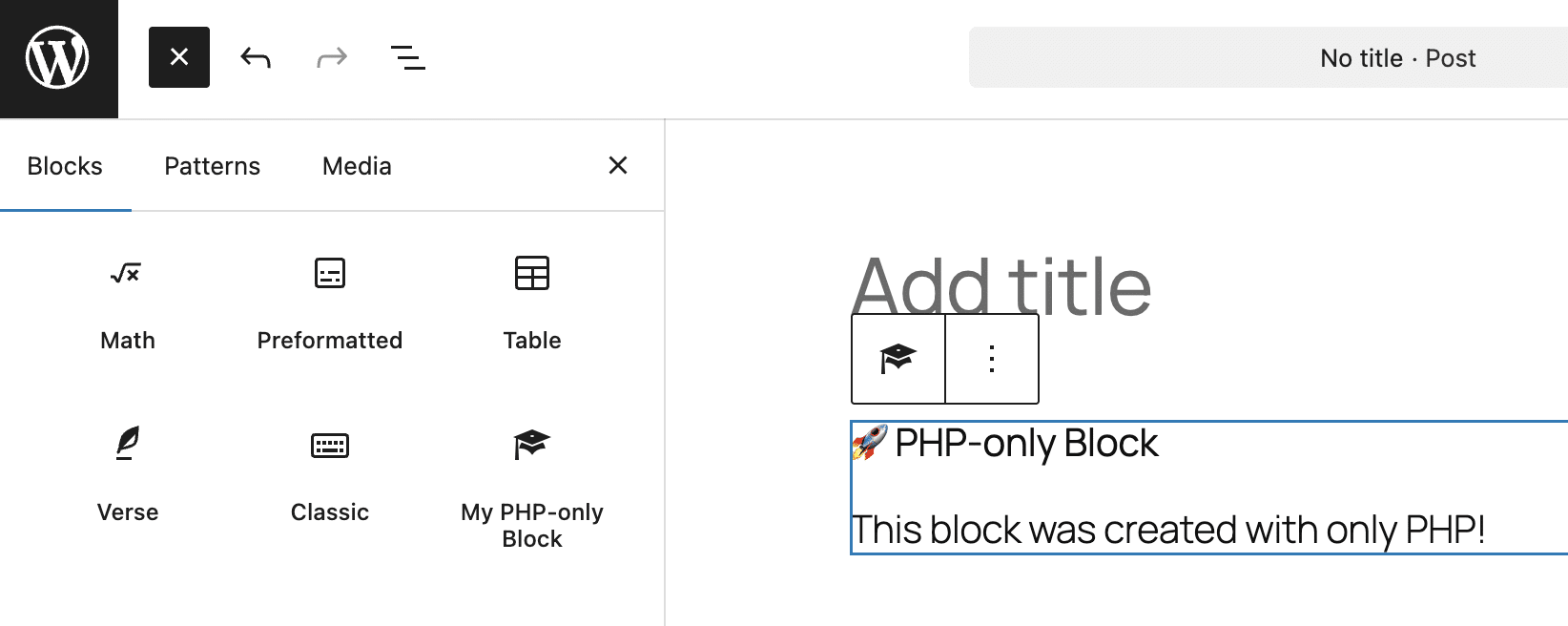
WordPress 7.0 introduces the facility to sign up blocks completely by way of PHP with mechanically generated inspector controls. This addition streamlines builders’ workflows and encourages websites that use hybrid topics or legacy PHP purposes and shortcodes to undertake and broaden at the block editor. Here's an instance of a block registered by way of PHP:
/**
 * Render callback (frontend and editor)
 */
serve as my_php_only_block_render( $attributes ) {
	go back '
		🚀 PHP-only Block
		This block was once created with solely PHP!
	';
}

/**
 * Sign in the block at the 'init' hook.
 */
add_action( 'init', serve as() {
	register_block_type( 'my-plugin/php-only-test-block', array(
		'name'		   => 'My PHP-only Block',
		'icon'			=> 'welcome-learn-more',
		'class'		=> 'textual content',
		'render_callback' => 'my_php_only_block_render',
		'helps'		=> array(
			// Routinely registers the block within the Editor JS (prior to now auto_ssr)
			'auto_register' => true,
		),
	) );
});
On the time of this writing, PHP-only blocks aren't dynamic and will solely use particular configuration controls. However there are nonetheless many use instances to discover. Because of this, we've got revealed an academic overlaying solely PHP-only blocks. If you're a PHP developer, it's price looking.
A easy PHP-only block
DataViews, DataForm, and Box API enhancements
WordPress 7.0 introduces a number of enhancements to DataViews, marking a decisive step towards a extra trendy, modular administrative interface. This replace transforms records control right into a extremely customizable revel in with a declarative means. Builders can now create advanced tradition interfaces through merely defining their regulations in JSON structure, permitting the core to generate the interface.
New additions come with:
Information visualization enhancements (DataViews): The brand new Job structure makes use of an activity-feed-timeline taste. There may be a brand new compact view mode for lists.
Shape enhancements (DataForm): The brand new Main points structure is now to be had, along side edit icons for the Panel structure. Those icons will also be configured to seem solely when wanted.
Information keep watch over enhancements (Box API): Computerized box validation is to be had, along side new formatting customization choices for numeric and date box varieties.
The next is an instance of outline a view that teams and shows records in a compact mode:
For an in depth evaluate of the DataViews, DataForm, and Box API enhancements, please confer with the dev observe.
Shopper-side Skills API
WordPress 6.9 offered the Skills API, a brand new useful interface that gives a standardized registry for plugins, topics, and WordPress core to engage with WordPress through exposing their functions in each human- and machine-readable codecs.
Now, WordPress 7.0 introduces a JavaScript API that permits you to enforce client-side options like navigating or including blocks in your content material at once from JavaScript, in a safe and standardized method.
The brand new Shopper-side Skills API is split into two programs.
@wordpress/core-abilities: In case your plugin must get entry to the server’s registered expertise, you’ll want to hook into the @wordpress/core-abilities bundle. This bundle retrieves the entire registered expertise and classes by way of the REST API and shops them within the @wordpress/expertise retailer.
@wordpress/expertise: This bundle supplies the skills retailer with out loading the skills registered at the server. In case your plugin solely must sign up client-side functions and does now not require get entry to to server-registered functions, it should enqueue @wordpress/expertise.
Consult with the developer observe for an in depth research of the brand new Shopper-side Skills API and several other code examples.
Interactivity API adjustments
The Interactivity API is a WordPress-native API that permits builders so as to add interactivity to their internet sites in a standardized method. WordPress 7.0 improves the Interactivity API with a brand new watch() serve as that permits you to programmatically follow state adjustments. Prior to now, it was once solely conceivable to make use of the data-wp-watch directive to react to state adjustments.
Different adjustments made in WordPress 7.0 relate to the core/router retailer.
For a extra detailed description of the adjustments to the Interactivity API, please confer with the dev observe.
Different adjustments for builders
Listed below are a couple of different adjustments for builders price citing:
Unsynced patterns and template portions are actually set to contentOnly through default. Customers will see controls for modifying textual content and media first, with out risking by chance breaking the block construction. If in case you have constructed tradition blocks and need them to stay editable, make sure to set "function": "contentOnly" within the block.json report. Builders can decide out of this option by way of PHP the usage of the block_editor_settings_all filter out, or by way of JavaScript through atmosphere disableContentOnlyForUnsyncedPatterns to true.
The Dimensions block reinforce gadget has been considerably progressed. You'll use width and peak as usual block helps beneath dimensions in block.json, and topics can outline measurement measurement presets of their theme.json.
Having a look forward: 7.0 marks a brand new generation for WordPress
WordPress 7.0 isn't just an replace; it represents a watershed second for each customers and builders. Because of AI integration and the Skills API, AI can now navigate the dashboard, create new content material, edit current posts, and collaborate with people in genuine time. We in point of fact really feel we're status at a historical turning level, and we will be able to’t wait to discover those AI-powered equipment and get started developing one thing solely new ourselves.
However WordPress 7.0 is extra than simply AI and RTC. The modifying revel in has been totally reimagined, that includes real-time collaboration, a brand new block-level revision structure, new core blocks, and demanding updates to the design gadget.
Past AI integration, builders will have the benefit of improvements that streamline the advance workflow and free up prior to now unseen probabilities. From the iframed editor and pseudo-class reinforce in theme.json to the Shopper-side Skills API and PHP-only blocks, WordPress 7.0 supplies a large number of equipment to construct an increasing number of tough websites and programs.
To totally leverage the potential for WordPress 7.0, you want a state-of-the-art webhosting provider optimized for functionality and safety. At Kinsta, you’ll to find the entirety you want to push WordPress to its most doable. Take a look at our plans and to find the person who absolute best suits your web site’s wishes.