
As a content material creator with over 7 years of search engine marketing enjoy, I will hopefully say that key phrase clustering is a important method—even in an international the place the search engine marketing panorama has modified considerably.
Key phrase clustering builds authority, boosts what you are promoting’s internet presence, and is helping you in finding your target market anywhere they’re of their purchaser’s adventure. However what’s key phrase clustering, and the way does it paintings? Stay studying to determine.
Desk of Contents
- What’s key phrase clustering?
- How key phrase clustering builds matter authority
- Key phrase clustering strategies
- Methods to do key phrase clustering
- 4 Perfect key phrase clustering gear
- Incessantly requested questions on key phrase clustering.

Contents
- 1 What’s key phrase clustering?
- 2 How key phrase clustering builds matter authority
- 3 Key phrase clustering strategies
- 4 Methods to do key phrase clustering
- 4.0.1 Step 1: Key phrase Assortment & Knowledge Enrichment
- 4.0.2 Step 2: Intent Segmentation
- 4.0.3 Step 3: Observe Your Clustering Way
- 4.0.4 Step 4: Map Clusters to a Pillar Structure
- 4.0.5 Step 5: Interior Linking Structure
- 4.0.6 Step 6: AEO — Resolution Engine Optimization
- 4.0.7 Step 7: Semantic Seek Optimization
- 5 4 Perfect key phrase clustering gear
- 6 Incessantly requested questions on key phrase clustering.
What’s key phrase clustering?
Key phrase clustering is an search engine marketing method that teams comparable key phrases with the similar seek intent and objectives them concurrently at the identical web page. For instance, other folks in search of “cat toys,” “toys for cats,” and different permutations are in search of the similar product and can see the similar seek effects when the use of engines like google or resolution engines.
Key phrase clustering comes to concentrated on a number one key phrase and secondary key phrases at the identical web page. The main key phrase is the primary time period you wish to have to rank for (“cat toys”), and secondary key phrases are synonyms and long-tail variants (“toys for cats”).
Via development your content material round central subject matters and comparable key phrases, you sign to engines like google that you’re an expert concerning the matter. It’s as though somebody went via my vinyl document assortment and spotted I’ve albums via quite a lot of punk artists. They’d most probably suppose I’m beautiful an expert concerning the style.
When you end up your self an expert to engines like google, then they’ll rank your web page upper in seek effects associated with that matter. Different ways key phrase clustering builds matter authority come with:
Complete protection: Whilst you cluster key phrases, you construct a pillar web page for a vast matter that connects to more than one “spoke pages” for comparable subtopics that duvet the topic from other angles.
Let’s return to the cat toys instance. A pillar web page would duvet the vast matter of “cat toys,” and the spoke pages would duvet subtopics similar to “interactive cat toys,” “cat toys for indoor cats,” and “cat toys for senior cats.”

Robust inside linking: Clustered content material is composed of extremely comparable key phrases, subject matters, and intent. Now not most effective does this create a transparent semantic image of your web site’s experience, but it surely additionally makes it simple for engines to move slowly your web site and go authority from one web page to the following.
Complete seek adventure protection: Clusters normally map to other seek intents, from informational to navigational to transactional. Via masking all phases of the patron’s seek adventure, you seize customers at each level within the funnel and give a boost to authority indicators throughout question sorts.
Decreased cannibalization: Disorganized key phrase concentrated on ceaselessly leads to more than one pages competing for a similar question, which is able to purpose one web page to “cannibalize” some other. When pages cannibalize every different, authority, back links, and visitors are break up, reducing general scores.
Strategic key phrase clustering assigns every key phrase to a unmarried URL, consolidating authority and scores.
Key phrase clustering strategies
The 3 primary key phrase clustering strategies are SERP-based clustering, semantic key phrase grouping, and hybrid clustering. I’ll dive into every with main points on how they paintings, professionals and cons, and ideal use circumstances.
SERP-Based totally Clustering
Serp-based clustering teams key phrases in response to shared seek effects. For instance, if two key phrases go back an important overlap of the similar URLs in Google’s peak 10, Google will position those key phrases in the similar cluster as a result of Google itself has made up our minds one web page satisfies each queries.
Professionals:
- Displays actual seek engine conduct fairly than assumptions
- Reduces cannibalization chance with excessive precision
- Mechanically accounts for seek intent
- Knowledge-driven and goal
Cons:
- Device-dependent and dear at scale as a result of SERP-based clustering calls for reside SERP information
- SERP overlap fluctuates as a result of clusters can shift through the years
- Misses semantic relationships between key phrases that don’t but have overlapping effects
- Will also be gradual and resource-intensive for giant key phrase lists
Perfect-fit eventualities:
- Aggressive niches the place cannibalization is an actual chance
- When you wish to have to come to a decision whether or not to merge or break up current pages
- Massive e-commerce websites mapping product/class pages to queries
- Any time precision issues greater than pace
2. Semantic Key phrase Grouping
Semantic key phrase grouping varieties key phrases via linguistic and conceptual similarity, similar to shared root phrases, synonyms, and interchangeable phrases. The speculation is if phrases imply an identical issues, they belong in combination.
Professionals:
- Rapid and scalable since no reside SERP calls are wanted
- Works effectively for development content material outlines and matter maps
- Surfaces thematic relationships that SERP information would possibly leave out
- Nice for early-stage analysis sooner than content material exists
Cons:
- Ignores exact seek intent; semantically an identical does no longer at all times equivalent the similar person function
- Can incorrectly cluster key phrases that Google treats as distinct
- Much less dependable for cannibalization selections
- Embedding high quality is dependent closely at the type or software used
Perfect-fit eventualities:
- Early-stage web site making plans and matter structure
- Content material ideation and siloing for brand spanking new verticals
- When running with very huge key phrase units (10k+) that want rapid group
- Informational content material the place intent variation is low
3. Hybrid Clustering
Hybrid clustering combines each strategies via normally the use of semantic grouping as a primary go to briefly arrange huge key phrase units, then validating or refining clusters the use of SERP overlap information for high-priority teams. Some gear layer further indicators on peak, similar to cost-per-click, quantity, and click on intent.
Professionals:
- Pairs pace with precision
- Price potency for the reason that semantic go reduces the SERP calls wanted
- Extra powerful clusters that mirror each that means and actual rating conduct
- Versatile as a result of you’ll song how a lot weight every sign carries
Cons:
- Extra advanced to put in force and deal with
- Calls for both a complicated software or an outlined guide workflow
- Can produce conflicting indicators that want human judgment to unravel
- Overhead is also useless for small websites
Perfect-fit eventualities:
- Mid-to-large websites development out complete matter authority methods
- search engine marketing groups operating common content material audits and hole analyses
- When you wish to have each strategic content material making plans and tactical web page selections
- Businesses managing more than one purchasers throughout other industries
So, how do you select the most efficient approach to your search engine marketing technique? I counsel beginning with semantic key phrase grouping in case your focal point is discovery, i.e., you’re mapping a brand new area of interest, making plans your web site’s construction, or running with an enormous uncooked key phrase record.
Use the SERP-based approach when the stakes are excessive—similar to while you’re merging pages, selecting URL construction, or running in a aggressive house the place the unsuitable cluster can result in cannibalization to your web site.
In the end, pass hybrid for those who’re development a sustained content material operation the place each strategic making plans and tactical execution want to occur persistently at scale.
The process isn’t a hard and fast selection; in reality, maximum mature search engine marketing workflows transfer via all 3, the use of every on the proper degree of the method.
Methods to do key phrase clustering
Step 1: Key phrase Assortment & Knowledge Enrichment
Sooner than clustering the rest, you wish to have a complete, enriched key phrase set. In my enjoy, skinny information produces susceptible clusters.
Resources to tug from:
- Google Seek Console (queries you already rank for)
- Key phrase analysis gear (Ahrefs, Semrush, Moz)
- Competitor hole research
- Autocomplete and Folks Additionally Ask scrapes
- Interior web site seek information
Enrich each key phrase with:
- Seek quantity
- Key phrase challenge
- CPC (indicators industrial intent)
- Present rating place
- Seek intent classification (informational, navigational, industrial, transactional)
The intent classification is significant as it’s your first filter out sooner than any clustering good judgment is carried out. Consider, key phrases with basically other intents must by no means be clustered in combination, irrespective of semantic similarity.
Step 2: Intent Segmentation
Cut up your key phrase record via intent sooner than clustering. This prevents the commonest clustering mistake: grouping key phrases that percentage an issue however serve totally other person wishes.
A person looking out “what’s a CRM” and “purchase CRM tool” are on reverse ends of the adventure. Placing them in the similar cluster produces a web page that satisfies neither.
Intent classes to section via:
- Informational — questions, how-tos, definitions (“how does key phrase clustering paintings”)
- Business — comparisons, evaluations, best-of lists (“ideal key phrase clustering gear”)
- Transactional — acquire or signup-ready (“key phrase clustering software unfastened trial”)
- Navigational — logo or destination-specific (“Ahrefs key phrase clustering”)
As soon as segmented, cluster inside every intent class. This assists in keeping your content material purpose-built for a selected person state.
Step 3: Observe Your Clustering Way
The usage of the process suitable to your scale and function (SERP-based, semantic, or hybrid as lined previous), workforce your intent-segmented key phrases into clusters. Every cluster must:
- Have one transparent head time period (the principle key phrase that defines the cluster’s matter)
- Comprise supporting long-tail variants {that a} unmarried web page can deal with
- Constitute a unmarried seek intent all through
- Be distinct sufficient from different clusters that content material overlap is minimum
A sensible threshold for SERP-based clustering: if two key phrases percentage 3 or extra of the similar top-10 URLs, they belong in the similar cluster. If the overlap is 0 or 1, they most probably warrant separate pages.
For semantic clustering, use cosine similarity rankings between key phrase embeddings. A similarity threshold of 0.75–0.85 normally produces blank clusters with out over-merging.
Step 4: Map Clusters to a Pillar Structure
As soon as clusters are shaped, assign them to a content material hierarchy. That is the place clustering turns into a structural technique fairly than simply an organizational workout.
The 3-tier structure:
Tier 1 — Pillar Pages: Large, high-volume, high-difficulty subjects. Those pages intention to be the definitive useful resource on a subject matter. Pillar pages create the hub that provides surrounding content material authority fairly than looking to rank for each key phrase of their cluster.
Tier 2 — Cluster Pages: Every key phrase cluster from Step 3 maps to 1 cluster web page. Those pass deep into a selected subtopic, concentrated on the lengthy tail and supporting key phrases inside their cluster. They draw authority from the pillar and go back it by way of inside hyperlinks.
Tier 3 — Supporting Content material: Extremely particular pages — FAQs, thesaurus entries, case research, information pages — that focus on very slim queries and feed authority upward into cluster pages.
Each piece of content material must know its tier, its guardian pillar, and its sibling cluster pages to tell your inside linking technique at once.
Step 5: Interior Linking Structure
Interior linking is the place your cluster map turns into a residing authority engine. Maximum websites deal with inside hyperlinks as an afterthought. In a correctly completed cluster technique, they function structural load-bearing parts.
The core idea: Hyperlinks go PageRank and topical relevance indicators. A well-linked cluster makes a speciality of the pages that want to rank, whilst additionally indicating the semantic relationships between pages to engines like google.
Methods to construct your inside hyperlink construction:
Pillar ↔ Cluster hyperlinks (bidirectional) Each cluster web page hyperlinks to its pillar with keyword-rich anchor textual content. The pillar hyperlinks out to every of its cluster pages. This bidirectional float creates a closed authority loop — fairness doesn’t leak out of the subject silo.
Cluster ↔ Cluster hyperlinks (contextual): Comparable cluster pages must hyperlink to one another when there’s authentic contextual relevance. A web page on “key phrase analysis procedure” must naturally hyperlink to “key phrase clustering strategies” — those hyperlinks give a boost to the semantic community to engines like google.
Anchor textual content technique: Use actual or close-variant anchor textual content to your maximum vital hyperlinks. Google makes use of anchor textual content as a relevance sign — imprecise anchors like “click on right here” or “be told extra” waste the chance. Range anchors naturally to steer clear of over-optimization flags, however accomplish that intentionally.
Hyperlink intensity control: Necessary cluster pages must be reachable inside 2–3 clicks from the homepage. Pages buried 5+ clicks deep obtain little move slowly consideration and minimum PageRank. Your cluster structure must naturally put into effect shallow hyperlink intensity throughout matter spaces.
Averting orphan pages: Each web page for your cluster should have no less than one inbound inside hyperlink. Orphan pages obtain no PageRank, get crawled once in a while, and successfully don’t exist for your authority construction, regardless of how just right the content material is.
Move slowly finances potency: For massive websites, inside linking at once impacts which pages get crawled and the way ceaselessly. A tightly connected cluster construction guarantees crawlers successfully uncover and re-crawl your highest-priority content material, whilst skinny or reproduction pages get naturally deprioritized.
Step 6: AEO — Resolution Engine Optimization
Seek is not with reference to rating within the 10 blue hyperlinks. Resolution engines — together with Google’s AI Overviews, SGE, Bing Copilot, and standalone LLMs like ChatGPT and Perplexity — pull content material at once into synthesized responses.
AEO is the observe of structuring your content material so it’s decided on because the supply.
Why key phrase clustering at once allows AEO: Resolution engines choose assets that show deep, complete protection of an issue. A well-clustered content material library indicators precisely that — you haven’t written one article on a subject matter, you’ve constructed an authoritative wisdom base round it.
Structural parts that strengthen resolution engine variety:
Direct resolution formatting: Position a concise, direct resolution to the principle query throughout the first 100 phrases of any informational web page. Resolution engines often pull from opening paragraphs. Don’t bury the solution after 3 paragraphs of preamble.
FAQ and Q&A blocks. Every cluster web page must come with a structured FAQ segment addressing the secondary questions inside its key phrase cluster. Those map at once to Folks Additionally Ask bins and are high extraction objectives for AI Overviews. Use correct FAQ schema markup to make extraction more straightforward.
Schema markup at scale. Enforce structured information throughout your cluster:
- Article schema on all editorial content material
- FAQPage schema on Q&A sections
- HowTo schema on procedure content material
- Breadcrumb Checklist schema to give a boost to your content material hierarchy
- Speakable Specification for voice-optimized content material
Schema supplies machine-readable affirmation of what your content material is ready, expanding variety self belief.
Snippet-optimized formatting: Resolution engines extract content material that’s already formatted for speedy intake. Use definition blocks for ideas, numbered lists for processes, comparability tables for multi-option subjects, and brief declarative sentences for factual claims. In case your content material reads like a solution, it’s handled like one.
Passage-level optimization, Google’s passage indexing manner person sections of a web page can rank independently. Every H2/H3 segment for your cluster pages must be self-contained sufficient to respond to its personal particular query — don’t depend on surrounding context to make a bit significant.
Step 7: Semantic Seek Optimization
Semantic seek is the underlying era that permits clustering. Figuring out it deeply allows you to write content material that engines like google can appropriately interpret, no longer simply index.
Now you could have the stairs, right here’s how semantic seek in truth works:
Fashionable engines like google don’t fit key phrases — they map that means. Google’s language fashions (constructed on transformer structure very similar to BERT and MUM) convert queries and paperwork into high-dimensional vectors and in finding the nearest that means fit. This implies:
- Synonyms and paraphrases rank in addition to actual key phrases
- Context inside a file impacts how every sentence is interpreted
- Co-occurring phrases sign topical intensity even with out actual key phrase repetition
- The absence of anticipated comparable phrases can decrease a web page’s topical relevance rating
When writing for semantic intensive, bear in mind those parts:
Entity protection: Determine the important thing entities (other folks, puts, ideas, merchandise) that belong on your matter cluster and make sure your content material references them naturally.
When you’re writing about “content material business plan,” semantic completeness manner masking entities similar to editorial calendars, purchaser personas, content material distribution, and funnel phases—no longer simply repeating the pinnacle key phrase.
Co-occurrence and LSI indicators. Whilst the time period “LSI key phrases” is technically out of date, the underlying idea is legitimate: content material that naturally makes use of the vocabulary of an issue house rankings upper for semantic relevance.
Use gear like Clearscope, Surfer search engine marketing, or MarketMuse to spot the phrases that top-ranking pages persistently use, then ensure that your content material covers the similar conceptual flooring.
Subject completeness vs. key phrase density: Semantic seek penalizes skinny protection up to it rewards intensity. A web page that mentions a key phrase 20 instances however covers just one size of an issue will lose to a web page that mentions it 5 instances however totally addresses comparable ideas, not unusual questions, counterarguments, and sensible packages.
Contextual relevance via proximity. The semantic dating between your pages issues up to the content material inside them. When your cluster pages hyperlink to one another with descriptive anchor textual content, you’re development a contextual graph that engines like google can interpret.
Two pages connected via related anchors are regarded as semantically comparable — that is necessarily guide wisdom graph building.
Structured information as semantic markup, Schema.org vocabulary is a right away semantic sign. Whilst you mark up a web page with structured information, you’re no longer simply serving to wealthy effects — you’re offering machine-readable semantic labels that override any ambiguity for your herbal language content material.
A web page with an Article schema, a couple of particular Subject entity, authored via a identified Individual entity, is semantically unambiguous.
4 Perfect key phrase clustering gear
1. Key phrase Insights
What we love: Key phrase Perception’s SERP-based clustering engine is probably the most correct I’ve examined — it teams key phrases in response to actual URL overlap in Google’s peak effects, so clusters mirror how engines like google in truth suppose, no longer simply how phrases sound an identical.
Producing content material briefs at once from clusters saves our workforce hours, and the GSC integration manner we’re running with reside rating information fairly than guesswork.
Perfect for: search engine marketing execs and content material groups who desire a devoted, precision-first clustering software with a complete workflow from analysis to transient with out paying for a bloated all-in-one suite.

2. Semrush Key phrase Technique Builder
What we love: Semrush’s visible matter map gives an invaluable making plans interface that presentations how pillar subjects and subtopics relate, and it adjustments how we consider content material structure.
Perfect for: Advertising and marketing groups and businesses already operating their search engine marketing operations within Semrush who need clustering baked right into a unmarried, end-to-end workflow fairly than managing a separate software.

3. Ahrefs Key phrases Explorer
What we love: Ahrefs Guardian Subject technique is rapid and environment friendly, particularly for large-scale key phrase analysis throughout more than one markets or purchasers.
Perfect for: Analysis-heavy groups who want to procedure huge key phrase units briefly, or any person already the use of Ahrefs as their number one search engine marketing platform who desires dependable clustering with out including some other software to the stack.

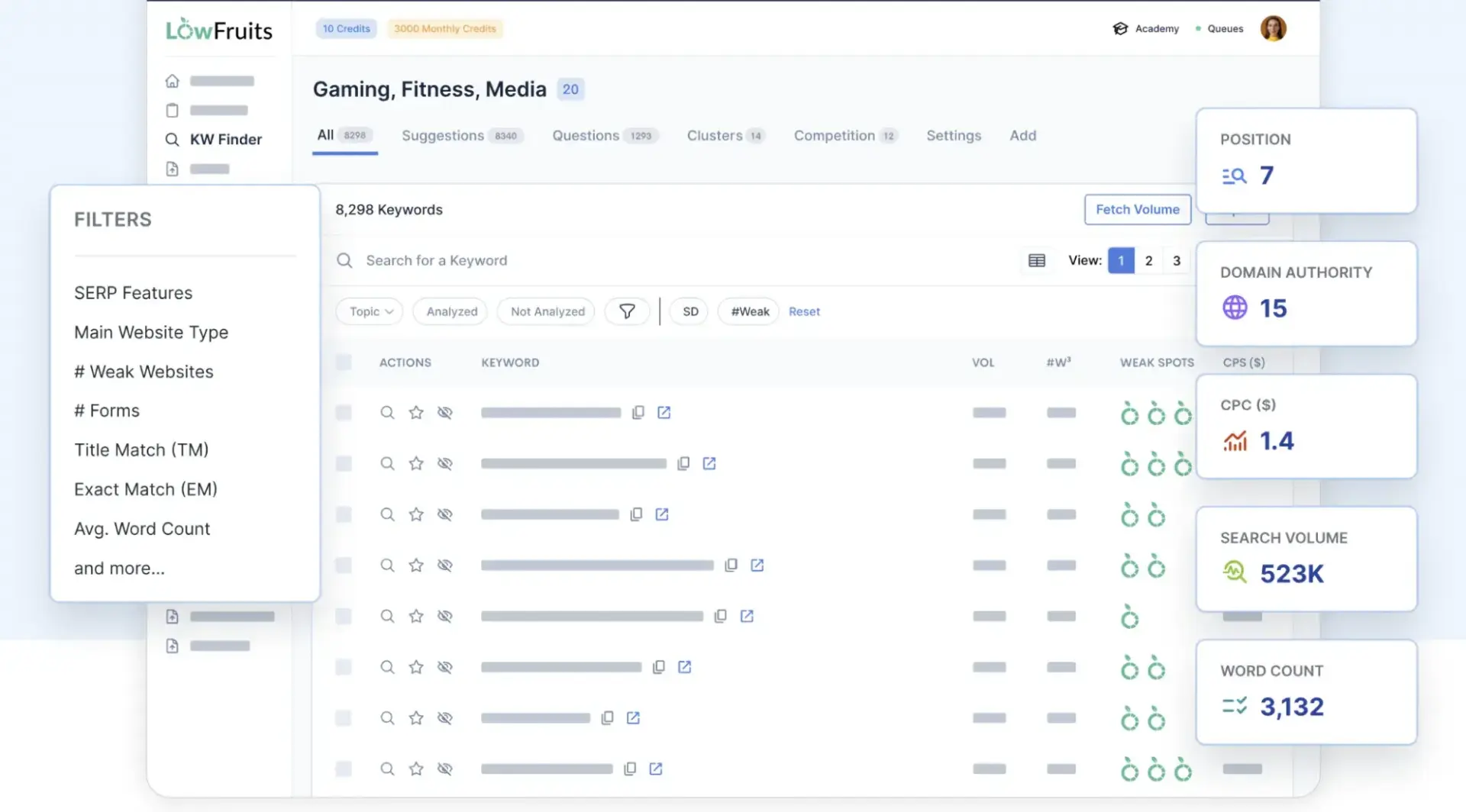
4. LowFruits
What we love: The pay-as-you-go type is handy, and clustering itself is unfastened; credit are most effective fed on for deeper SERP research.
For area of interest websites and smaller initiatives, the signal-to-noise ratio is very good: clusters are blank, actionable, and don’t require a steep finding out curve to interpret.
Perfect for: Bloggers, area of interest web site operators, and small groups who need forged SERP-based and semantic clustering with out the overhead of an undertaking platform — particularly helpful when finances flexibility issues greater than function intensity.
Incessantly requested questions on key phrase clustering.
When must you no longer use key phrase clustering?
Key phrase clustering loses its price when your web site is simply too new to have established any topical authority. At that degree, a unmarried well-targeted pillar web page will outperform a half-built cluster each time.
It’s additionally counterproductive when carried out to a key phrase record that hasn’t been intent-segmented first, since clustering mixed-intent key phrases produces pages that fulfill no person.
When you’re operating a single-product or extremely area of interest web site with a restricted key phrase universe, the overhead of a complete cluster structure might outweigh the ease. In the ones circumstances, a flat content material construction with robust inside linking ceaselessly plays simply as effectively.
What number of key phrases belong in a single cluster?
There’s no common quantity, however maximum well-structured clusters comprise 5-20 key phrases concentrated on a unmarried web page. The fitting dimension is dependent upon how a lot variation exists throughout the matter — a vast informational cluster would possibly enhance 15–20 long-tail variants, whilst a transactional cluster would possibly most effective want 5–8 tightly comparable phrases.
The actual take a look at isn’t amount however whether or not a unmarried piece of content material can naturally deal with each key phrase within the cluster with out diluting its focal point. When you’re stretching the web page to hide key phrases that really feel tangential, that’s a sign to separate the cluster.
Must each cluster have a pillar web page?
Now not essentially — the pillar web page type works ideal when you’ve got sufficient cluster content material to justify a central hub, normally 6–10 supporting pages minimal. For smaller clusters occupied with slim subtopics, a well-optimized cluster web page can function a standalone asset with no devoted pillar above it.
That stated, each cluster must no less than map to a broader matter tier, despite the fact that a complete pillar web page doesn’t exist but — this assists in keeping your content material structure scalable as you put up extra. Recall to mind the pillar as one thing you develop into, no longer a prerequisite for beginning.
How do you save you key phrase cannibalization with clusters?
One of the best prevention is assigning transparent key phrase possession all the way through the clustering segment — every key phrase must map to precisely one URL sooner than any content material is written. Use a monitoring sheet that logs the principle key phrase, goal URL, and cluster project for each web page, making conflicts visual sooner than they transform rating issues.
If cannibalization already exists, run a SERP overlap take a look at.
If two of your pages seem in the similar effects for a similar question, consolidate them or use canonical tags to claim the authoritative model. Preserving cluster barriers tight and reviewing your key phrase map quarterly prevents overlap from silently gathering through the years.
What’s the easiest way to validate cluster intent briefly?
The quickest approach is a guide SERP take a look at: seek your number one cluster key phrase and scan the structure, content material kind, and language of the highest 5 leads to below 2 mins. If the consequences are predominantly listicles, your cluster is informational; in the event that they’re product pages or comparability tables, it’s industrial or transactional.
A secondary take a look at the use of the Folks Additionally Ask field will floor the adjoining questions your cluster content material wishes to respond to, confirming whether or not your key phrase grouping aligns with how customers in truth consider the subject.
For better lists, gear like Semrush’s intent filter out or Key phrase Insights’ computerized intent classification can validate loads of clusters in one go.
