

There’s numerous buzz about CLI coding brokers nowadays.
This new elegance of AI-driven equipment lives to your native terminal and acts as self reliant shell operators. They use your current command-line surroundings (together with Git, SSH, and WP-CLI) to navigate record timber, run instructions, investigate cross-check output, and get to the bottom of problems in a continual, self-correcting comments loop.
This text will introduce you to CLI coding brokers, spoil down how the “Agentic Loop” works below the hood, and stroll you via the best way to arrange an area CLI agent to control far flung WordPress environments safely the usage of WP-CLI.
Able to deliver your WordPress workflow to the following stage with CLI brokers? Let’s dive in!
The command-line way: CLI Coding Brokers
Like MCP-based integrations, CLI brokers are a contemporary option to attach Huge Language Fashions (LLMs) to real-world construction environments. Then again, even supposing each approaches intention to bridge the distance between AI reasoning and code technology, CLI coding brokers and MCP integrations are technically distinct answers that function at very other layers of your tech stack.
Whilst Type Context Protocol (MCP) permits LLMs to have interaction with exterior equipment and information resources via predefined client-server interfaces, CLI coding brokers are AI-driven equipment that act as self reliant shell assistants. They are living to your native terminal shell and feature direct get entry to to gadget utilities, record control equipment, and CLI interfaces similar to git, ssh, and wp-cli.
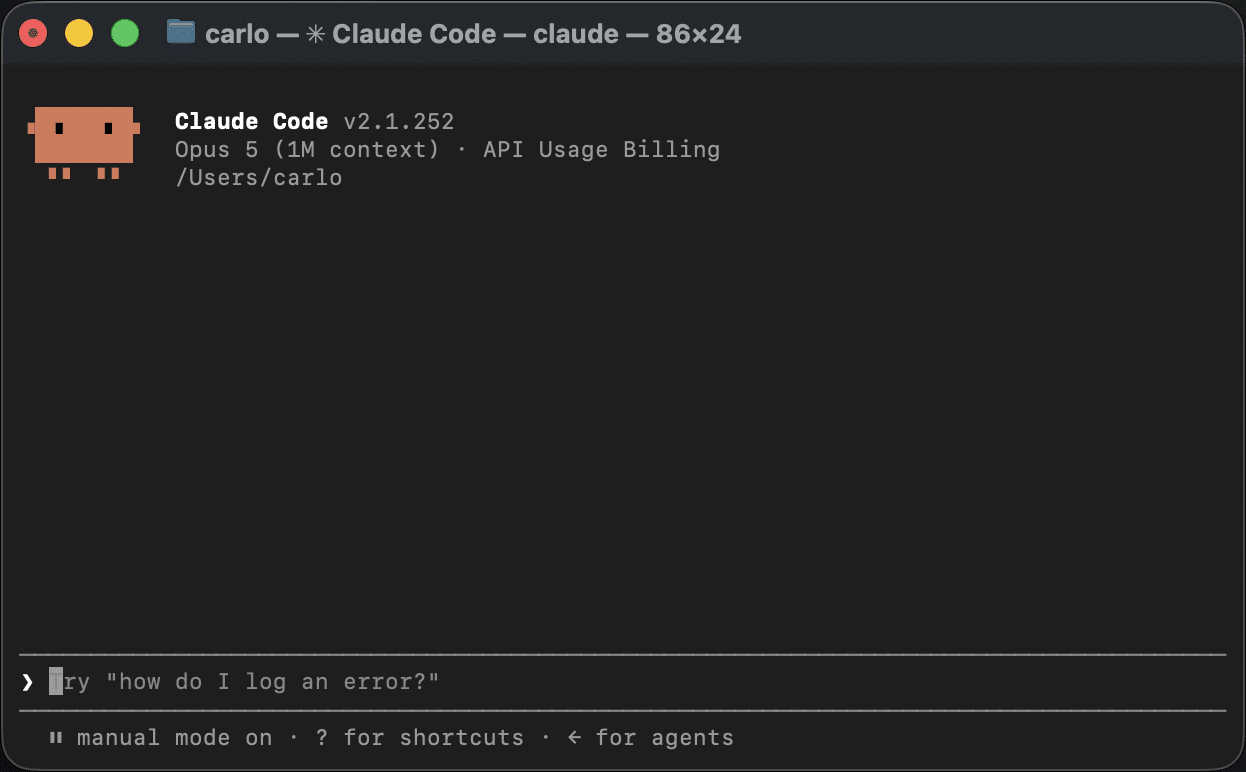
Examples of CLI brokers come with Claude Code, Antigravity CLI, Cursor CLI, and Aider.
Execs, Cons, and use instances of CLI coding brokers
Somewhat than asking of yourself which software absolute best suits your technical or operational wishes, assume as an alternative concerning the particular advantages you achieve through adopting one or the opposite way, or each at other phases of your workflow.
5 execs of CLI coding brokers
As we discussed, CLI brokers function at a unique stage within the workflow than MCP integrations and include other benefits and downsides.
Listed here are 5 benefits that CLI brokers be offering to construction groups.
1. Rapid get entry to to an ecosystem of equipment
CLI brokers can straight away use the command-line equipment to be had of their surroundings, together with Git, WP-CLI, SSH, Docker, npm, gadget utilities, and cloud equipment.
2. Autonomy and dynamic decision-making
An agent isn’t tied to a predefined workflow. As a substitute, it will probably autonomously come to a decision which command to run, determine essentially the most suitable software, choose the tips to deliver into context, and plan the next move.
3. Adaptation in line with output
After receiving an operation’s output, the agent analyzes the outcome and comes to a decision what to do subsequent. If the following motion not suits the unique technique, it will probably take a unique way. This makes CLI brokers specifically nicely fitted to non-linear and unpredictable issues.
4. Flexibility
An agent can dynamically mix shell instructions and equipment to accomplish complicated operations with out designing each workflow upfront.
5. Direct surroundings get entry to
An agent can function immediately throughout the surroundings the place the issue exists, whether or not that’s the native laptop’s filesystem, a code repository, a container, or far flung infrastructure. This makes CLI brokers specifically helpful for debugging and troubleshooting, server control, tool construction, and WordPress operations.
5 cons of CLI coding brokers
Whilst tough automation equipment, CLI brokers have their obstacles. They require warning and strict guardrails round their autonomy.
Listed here are 5 drawbacks of CLI brokers.
1. Higher operational threat
An agent with direct shell get entry to and inadequate guardrails might run hallucinated or harmful instructions. Due to this fact, a human-in-the-loop is important to approve or reject delicate operations ahead of they’re done.
2. Unstructured interface
In contrast to APIs, the command shell doesn’t inform the style which movements are secure or suitable, so it calls for a great deal of terminal enjoy to make use of successfully. Whilst this is helping skilled command-line customers, it may be a barrier for much less technical groups.
3. Unpredictable output parsing
CLI brokers interpret simple textual content, stack lines, and other output codecs; for the reason that output varies from one application to some other, this can result in misinterpretations or execution mistakes.
4. Dependence at the surroundings
Permutations in PATH, permissions, surroundings variables, and native equipment could make the workflow non-portable.
5. Advanced get entry to keep an eye on
The will for detailed restrictions on what a CLI agent can and can not do calls for strict sandboxing, permission control on the OS stage, and protection coverage implementation.
Complementary equipment for various phases of your workflow
From what we’ve got mentioned thus far, MCP integrations and CLI coding brokers serve distinct use instances and will naturally coexist at other phases of your construction and operational workflow.
Recall to mind MCP as a production-ready API bridge that allows you to get entry to knowledge, equipment, and exterior products and services uncovered through an MCP server in a standardized, environment-agnostic, and not more error-prone approach.
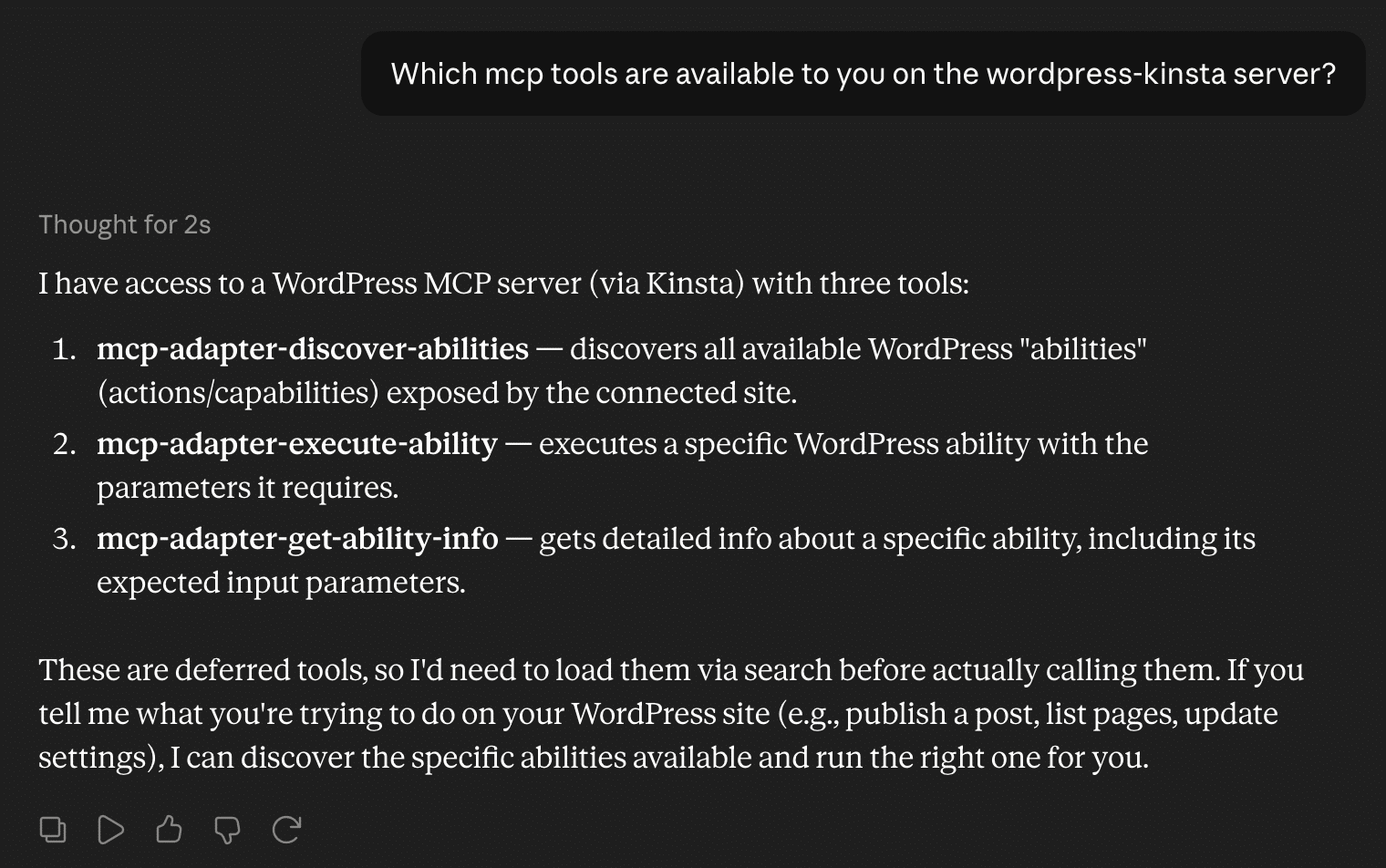
CLI brokers, however, are nice running partners that are living to your terminal shell. They excel throughout lively construction, debugging, or complicated server repairs, when you want velocity, context-awareness, and uncooked execution energy to analyze error logs, run far flung WP-CLI instructions over SSH, and refactor code at the fly.
By way of combining each approaches, you get the versatility of CLI brokers for construction, operations, and troubleshooting, whilst nonetheless getting the larger safety MCP supplies when integrating AI into strong SaaS merchandise or manufacturing environments.
How CLI brokers paintings: The Agentic Loop
Somewhat than executing a job in one step (one-shot execution), a CLI-native agent works through going via a 5-step iterative procedure referred to as the Agentic Loop: Apply, Explanation why, Plan, Act, and Overview.
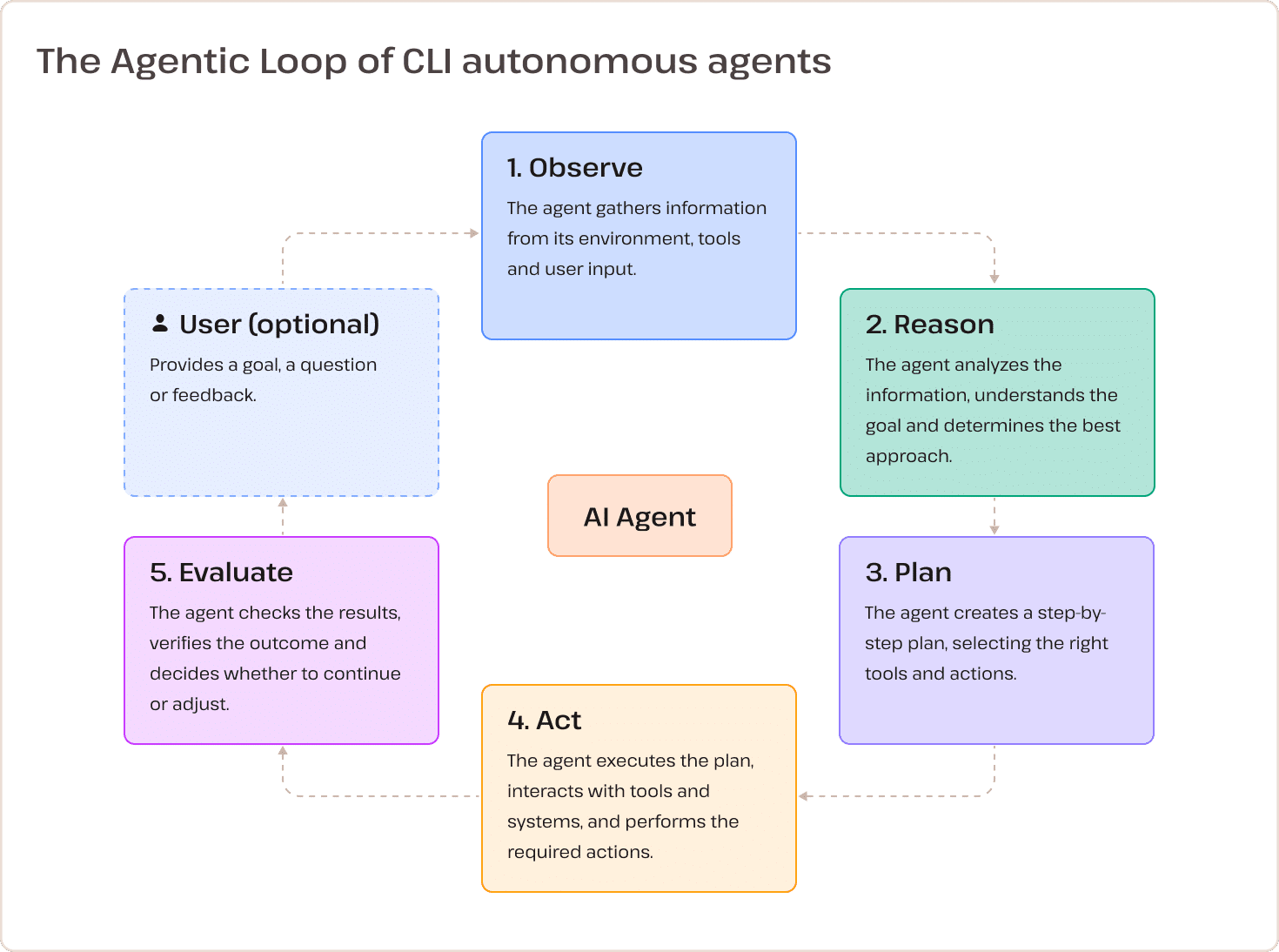
- Segment 1: Apply. The agent seems to be on the surroundings, builds context, examines the code construction, reads the configuration recordsdata (similar to
wp-cli.yml,AGENTS.md, orpackage deal.json), and gathers the gadget inputs, together with the terminal outputs and the log entries. - Segment 2: Explanation why. The gadget assesses the context that has been accrued to come to a decision at the maximum suitable motion; it determines which equipment to name (for instance, deciding whether or not to run
wp plugin listingfirst) and in addition evaluates any operational dangers, looking for human approval when safety calls for. - Segment 3: Plan. When coping with multi-step initiatives (for instance, “To find the plugin inflicting a deadly error and deactivate it”), the agent breaks down the consumer’s request into a sequence of sequential sub-tasks ahead of execution.
- Segment 4: Act. The agent is going from option to execution through sending the generated instructions immediately to the terminal shell or through making direct changes to the recordsdata within the repository or by way of SSH.
- Segment 5: Overview. In the end, the agent seems to be on the command’s go out code and analyses each
stdoutandstderr. If the command is a good fortune, it determines whether or not the objective has been absolutely completed or proceeds to the following sub-task; if the command fails, the agent captures the mistake, identifies the foundation motive, after which is going again to Explanation why to change its technique and tries once more as a part of an self reliant self-healing loop.
This steady, iterative mechanism shall we a CLI agent diagnose a damaged WordPress surroundings, repair a syntax error in a theme record, or run complicated database repairs with out step by step human intervention for each command.
Putting in place an area CLI agent to far flung WordPress
Now that we’ve sparked your interest, we’re moderately assured you’ll need to take a look at a CLI agent in your website.
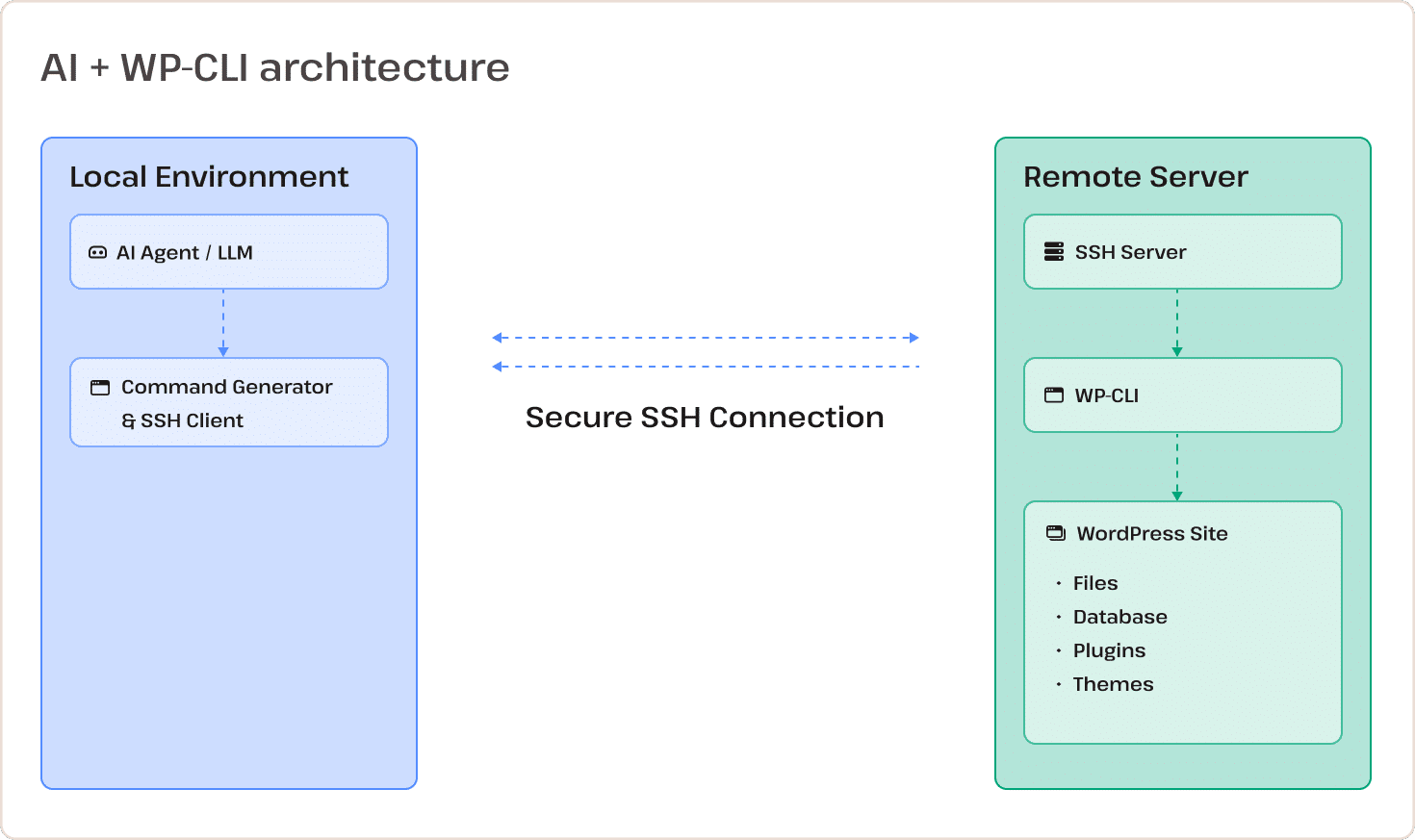
You received’t set up any AI plugins or configure a server at the far flung surroundings as you possibly can do for an MCP integration. As a substitute, you’ll construct a safe bridge the usage of usual command-line utilities.
Here’s what you want in position to paintings with a CLI agent:
- WP-CLI put in in the neighborhood.
- SSH get entry to for your far flung surroundings.
- WP-CLI operating at the far flung server.
You’ll practice those steps:
1. Get ready your native surroundings
Sooner than putting in place the far flung connection, chances are you’ll wish to examine your native surroundings through operating the next instructions:
php --version
wp --version
wp --info
If WP-CLI is put in however out of date, replace it to the most recent edition:
wp cli check-update
wp cli replaceIf WP-CLI isn’t but put in in your device, obtain the most recent WP-CLI Phar construct, make it executable, and transfer it for your gadget PATH (macOS/Linux):
# Obtain the reputable WP-CLI Phar archive from GitHub
curl -O https://uncooked.githubusercontent.com/wp-cli/builds/gh-pages/phar/wp-cli.phar

# Test that the Phar construct works through checking surroundings facts
php wp-cli.phar --info

# Make the Phar record executable
chmod +x wp-cli.phar

# Transfer the binary to an international PATH listing and rename it to 'wp'
sudo mv wp-cli.phar /usr/native/bin/wp
Then examine your set up:
wp --info2. Configure passwordless SSH
After you have WP-CLI put in in your gadget, you’ll ship wp instructions for your far flung server the usage of the --ssh international flag. As an example, you’ll retrieve an inventory of inactive plugins put in at the website with the next command:
wp plugin listing --status=inactive --ssh=consumer@server_ip:port/trail/to/your/websiteInput your password, and also you’ll see a desk record your website plugins.
You’ll run any WP-CLI command at the server through manually passing credentials the usage of the --ssh flag, however that suggests tedious credential access and a steadily interrupted agentic loop.
To keep away from this additional paintings, arrange a devoted SSH key pair and check in your server parameters to your native OpenSSH config record.
Step 1: Generate a devoted SSH key pair
Sooner than you start, examine for current SSH keys to your native .ssh listing:
ls -al ~/.sshWhen you don’t have a devoted key for WordPress website repairs, generate an ED25519 key pair through operating the next command:
ssh-keygen -t ed25519 -C "wp-cli-production" -f ~/.ssh/id_ed25519_wp_productionThe gadget will instructed you for an not obligatory passphrase, which you’ll depart clean.
The command above generates a non-public key (id_ed25519_wp_production), which you will have to no longer proportion, and a public key (id_ed25519_wp_production.pub) to add to the far flung server.
Subsequent, get started your native SSH agent and check in your personal key:
# macOS / Linux
eval "$(ssh-agent -s)"

# On Linux (and macOS for those who generated the important thing WITHOUT a passphrase)
ssh-add ~/.ssh/id_ed25519_wp_production

# On macOS, for those who generated the important thing WITH a passphrase and wish to retailer it in Keychain
ssh-add --apple-use-keychain ~/.ssh/id_ed25519_wp_production
Test that the SSH agent is in reality managing your personal key:
ssh-add -lIf the configuration was once finished accurately, you are going to see your fingerprint and the important thing remark:
256 SHA256:... wp-cli-production (ED25519)Now you’ll learn the general public SSH key stored in your disk:
# macOS / Linux: Show the general public key string to replicate
cat ~/.ssh/id_ed25519_wp_production.pub
Replica your public key string and upload it to the ~/.ssh/authorized_keys record in your far flung server:
# macOS / Linux: Mechanically add and append your public key to the far flung server
ssh-copy-id -i ~/.ssh/id_ed25519_wp_production.pub consumer@server_ip -p port_numberStep 2: Outline your host in SSH config
To keep away from typing your connection main points (IP deal with, port, username, and key trail) each time, you’ll map your connection within the ~/.ssh/config record.
Open or create the record with the next command:
nano ~/.ssh/configWithin the nano editor, upload a bunch alias block mapping your connection main points for your identification record:
Host manufacturing
  HostName
  Consumer
  Port
  IdentityFile ~/.ssh/id_ed25519_wp_production
  IdentitiesOnly sure
  AddKeysToAgent sure
  UseKeychain sure
Press Ctrl + O, Input, then Ctrl + X to save lots of and go out.
Now you must be capable of log into your server by way of SSH with this easy command:
ssh manufacturing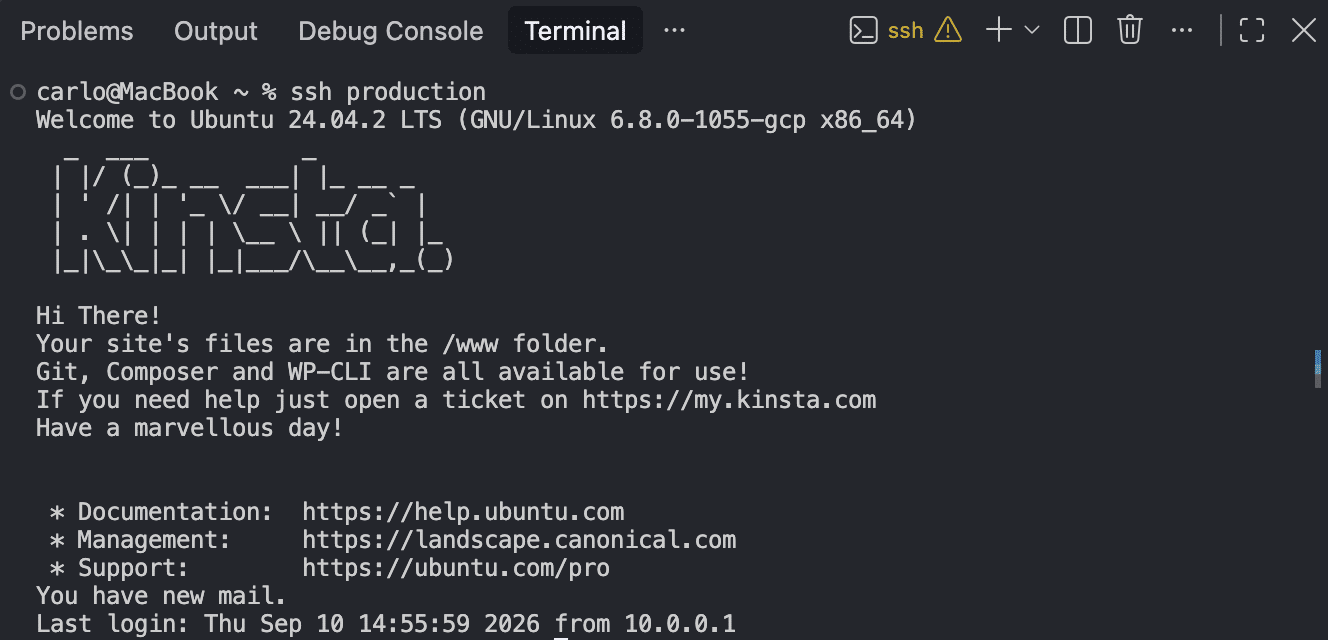
3. Sign up WP-CLI aliases
With WP-CLI aliases, you goal native or far flung WordPress installations the usage of shortcuts like @manufacturing, or @staging, or @construction, totally casting off trail parameters out of your wp instructions and AI activates.
Create or edit your international WP-CLI configuration record:
mkdir -p ~/.wp-cli && nano ~/.wp-cli/config.ymlMap your SSH host alias to absolutely the trail of your far flung WordPress internet root:
@manufacturing:
  ssh: manufacturing/trail/to/your/website
Test that your alias works:
wp @manufacturing plugin listingIf a success, you are going to see your far flung website’s plugins indexed to your native terminal.
Your surroundings is now waiting to hook up with an area CLI agent.
4. Set up and authenticate your CLI coding agent
Now that you’ve configured your native WP-CLI surroundings to be in contact along with your far flung website over passwordless SSH, it’s time to put in and arrange a CLI Jstomer. Within the following sections, we’ll duvet two of the preferred answers, each and every with its personal options and pricing style: Claude Code and Antigravity CLI.
Set up Claude Code
Claude Code is Anthropic’s agentic CLI software. Because the reputable documentation says, it “reads your codebase, edits recordsdata, runs instructions, and integrates along with your construction equipment.”
First, set up the Claude Code CLI globally (macOS and Linux):
curl -fsSL https://claude.ai/set up.sh | bashHome windows customers can in finding platform-specific directions within the reputable set up information.
As soon as performed, navigate for your challenge listing and release Claude Code:
cd /trail/to/your/challenge
claude
Claude Code will instructed you to authenticate your account or authorize your Anthropic API key (see to be had plan choices).
If you select to authenticate the usage of an API key, which is billed in line with utilization, navigate to the API Keys phase of the Claude Console and click on Create Key.
Replica the generated key and reserve it in a safe location. It’s going to appear to be a string beginning with sk-ant-....
After you have your API key, you’ll retailer it completely to your shell configuration record (~/.zshrc) so that you don’t have to go into it each time you engage with Claude:
echo 'export ANTHROPIC_API_KEY="sk-ant-api03-your-api-key..."' >> ~/.zshrc
supply ~/.zshrc
Then again, you’ll set the API key at some stage in the present terminal consultation the usage of the next command:
export ANTHROPIC_API_KEY="sk-ant-api03-your-api-key..."As soon as authenticated, you’ll release Claude Code through operating claude.
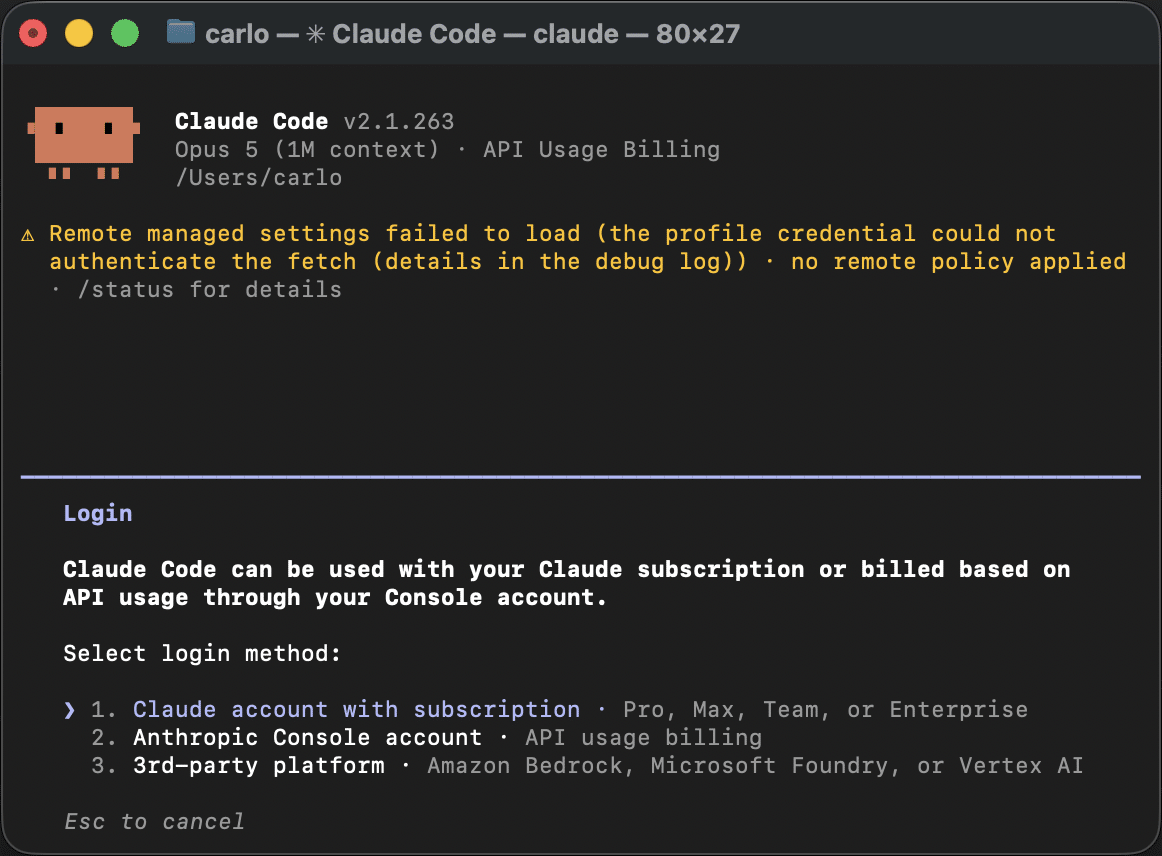
Now you’ll get started interacting with Claude Code to your terminal the usage of your WP-CLI aliases in herbal language:
examine the repute of the plugins on @manufacturing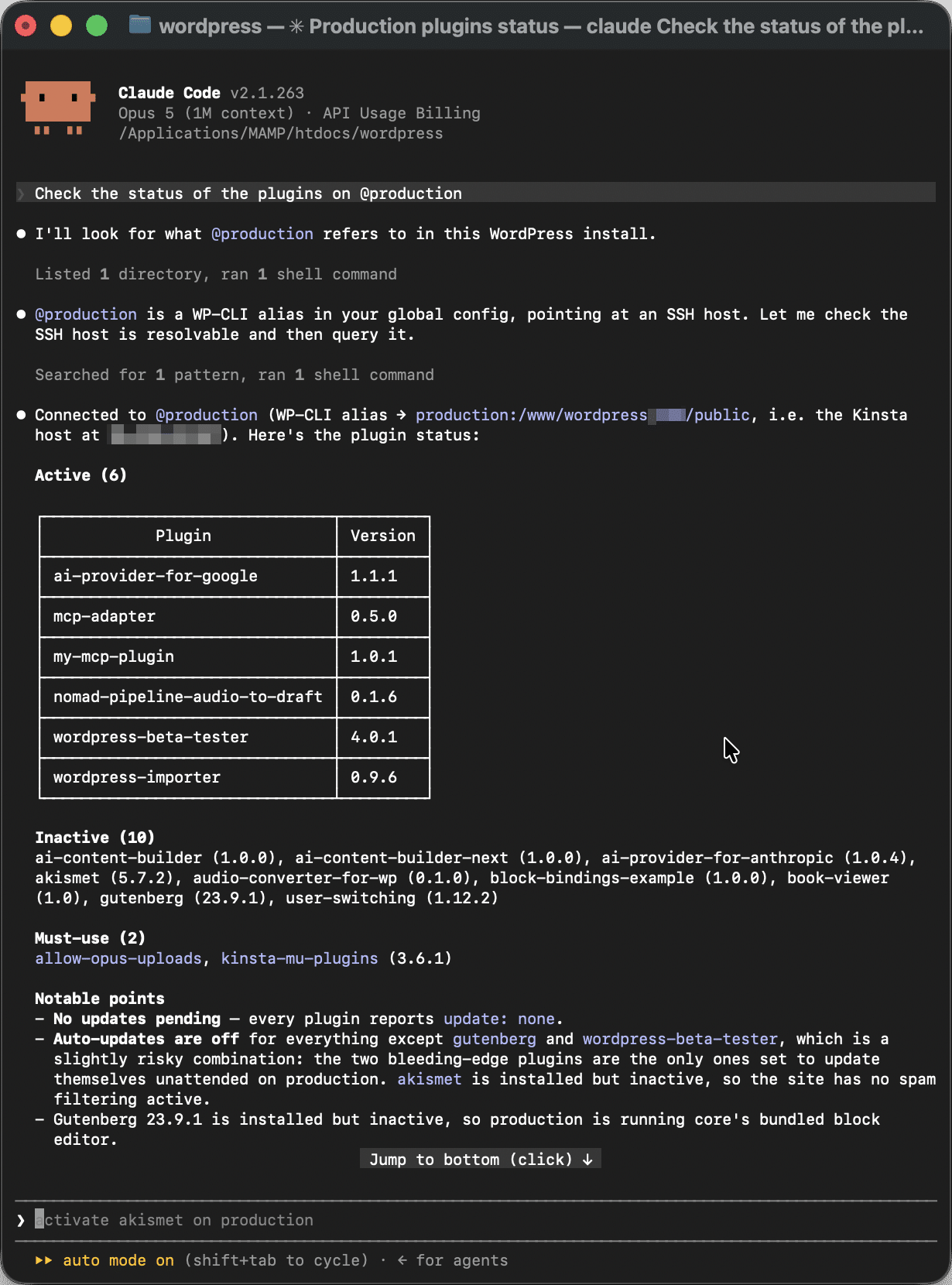
Set up Antigravity CLI
Antigravity CLI is Google’s local CLI coding assistant. Constructed because the evolution of Gemini CLI, Google’s new agentic software gives a very good selection to established marketplace equipment like Claude Code.
Like Claude Code, you’ll set up Antigravity CLI in numerous techniques. The really helpful option to globally set up the agent on macOS and Linux is by way of curl:
curl -fsSL https://antigravity.google/cli/set up.sh | bashIf you’re operating a unique running gadget or customized configuration, take a look at the Google Antigravity set up information.
As soon as the set up is whole, navigate for your challenge workspace and run the launcher command:
cd /trail/to/your/challenge
agy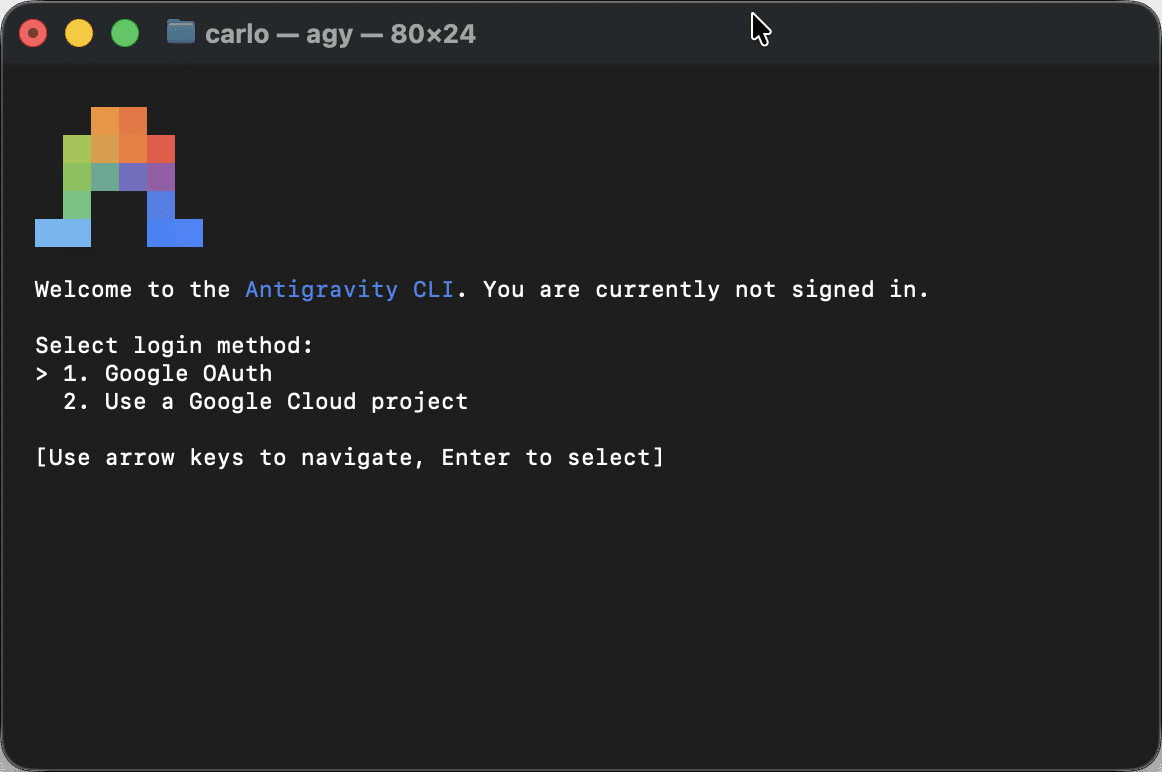
Antigravity CLI will robotically open your default browser to authorize the agent. Replica the code, paste it into your terminal shell, and press Input. As soon as logged in, your terminal surroundings is related to the Antigravity agentic engine.
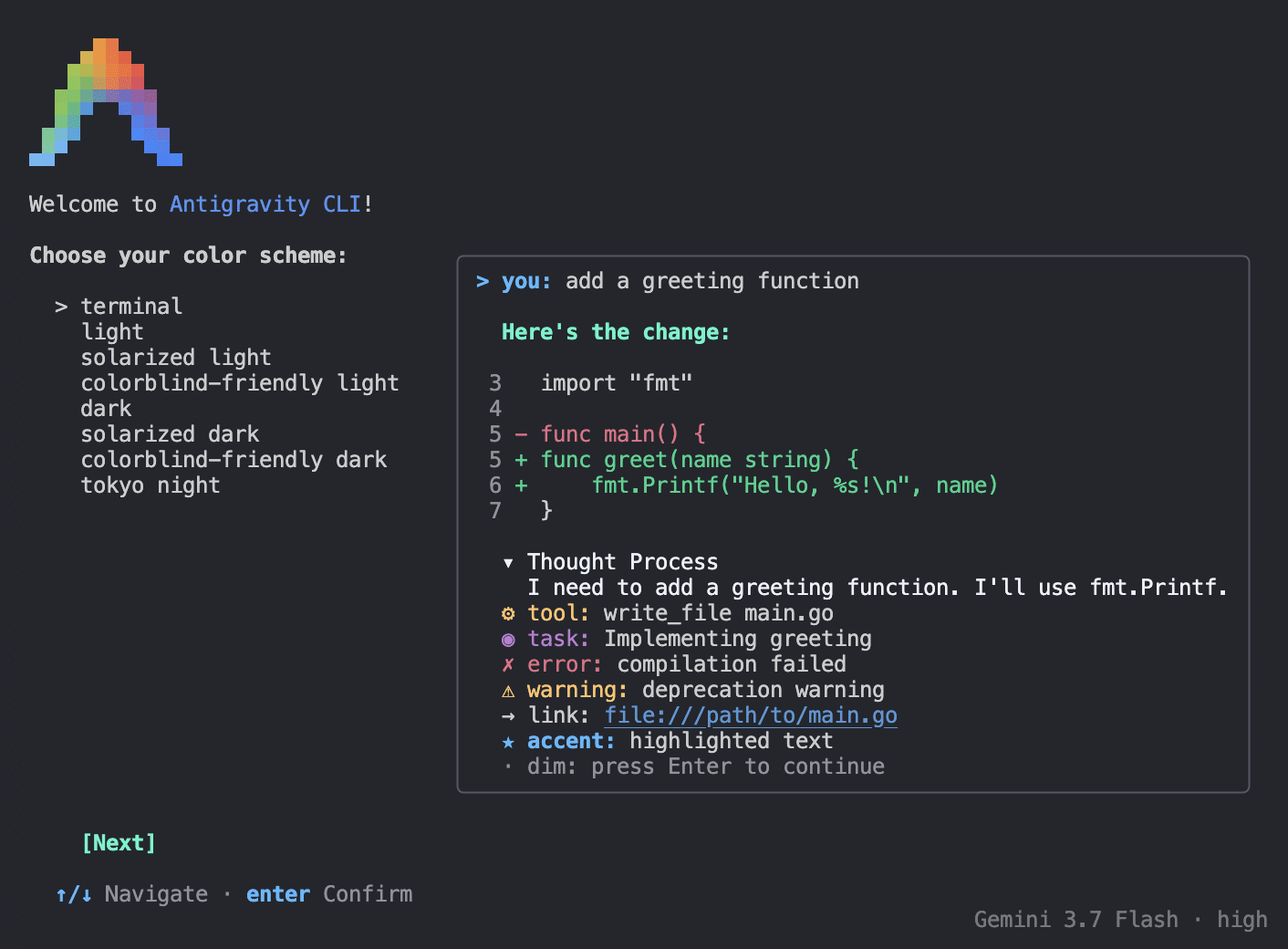
When you want the usage of a Gemini API key from Google AI Studio, you’ll retailer the important thing to your shell configuration (~/.zshrc or ~/.bashrc):
echo 'export GEMINI_API_KEY="your-gemini-api-key..."' >> ~/.zshrc
supply ~/.zshrc
With authentication configured, you’ll release the agent through merely operating:
agy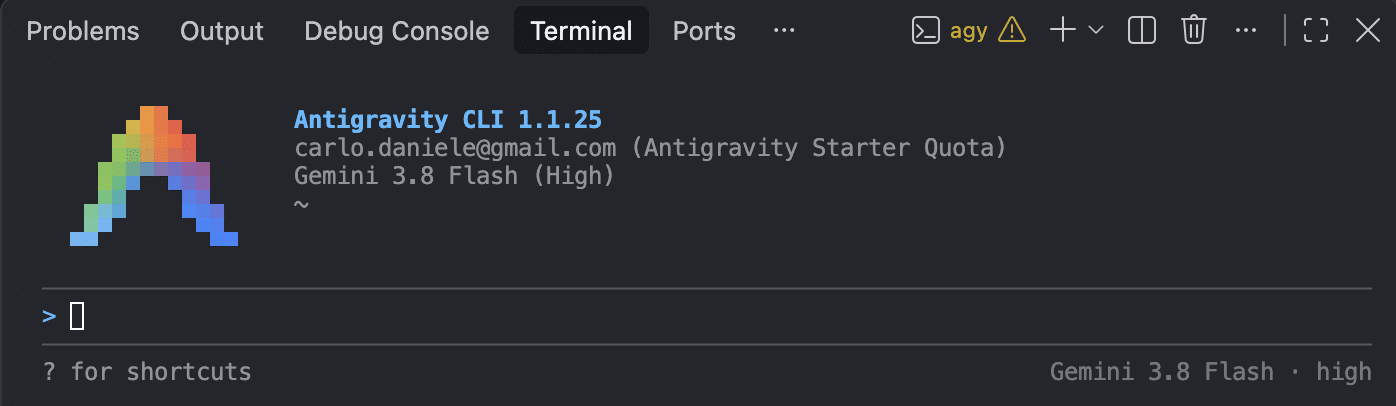
Antigravity CLI will investigate cross-check your surroundings, learn your challenge context (together with native wp-cli.yml or AGENTS.md directions if provide), and stay up for your instructed. You’ll now delegate far flung repairs initiatives or ask to execute complicated initiatives like the next:
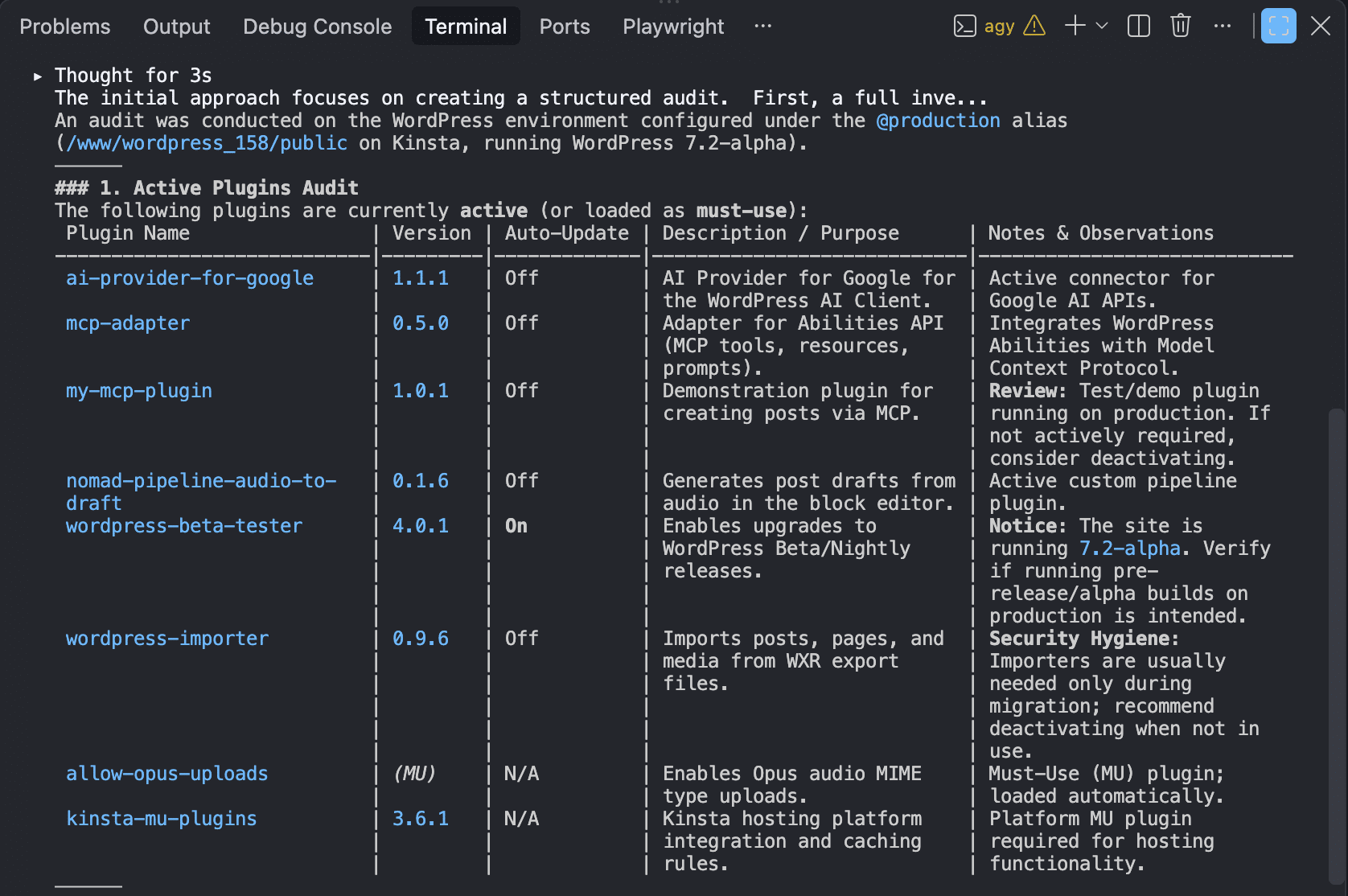
Audit lively plugins on @manufacturing and listing any inactive issues that may be safely got rid ofThe agent begins reasoning and executes a number of instructions.
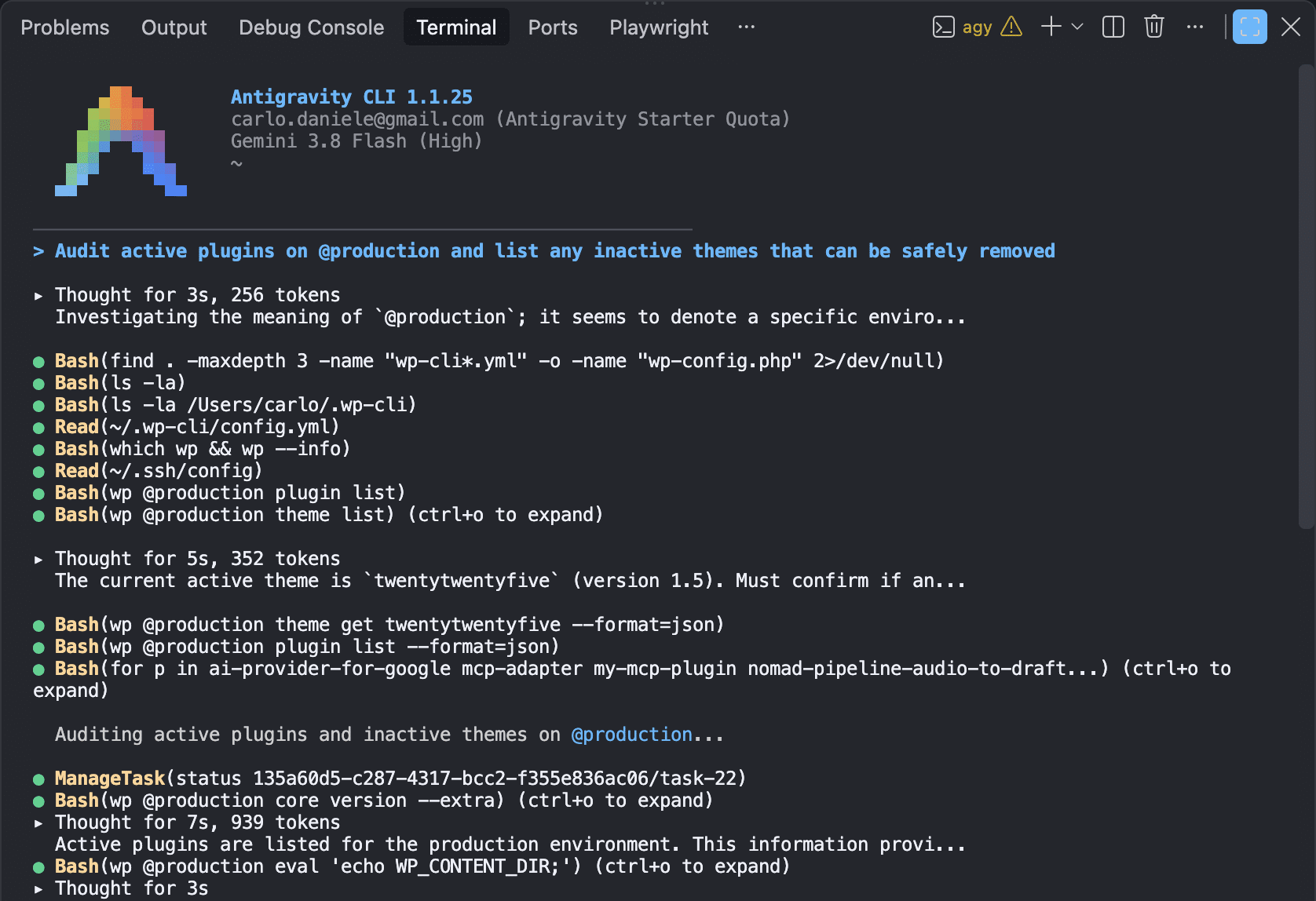
Subsequent, it supplies an Energetic Plugins Audit record.
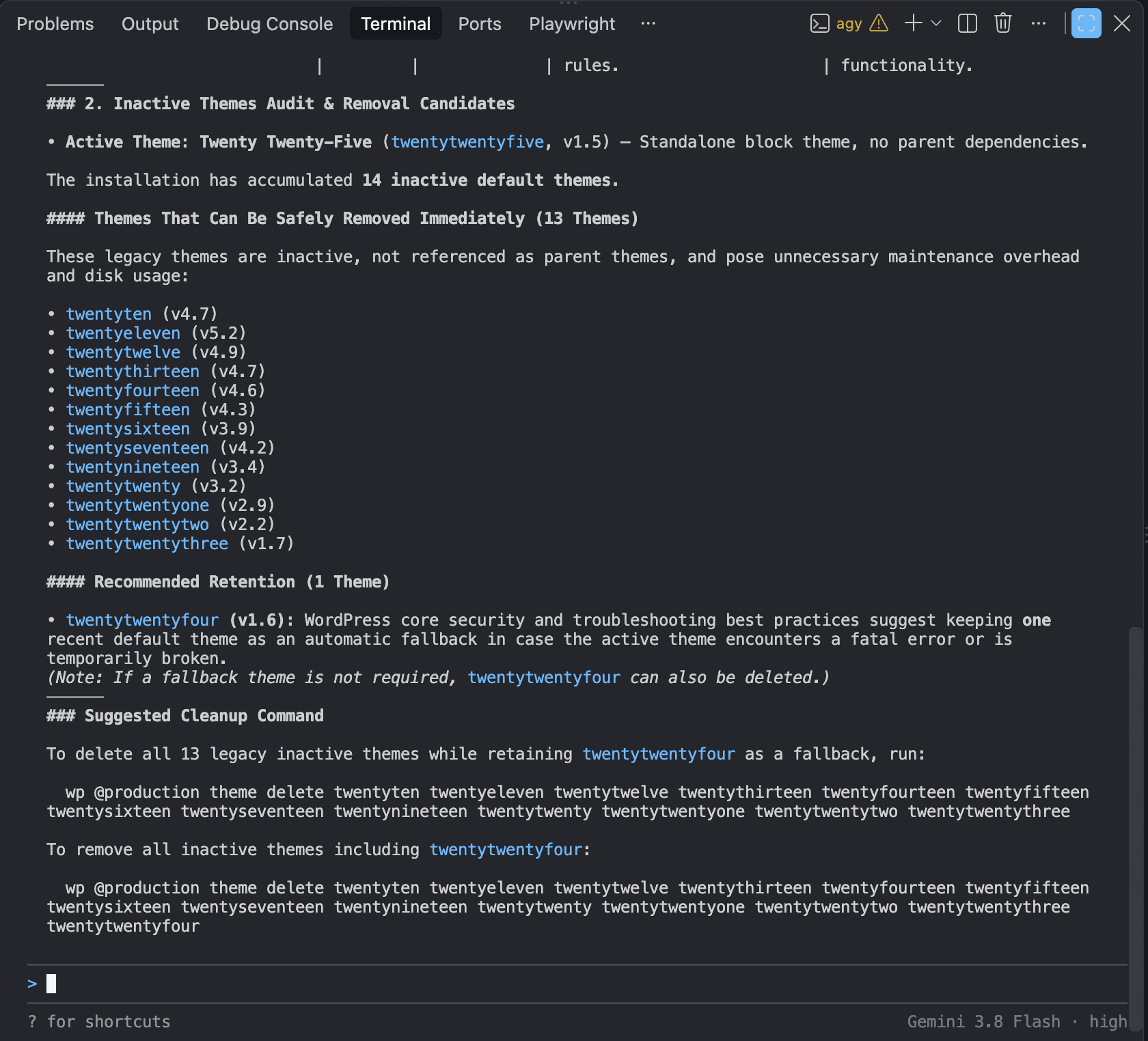
In the end, it supplies an Inactive Topics Audit & Removing Applicants record and suggests a few instructions to take away inactive issues.
Claude Code vs. Antigravity CLI: An actual-world WordPress safety audit
We examined the 2 CLI brokers to know the way their effects vary in a real-world use case. We deliberately saved the instructed we handed to each brokers easy. A well-structured instructed would have equipped extra context for the 2 brokers to construct upon and can have produced extra correct responses.
Here’s the instructed we handed to Antigravity CLI and Claude Code:
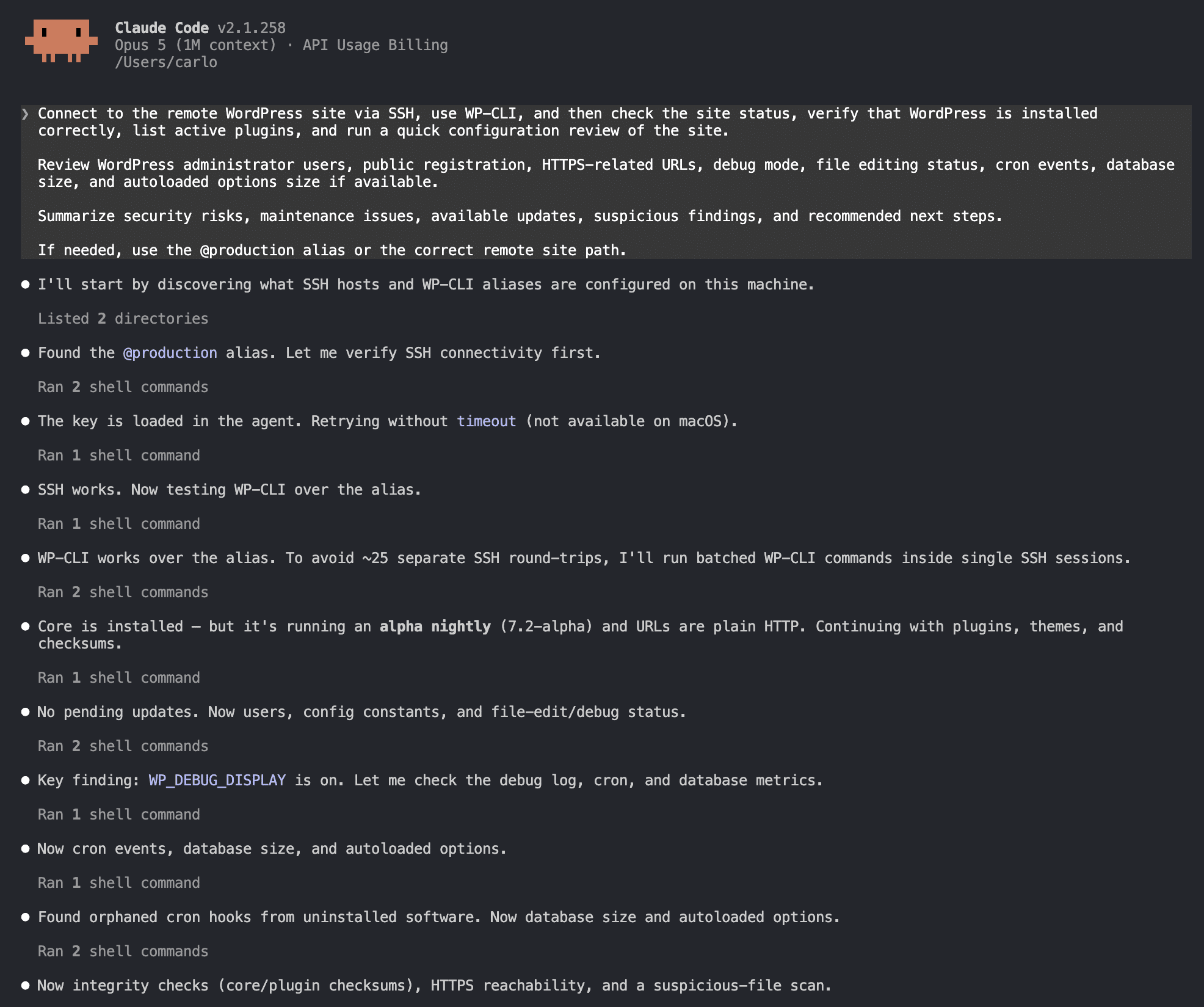
Hook up with the far flung WordPress website by way of SSH, use WP-CLI, after which examine the website repute, examine that WordPress is put in accurately, listing lively plugins, and run a snappy configuration overview of the website.

Assessment WordPress administrator customers, public registration, HTTPS-related URLs, debug mode, record enhancing repute, cron occasions, database dimension, and autoloaded choices dimension if to be had.

Summarize safety dangers, repairs problems, to be had updates, suspicious findings, and really helpful subsequent steps.

If wanted, use the @manufacturing alias or the proper far flung website trail.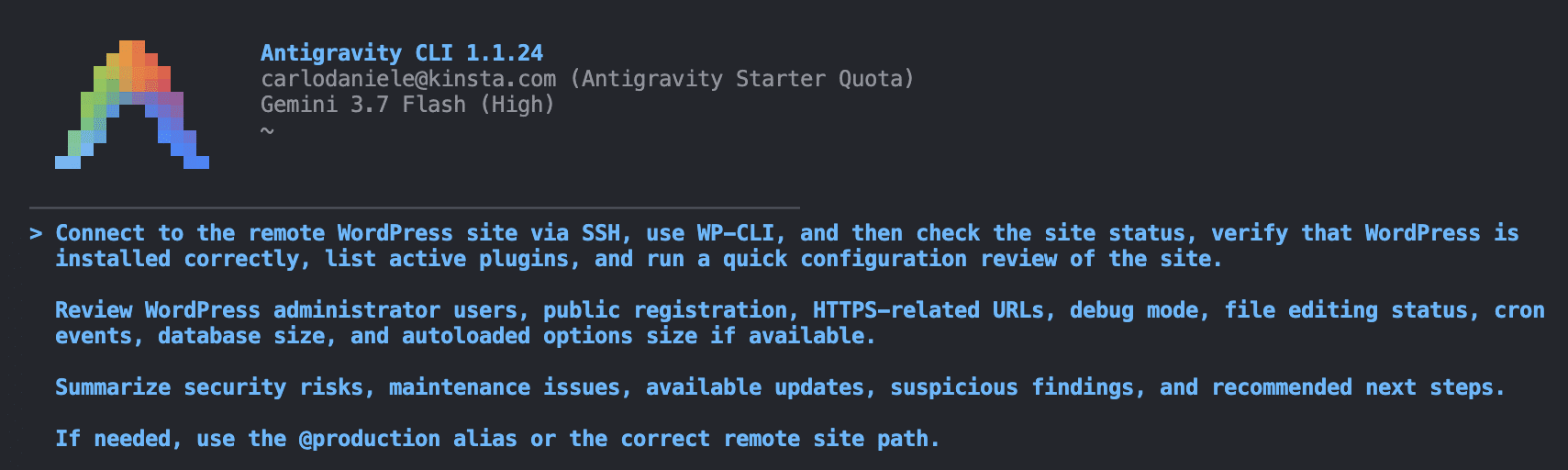
After the preliminary Reasoning and Motion section—throughout which each equipment paused a number of occasions to invite for permission to execute instructions—the 2 brokers equipped their respective stories, which differed in each construction and visible structure.
Antigravity CLI delivered a visually polished and well-structured record, obviously indicating the more than a few exams carried out:
- Website online Standing & Core Set up
- Consumer Accounts & Administrator Assessment
- Plugins & Topics Assessment
- Configuration & Safety Constants
- Cron Occasions & Database Well being
- Abstract of Dangers, Findings & Suggestions
- Beneficial Subsequent Steps
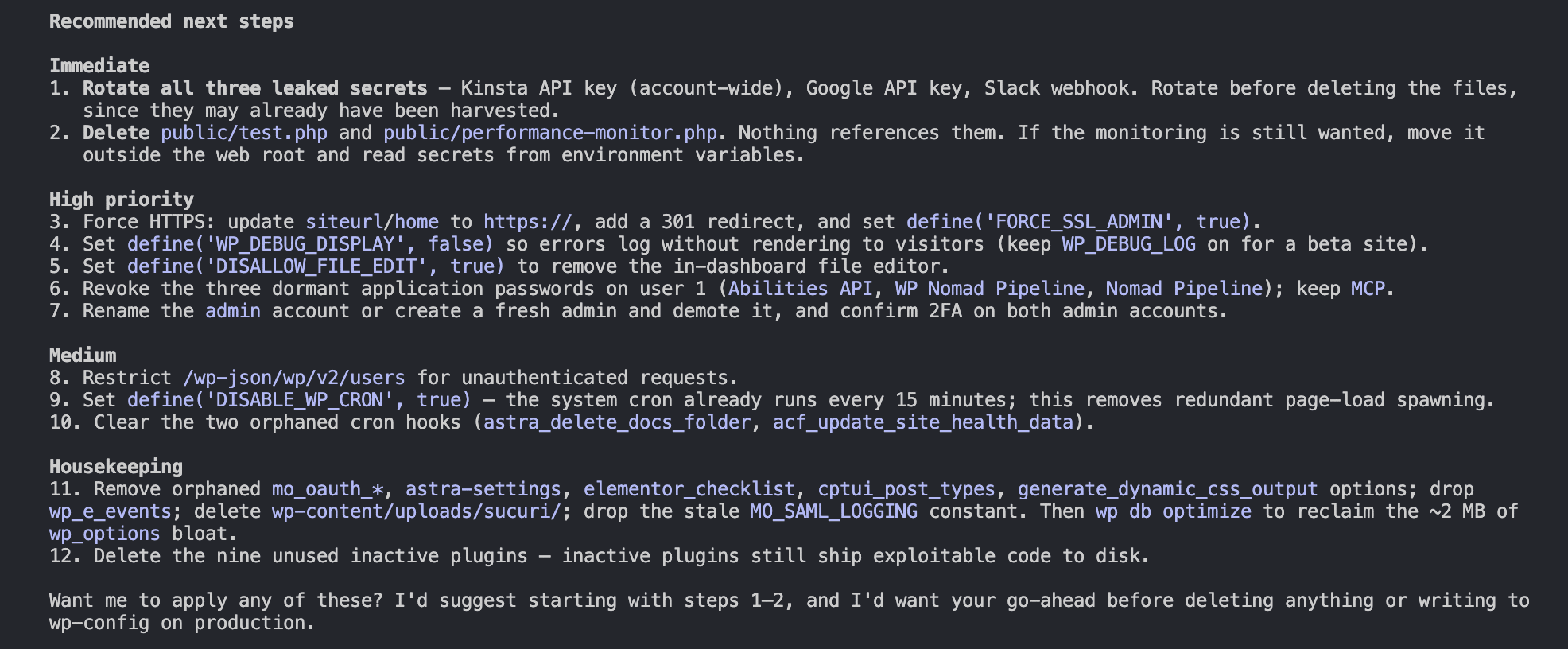
Claude Code, however, divided its research into 4 sections, together with an in depth Safety overview that flagged vulnerabilities no longer detected through Antigravity CLI.
- Website online repute
- Safety overview
- Upkeep & configuration
- Beneficial subsequent steps
Let’s examine the effects.
1. Website online repute
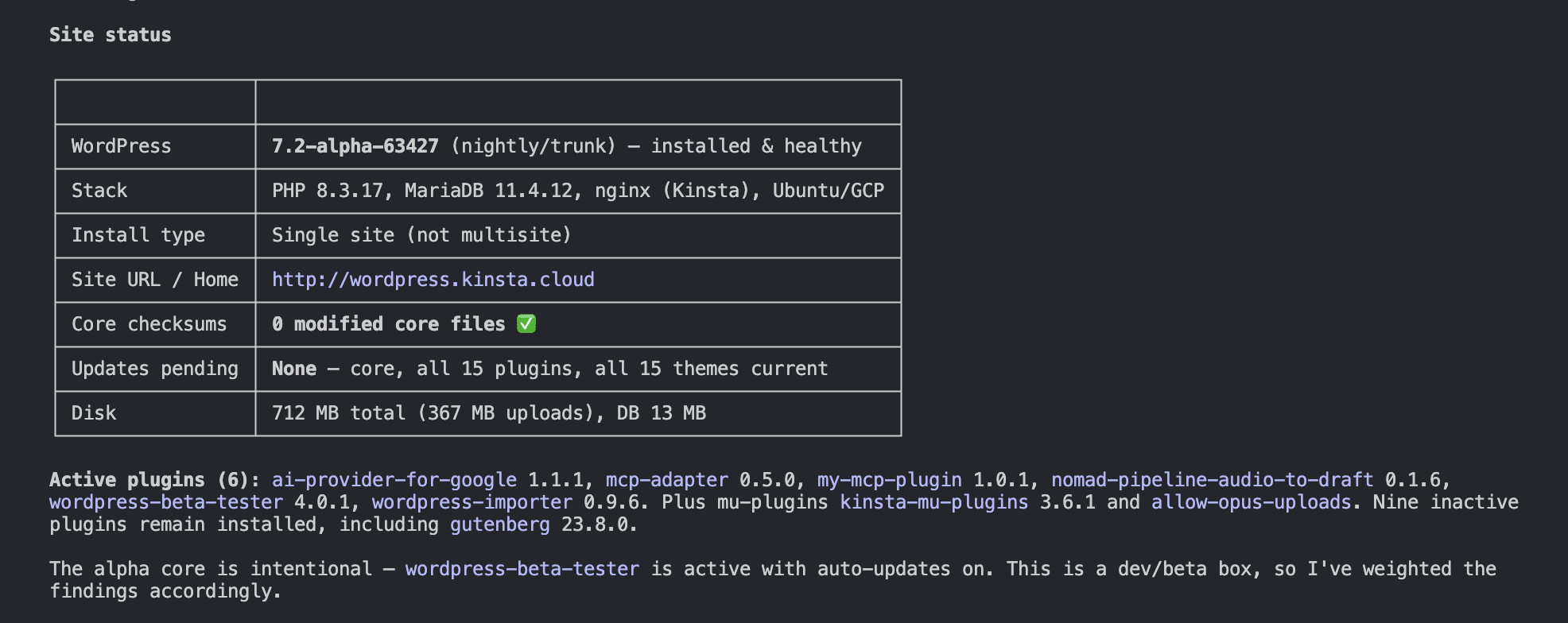
Each brokers accurately known the set up main points, however they provide them relatively another way on display.
The Website online repute phase in Claude Code is minimum and is blended with the plugins phase. It supplies no details about the topics put in at the website.
Then again, Claude Code stunned us with a Essential phase that issues out two bad safety vulnerabilities led to through uncovered keys left in check recordsdata within the website root. It additionally comprises useful data and recommends casting off the recordsdata in query.
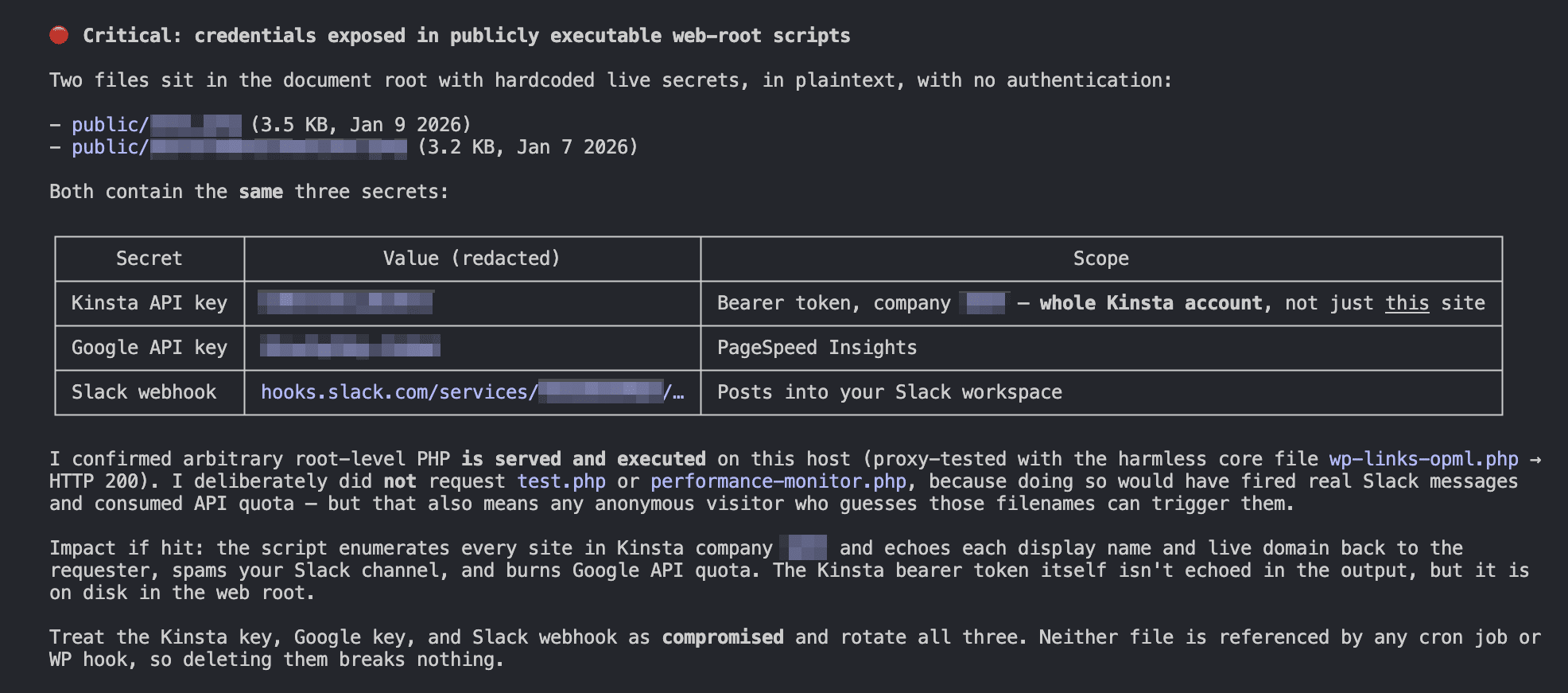
In Website online Standing, Antigravity CLI gifts extra knowledge in a blank, readable desk. Then again, it doesn’t display any details about the uncovered keys Claude Code discovered.
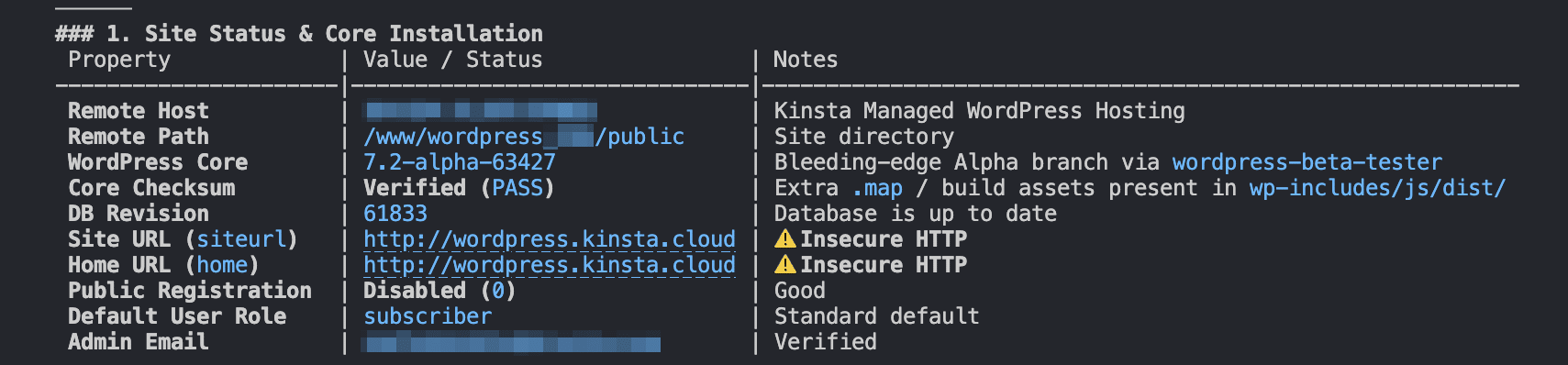
2. Consumer accounts and safety overview
The 2 brokers’ approaches vary on this phase as nicely.
Antigravity CLI presentations a transparent consumer desk with all of the to be had knowledge, together with roles.

Antigravity CLI covers safety dangers in a later phase, highlighting dangers related to constants, the admin consumer, lacking HTTPS URLs, and different problems.
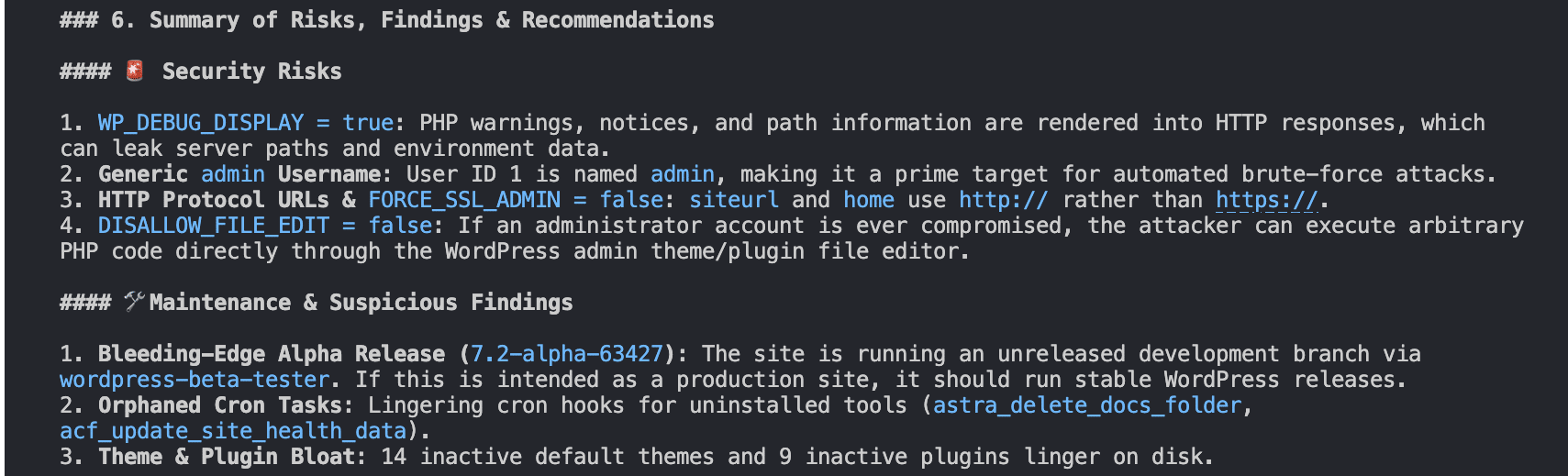
Claude Code’s way is a lot more security-oriented. Its consumer desk is very important, however on this phase, Claude Code is going past customers through additionally offering a desk of utility passwords, specifying the consumer they belong to.
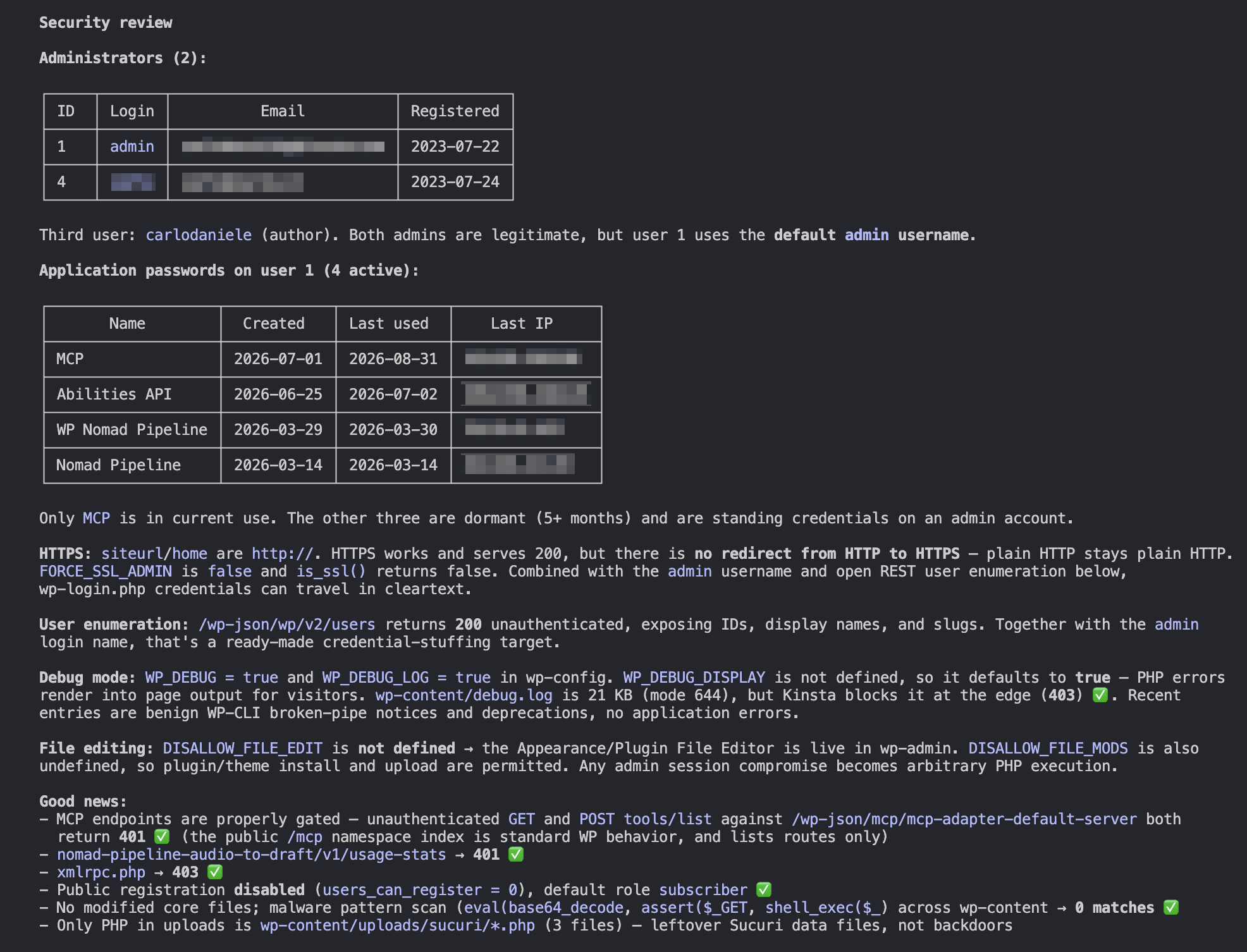
However that’s no longer all. Claude Code additionally supplies an in depth research of dangers associated with lacking HTTPS enforcement, consumer enumeration, debug mode, and record enhancing, suggesting the corrective measures to undertake.
3. Plugins and issues
Antigravity CLI lists plugins and issues in a devoted phase.
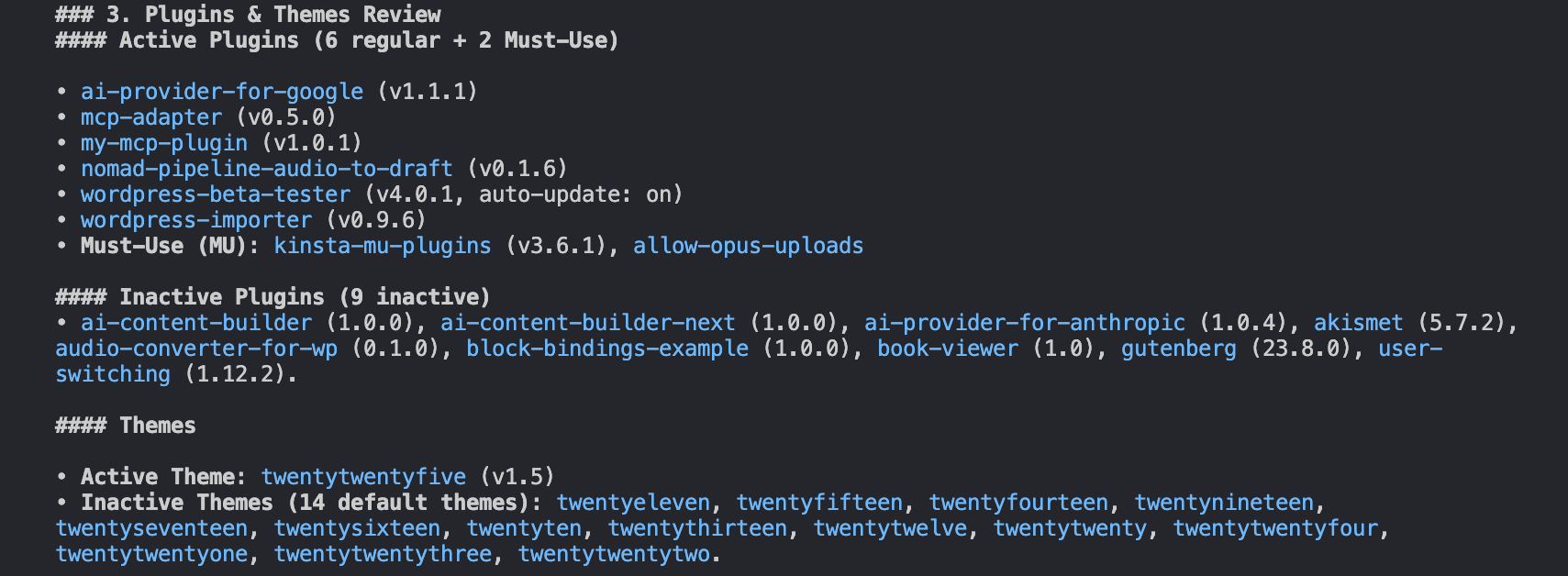
In Claude Code, the plugin phase is below Website online repute (phase 1). It supplies no details about put in issues.
4. Configuration, safety constants, repairs, and database well being
This phase that presentations the largest variations between the 2 CLI brokers.
In phase 4, Antigravity CLI supplies an in depth desk of the detected constants, that includes a Safety Evaluate column with fundamental safety main points.

In phase 5, it supplies a moderately transient evaluation of cron repute and database well being.
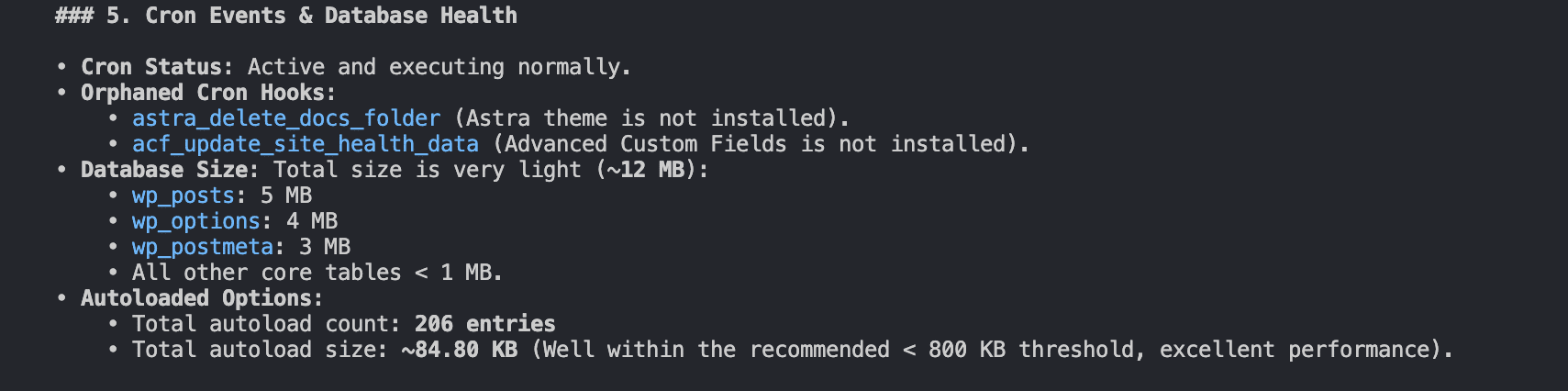
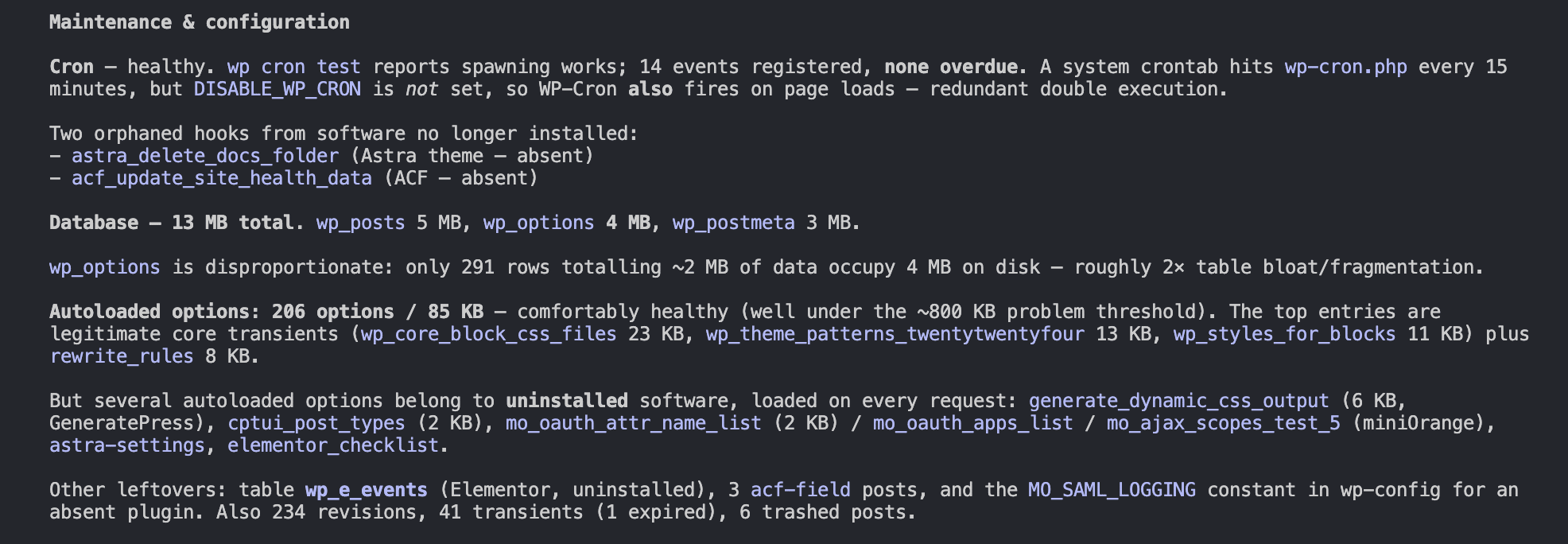
Claude Code units itself obviously excluding Antigravity CLI with an especially detailed Upkeep & configuration phase. It describes the repute of cron, hooks not provide at the website, autoloaded choices, and extra.
5. Beneficial subsequent steps
Each brokers conclude the record with a Suggestions and subsequent steps phase to get rid of the detected anomalies.
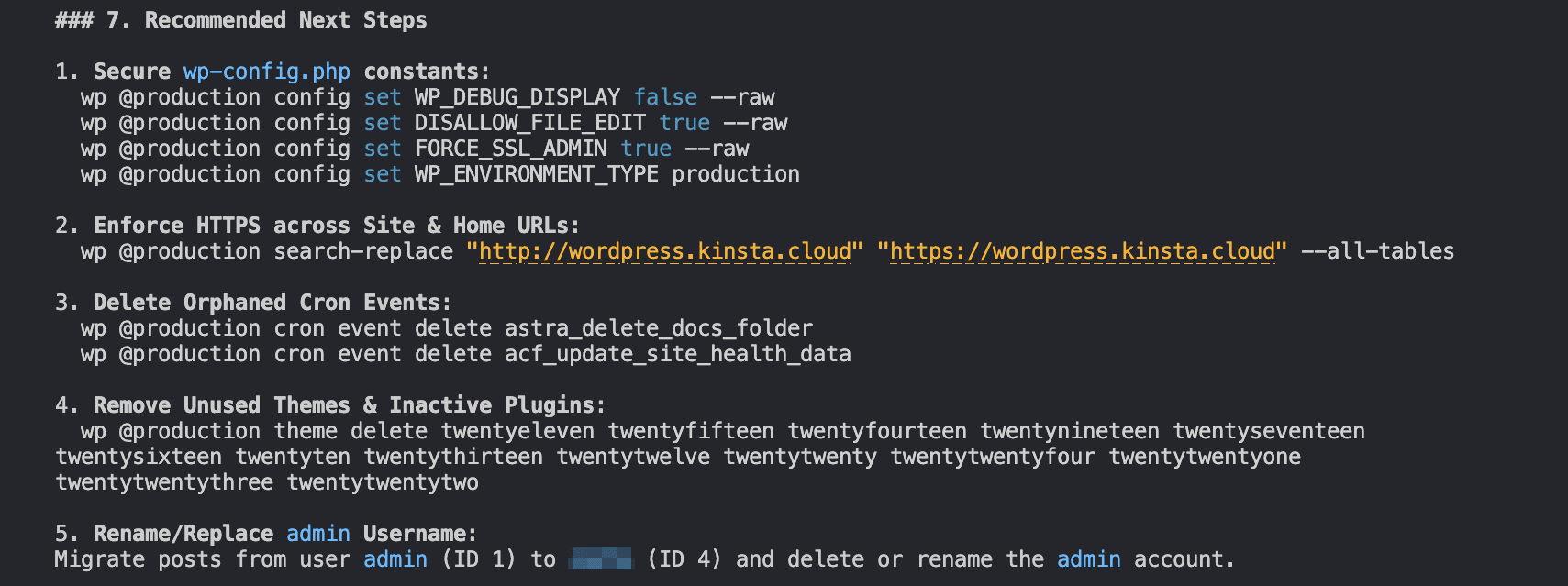
Antigravity CLI supplies quick operational suggestions, together with instructions to safe wp-config.php constants, implement HTTPS throughout your whole website, take away orphaned cron occasions, delete unused issues and inactive plugins, and rename or change the admin consumer.
Claude Code supplies a structured listing of suggestions ordered through threat severity and asks whether or not the consumer needs the agent to autonomously take away the uncovered keys and fasten the insects.
Conclusions and subsequent steps
From what we’ve got mentioned on this article, it’s transparent that there is not any absolute winner. Each CLI brokers we introduced are tough control and construction equipment, however each and every has its personal strengths.
We favored Claude Code’s security-oriented way, the intensity of its exams, and the element in its research.
What we preferred about Antigravity CLI is the readability of its record and its focal point on quick motion, whole with ready-to-use WP-CLI instructions (despite the fact that you’ll all the time ask the agent to run them for you the usage of herbal language).
In the end, the largest distinction will most probably come from you—through finding out the best way to speak along with your agent the usage of sparsely crafted gadget directions and transparent, detailed activates.
If automation is your precedence nowadays, Kinsta will give you all of the equipment you want to show your terminal into an operational keep an eye on panel for managing your webhosting and your entire websites. A formidable REST API, SSH get entry to, and WP-CLI are waiting to make use of for all our shoppers, without reference to their plan.
Check out Kinsta unfastened for a month, risk-free. Take a look at our plans right here.
The publish Automating WordPress operations with CLI brokers on Kinsta gave the impression first on Kinsta®.
WP Hosting